
• TalkBass has been independent since 1998. Add your voice.
    Create a free account to reply to discussions, view embedded media, and browse with fewer display ads.
    Join freeLog in
    Want zero display ads or expanded classifieds tools? Compare plans.

Double Bass Further Identifying Czech-Made Bass & Soundpost Repair

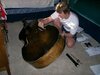
Acquired at the end of my teens in 1990, this double bass of Czech origin has been in the family since then but seldom played for many years. Found in the back of a music shop's storeroom missing a fingerboard and bridge, I paid $75usd — the store owners were merely interested in clearing space — then $120 for a rather nice ebony fingerboard mounted by a local luthier. It was occasionally thumped on rockabilly style for a time. The soundpost became dislodged at some point and was eventually removed, then, unfortunately, lost. Later, a frightful attempt was made to tune it up without one.

Photos attached, including an interior view and of the label; it reads "Copy of Antonius Stradivarius. Fecit anno 19[—?]. Made in Czechoslovakia."

Would be greatly appreciative of any information identifying the make and rough timeframe of production. Was told once that it may be from the 1940s. Damage from putting the strings under tension briefly without a post needs to be evaluated, and then steps to repair/reinstall a soundpost covered. Certainly a degree of sentimental value in this instrument, and a hope now to properly salvage and care for it.
 

Attachments
  • 10869890_10152931677262232_6586119490144286476_o.jpg
    10869890_10152931677262232_6586119490144286476_o.jpg
    299.3 KB · Views: 69
  • 10847424_10152931677352232_4437756914457824275_o copy.jpg
    10847424_10152931677352232_4437756914457824275_o copy.jpg
    525.7 KB · Views: 85
  • 10679999_10152931677332232_3027312967194837298_o.jpg
    10679999_10152931677332232_3027312967194837298_o.jpg
    210.1 KB · Views: 66
Last edited:
A bit of irony in the label since there are no actual Stradivarius double basses. But at least the label tells where the instrument was made if that is reliable. Hoping one of our more age-knowledgeable folks will speak up, but at least you know it is of post-1900, pre-1993 production.

It's hard to judge from the pictures, but I agree that your biggest concern is probably structural integrity of the top after being strung at tension without a sound post. That should probably be evaluated by a double bass specialized luthier at the time of getting a new sound post and any other repairs or part replacements.

Do you still have the bridge and tailpiece?
 
Last edited:
  • Like
Reactions: Davino
Yes, we do have the tailpiece, bridge, and endpin. Having to search for more photos (I reside in Taipei, the bass—in California), and can't comment from memory on the grain, but the finish is quite dark and dull as can be, which may not say much. The irony of the Strad copy label was never lost on us. At the time the heavy ebony fingerboard was applied, a certain amount of finish was lost along the neck. It's a bit of a brute but it was perfect for a teen's budget. Will post a lightened photo of the interior—bass bar visible, along with what appear to be many little tacked-on repairs before our time, and some cracking. Is it possible to discern whether this is a 'blocked' bass from the photo (I'm forgetting the proper term)?

Based upon the evaluation we receive here from the more knowledgeable, we'll consider the level or repair to aim for. Looking forward to more input. Thank you.
 
Last edited:
  • Like
Reactions: Don Hergert
Is it possible to discern whether this is a 'blocked' bass from the photo (I'm forgetting the proper term)?

Might you be referring to "blockless wonder"? These DBs were produced without a neck block. They have a reputation for sounding good, but being extra light and fragile unless they are rebuilt with an actual neck block (typically at significant expense)...

My uneducated guess is that your new picture shows a neck block, but I could be wrong -- that could actually simply be the slotted end of the neck. The "blockless wonders" I've seen were pre-1900, but really need more expertise than I can provide, someone here will be able to help.
 
Last edited:
  • Like
Reactions: Davino
Yes, indeed that's the term. And the small strip interior wood repairs... it appears these may be called "cleats"? The headstock isn't visible in these photos, but I believe it has what's called Tyrolean-style tuners, two on each plate. Looking forward to visiting CA this winter and removing those for a good metal polishing, and being equipped with a strategy for moving forward with the more substantive repairs. Curious to learn about the instrument... identifying a closer date range, and whether the top is spruce.
 
Last edited:
  • Like
Reactions: Don Hergert
Hi Davino,

Your bass has a block. It's the substantial piece of wood between the repairs on your bass. The neck fits into a channel cut into the top side of the block. A blockless wonder has a small "foot" that attaches to the back of the bass, maybe 1/3 as much wood as what you have. They saved a bit of wood and a bit of fitting time by building them that way (but they're a lot less refined, and a lot less stable).

You only have to worry about damage caused by a missing soundpost if you can find damage. Worst case scenarios are that the top has cracked in that area, or is significantly deformed. I couldn't tell from your pics. If neither of the above is true, you may just need to have it properly set up!
 
Just saw your last few comments. I think your bass has a ply top, based on the lack of a carved "lip" around the edge. It could be spruce veneer, but it's hard to tell from the photos.

Re the tuners, please *don't* polish them! If they're dull looking, that's just age-appropriate patina. I have a nice 1940s bass at the moment, and the worst thing about it is the gleaming, shiny brass tuners that someone "improved". Oil them and make them work, sure, but please don't ruin the patina!
 
Last edited:
Hi Davino,

Your bass has a block. It's the substantial piece of wood between the repairs on your bass. The neck fits into a channel cut into the top side of the block. A blockless wonder has a small "foot" that attaches to the back of the bass, maybe 1/3 as much wood as what you have. They saved a bit of wood and a bit of fitting time by building them that way (but they're a lot less refined, and a lot less stable).

You only have to worry about damage caused by a missing soundpost if you can find damage. Worst case scenarios are that the top has cracked in that area, or is significantly deformed. I couldn't tell from your pics. If neither of the above is true, you may just need to have it properly set up!

Thank you for the confirming the block's presence. I'm not aware of any visible crack to the top but that's not to say it's unlikely. There is, however, a degree of visible deformation, I'm fairly sure, although whether it's substantial or not will require a closer look by someone. What might be considered significant — how far? And if it's the case, what would be the process, if one exits, for gradually working out the deformation?
 
  • Like
Reactions: Don Hergert
Just saw your last few comments. I think your bass has a ply top, based on the lack of a carved "lip" around the edge. It could be spruce veneer, but it's hard to tell from the photos.

Re the tuners, please *don't* polish them! If they're dull looking, that's just age-appropriate patina. I have a nice 1940s bass at the moment, and the worst thing about it is the gleaming, shiny brass tuners that someone "improved". Oil them and make them work, sure, but please don't ruin the patina!

We'll retain the patina.
 
  • Like
Reactions: Don Hergert
From the "lightened" pic - is there light coming through the top to the left of the right ZF-hole - presumably where the soundpost stood? :eek:

Any way someone in Cal can get more/better photos?

There isn't a hole or crack letting light through there. That's just part of the F-hole, the shape of which is a bit interrupted in that photo and lends it the appearance of a separate hole.

Yes, more photos are on the way when I return in winter.
 
  • Like
Reactions: Don Hergert
I'm concerned about the deformation — memory is rough, but it's visible (more than 1cm, very approximately). Is there a process to gradually undo it through several incrementally larger posts over time, perhaps? And still quite curious to learn more about its provenance. What parts need to be photographed in good detail to help with that? Yes, there's magic in an 80-year-old patina to brass, impossible to replicate with honesty, but the wood finish is really a very dull and lacking in contrast finish. Maybe the tuners' patina is the stronger feature. Not sure about it all but appreciative of others sharing their knowledge and input.
 
Many basses have some top deformation and still play and sound well, or even great. Unless it's quite a severe collapse it's probably okay to leave it.

A 'proper' restoring of the top contour is time consuming and expensive - possibly worth more than the bass.

Plywood basses, if that's what yours is, can often be convinced to go back to their original shape more easily than a solid top, and sometimes the work can be done through the f holes. Like a lot of repairs, you have to weigh the cost / benefit.
 
  • Like
Reactions: Davino
Yes, I certainly imagine all of that would be the case. Let me give some more parameters and details:
1. I have a level of experience working on/repairing guitars and electric basses
2. The minimum goal for this instrument is just to make it somewhat playable, and take it out of its unsightly, unstrung state.
3. Greater commitment would depend on a more accurate evaluation of its value and age, which, regardless of the amount of work to be done, will be great to know.
 
I respect your apparent passion and interest, but I suggest much further discussion is premature given the lack of info/photos, and the time before you will be on the same continent as the instrument.

As for photos, you can check the site for threads in which folk have given good photographic documentation. At minimum, I suggest decent shots of:
-top/back edge to confirm ply or carved
-oblique angle of top to show any deformation
-heel from side and back
-scroll from side/front
-any cracks/issues of which you are aware
-close-up of bridge from side/top

In general - unless the finish is completely beyond rescue, refinish generally reduces rather than adds value. WRT both wood and metal, a good clean and polish will produce a look no new instrument can match. But it is your bass, so do with it what you wish.
 
  • Like
Reactions: Davino
My misleading comment on polishing brass aside, I'm very aware of the value to an original finish on the body and certainly wasn't proposing nor even thinking of refinishing a vintage instrument's wood. Thank you also for specifying what to photograph – there were a couple I wasn't thinking of. All those pics will be forthcoming. May have to devise a means of getting further inside the body to photograph what otherwise cannot be seen. Merely trying to prep for the visit (not a return) to the US.
 
Last edited:
The bass resides in the Central San Joaquin Valley, Fresno specifically. The ebony fingerboard and original setup in 1991 was done by well known local luthier Michael Longnecker.

I'll be supplying such photos in late December when visiting. Unless we discover there to be greater value to the instrument, I may only be interested in having the instrument back together and whole, but not necessarily paying substantial costs to convert it into a reasonable well playing bass.