• TalkBass has been independent since 1998. Add your voice.
    Create a free account to reply to discussions, view embedded media, and browse with fewer display ads.
    Join freeLog in
    Want zero display ads or expanded classifieds tools? Compare plans.

Getting old

So, reaching low E at the 5th fret on the B string? That makes the scale about 26". Clearly the reach is significantly reduced.
Yep.

Along with this benefit the 5 string has some potential issues. Muting is more challenging. Narrow string spacing could be an issue. The neck will be wider. The headstock will be heavier shifting the weight balance in the wrong direction.
Muting comes with practice, neck width the same and you'll get used to the spacing. As for the headstock, that depends upon the design; an SR 3+2 with a smaller headstock will be less of an issue than a 5IL with heavy Fender style tuners.
 
  • Like
Reactions: darwin-bass
Muting comes with practice, neck width the same and you'll get used to the spacing. As for the headstock, that depends upon the design; an SR 3+2 with a smaller headstock will be less of an issue than a 5IL with heavy Fender style tuners.

True, very true. In my case the neck width, even with narrow spacing is just too much for my bad L hand. I can play a 4 until the cows come home but a 5 hurts my thumb joint (arthritis) within 10 minutes. So for me it is 4-bangers until I die.
 
^^ Fair enough. I have a couple of shorties, and have owned a number of others in the past from Alembic Series to Fender Jaguar, and at the affordable end of the spectrum, my Samick Greg Bennett Corsair CR13 is a peach. Light, lovely slim, fast neck and the pickups are good enough that I can't be bothered changing them. I bought the Jag a couple of years back new, and hated it, trading it for a Soundgear almost straight away, but the CR13 stayed. You can probably pick one up for less than $150. Mine is a mint unit from a retiring music teach for $A150 or about $US110 or so. It's the one on the left. The marks on the FB are note stickers from the previous owner.
20210106 Samick shortie bodies.jpg


The one on the right is also a 30" and is now clean. When the photo was taken it had just come out of 12y+ storage.
 
I'm curious. What performance aspects were sacrificed with 32" scale?
For me, I noticed a bit reduced sustain and less pitch fundamental. I am referring to my experience with a 70's Gibson EB-3. One time while doing a gig in New Orleans where 2 bands were billed, I was playing the EB-3. The bass player from the other band invited me to play a few sets on his American Precision. The P-bass was immediately and clearly more satisfying to me. Upon returning to my home state , I purchased a Fender Precision. Now I have several others and have not tried a 32" scale in decades. Thats how it happened for me a long while back.
 
  • Like
Reactions: EatS1stBassist
For me, I noticed a bit reduced sustain and less pitch fundamental. I am referring to my experience with a 70's Gibson EB-3. One time while doing a gig in New Orleans where 2 bands were billed, I was playing the EB-3. The bass player from the other band invited me to play a few sets on his American Precision. The P-bass was immediately and clearly more satisfying to me. Upon returning to my home state , I purchased a Fender Precision. Now I have several others and have not tried a 32" scale in decades. Thats how it happened for me a long while back.

Ah, yea that makes total sense. I ask because I have a 32" scale P bass that I've compared head-to-head with a G&L LB-100 and the difference in tone was very small with the medium scale being just a bit fuller sounding. Though that could be differences in pickups (stock G&L vs SD SPB-1) as much as anything else. The medium scale bass won in the categories of weight, balance and playability.

But that is comparing 2 P basses where the only difference is scale length. Comparing a P to an EB-0 there will be lots of differences other than just the scale length.

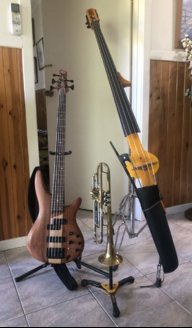
Three lightweights (pics)
 
  • Like
Reactions: EatS1stBassist
Ah, yea that makes total sense. I ask because I have a 32" scale P bass that I've compared head-to-head with a G&L LB-100 and the difference in tone was very small with the medium scale being just a bit fuller sounding. Though that could be differences in pickups (stock G&L vs SD SPB-1) as much as anything else. The medium scale bass won in the categories of weight, balance and playability.

But that is comparing 2 P basses where the only difference is scale length. Comparing a P to an EB-0 there will be lots of differences other than just the scale length.

Three lightweights (pics)
I also prefer the taughtness of strings on a 34" scale. More responsive to my fingers I think.
 
I
For me, I noticed a bit reduced sustain and less pitch fundamental. I am referring to my experience with a 70's Gibson EB-3. One time while doing a gig in New Orleans where 2 bands were billed, I was playing the EB-3. The bass player from the other band invited me to play a few sets on his American Precision. The P-bass was immediately and clearly more satisfying to me. Upon returning to my home state , I purchased a Fender Precision. Now I have several others and have not tried a 32" scale in decades. Thats how it happened for me a long while back.

I have never played a Gibson EB-3. however, I have played other short-scale basses, including my own mid-sixties Baldwin. My experience has been that the higher strings seem to have a stronger fundamental than on my 34" and 35" basses; as I pluck each open string from bottom to top, the higher strings don't seem to become thinner sounding. YMMV
 
  • Like
Reactions: EatS1stBassist
Well, sounds to me like you have a legitimate reason for switching to a short scale bass; so by all means, do so. Other than to warn you that, like long scale basses, short scale basses have necks that may be too wide/narrow or too thick/thin for you, I don't have much advice to give. I've been lucky with my shorty necks, but... some of them do push the "acceptable to me" boundaries... And, don't assume that "Short" = "Light". I do have some that are really light, but I also have some that are little boat anchors, too. As for recommendations? Sorry; I'm left handed, and decent-to-not-quite-Custom lefty short scale basses is a very small pond to fish in. About the only one I can personally recommend is the same one JimmyM did; the Danelectro Longhorn. The current MIK ones are very well made; sound very good, too; are very amenable to tone changes with different strings; and are stupid light. Mine weighs less than either of my violin basses, in fact. And, don't let its appearance fool you. It's really about the same as an Epiphone ES-335 guitar to play; it just has some of the upper bouts missing. Mine spends it's down time in an ES-335 case, in fact. As for my other shorties? They're all either old and obscure; no longer made; or ones I had made. Like I said; it's a very small pond...
 
  • Like
Reactions: EatS1stBassist
I


I have never played a Gibson EB-3. however, I have played other short-scale basses, including my own mid-sixties Baldwin. My experience has been that the higher strings seem to have a stronger fundamental than on my 34" and 35" basses; as I pluck each open string from bottom to top, the higher strings don't seem to become thinner sounding. YMMV
All pianos, grand or vertical benefit by the longest string length, especially in the deep bass. Same principles apply to a bass violin or bass guitar.
 
  • Like
Reactions: EatS1stBassist
OK, everyone on Talkbass is encouraging buying another bass. Somehow, I'm not surprised ;-)

However, before you do that, I'd suggest you prototype the solution. Take your current full scale bass, get a set of slightly heavier strings, tune it down to D standard, and put a capo in the second fret. The point of this is to determine if just a scale length will fix the issue - if playing a couple frets up doesn't help, then a short scale isn't the answer (or at least it isn't the whole answer).

The other thing of note here is that many sort scale basses move the bridge towards the center of the body - if the experiment with a capo says that short scale is the answer, you need a short scale with the bridge still near the end of the body. The Nordstrand cat bass is one example of a good short scale design in that regard.

Neck width and weight are other factors that might give you issues. But there's another issue that you may or may not have tried - you might just need to play your bass a bit higher - as I've grown older, my straps have gotten shorter - about an inch per decade (the bass gets half an inch higher each decade). A higher bass helps keep your wrist in a neutral position, which is one of the important things to do to be able to play at our (I'm 7 years behind you) age. I'm pretty tall, and I have no problems with full scale basses, but the height of my bass is critical for me to have decent ergonomics.
 
Last edited:
  • Like
Reactions: EatS1stBassist
So, reaching low E at the 5th fret on the B string? That makes the scale about 26". Clearly the reach is significantly reduced.

If the bass is a 34 inch scale length (Fender scale), the 5th fret is 25.5 - Fender's regular guitar scale. Fender really has one fret progression for almost all of it's instruments - it's just truncated to some fraction for whatever instrument you have. You can also think of it as a Telecaster scale that's truncated for short scales, and extrapolated for basses and baritones.

Your nut on a 34 inch bass? - long scale bass. 1st fret - medium scale bass. 2nd fret - short scale bass. 3rd and 4th frets - 2 baritone lengths. 5th fret - regular guitar scale. 6th fret - short guitar scale (24). 7th fret - student guitar scale (22.7ish).
 
  • Like
Reactions: EatS1stBassist
All pianos, grand or vertical benefit by the longest string length, especially in the deep bass. Same principles apply to a bass violin or bass guitar.

And if you're looking for a "piano-like" sound, as preferred by many pick players and Entwistle worshipers, long scale is probably the way to go. Many of us prefer short-scale basses, which emphasis the fundamental. I love the thick sound of my Japanese mid-'60s Orpheum hollow-body EB-1 copy.
 
  • Like
Reactions: EatS1stBassist
FWIW! By 2012 my hands and wrists had deteriorated to the point I could no longer hold tools in my hands or even play bass. I couldn’t even replace a screen. A TB Member had fallen through several floors in a construction accident. He restored himself with supplements. I took those for a year and a half. It took a long time to come back from arthritic damage. I mean I couldn’t even brush against cloth without it hurting. At night it felt like I was being crucified through my wrists. Needless to say I ended up selling a lot of cool basses. Well now my hands fingers and wrists are healed. Yes there were times I was wondering if it would work! Now, like JRA, I feel it in my shoulders so now I will be resuming my program. Hope this helps for a list of supplements PM me.
 
  • Like
Reactions: marchone
One bass that may provide some of the 34" scale sound is the fairly recent Sterling by Ernie Ball (or Ernie Ball) Short Scale Stingray - the Stingray SS4. Some of the reviews and comments here on TB and around the Net are very complementary - and its passive if you don't like batteries.

I second the GruvGear Duostrap recommendation. They are just great!
 
I got my Ibanez MSR20 Mikro last night played in church this morning. Got to say it was different sound wise it was okay, I was playing it trudgen's a Markbass 151p Jeff Berlin 15 combo. I was a guitar player well I still play guitar but I played guitar maybe 40 years lead guitar. Then came here they had plenty guitar players and needed a bass player been play bass 14 years now. Anyway this Ibby has a very thin neck which makes it fast to get around on, and a small body. tuners work great pickups sound decent great for church. For me it was very comfortable to play. Very light but I had my Lakland 3tbs hollowbody 34" there also. i am thinking I will leave the Ibby up there with me and play my Lakland then if my back and such starts bothering me between songs I will just switch. I will use an A-B box. But the little Ibanez is cool and fun to play, during practice before church I was doing little short leads on the bass and the worship leader liked it. I am glad I went ahead and got it. I am down to 2 basses and I am happy. the body is a little smaller then my strat.
311510B.jpg.68a10b7b8607fb33b30fefef8318bcec.jpg
gsrm20pwfront.jpg
 
I'm 69, been playing bass since 1968. I've gone to light passive 4s, roasted bodies and necks, light strings (Sunbeams), 1.6" nuts, 7.25 radius shallow "C" profile, heavily rolled fretboards (flat fretboards and deep D profiles have caused me issues/pain). My career has been extended. I don't want to give up superior (to me) 34" scale tone. My 2 main players are 8 lbs 5 ozs and 8 lbs 8 ozs. Sadly, my 5ers (Dingwall SJ5XXX, Lull T5, and Roscoe SKB 3005) all at 9.1 lbs are beautiful decorations. My 4s have drop D tuners, so unless I play in another Country Band, no more need for 5s.

BTW, it also helps to keep your own body weight down, do some cardio and light lifting, and glucosamine can be your friend. Oh, and Lakota buffalo hide straps are light, have some slight give, and are beautimous.
 
Last edited: