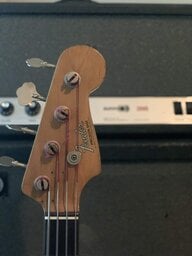
• TalkBass has been independent since 1998. Add your voice.
    Create a free account to reply to discussions, view embedded media, and browse with fewer display ads.
    Join freeLog in
    Want zero display ads or expanded classifieds tools? Compare plans.

getting solo sound & volume on a Precision

climber

Supporting Member
Oct 21, 2006
1,182
2,031
78
www.alhospers.com
in 60 years of playing bass I've never owned a Precision. since I love both Jamerson and Pino I decided to buy a Custom Shop Pino signature bass. I got a decent deal on Reverb and overall the bass is pretty nice and it really does have THAT sound. I just had the neck PLEKed and it plays great. I did 5 tracks for someone last week and both the producer and artist were really happy with how the tone sits in the mix. I've played it in the two bands I regularly play with and the guys are very complimentary.

so this is of course a passive bass. in fact it's the only passive one of 4 basses that I own! in both of the bands I play regularly with, one is mine, I take a lot of solos. normally I have my bass volume back about 1/3 from the max for normal ensemble, turn up for my solos and when I'm done I turn back down. I can't do this with the Pino because the tone changes a lot when the volume is lower! listening to several interviews with Pino about his tone he said that he turns the bass volume all the way up and the tone all the way back. setting it like that it really does sound great, but Pino doesn't do that much soloing with the P. I tried turning up the tone, but it sounds pretty crappy like that.

so I guess I'm wondering what the solution is? what do folks do who play P basses and solo a lot? is the answer to use a pedal. I own a bunch of pedals, and even a pedal board, but I gave up using it about 8 years ago. I found it to be a hassle... maybe using a compressor to boost the sound, or a volume pedal? what are your thoughts? does anyone know some players who play P bass and solo a lot?

just for context, here's a video of my band where I'm playing behind everyone, then take a solo, then step back behind the guitar solo...


thnX
 
I personally am not a fan of turning UP for solos and that goes for all instruments. The band should always settle down and softly comp while any solo is taking place. I have this battle with the guitar player in my band. I'm also not a knob twiddler. I set my volume (always full on) and eq (bass and amp) and I'm set for the night. I do have a solo at the end of the night and the band settles down and allows me to get my 16 bars in and I'm good to go. You're a good bass player. Just play. Stop chasing tone.

This is just my opinion.
 
in 60 years of playing bass I've never owned a Precision. since I love both Jamerson and Pino I decided to buy a Custom Shop Pino signature bass. I got a decent deal on Reverb and overall the bass is pretty nice and it really does have THAT sound. I just had the neck PLEKed and it plays great. I did 5 tracks for someone last week and both the producer and artist were really happy with how the tone sits in the mix. I've played it in the two bands I regularly play with and the guys are very complimentary.

so this is of course a passive bass. in fact it's the only passive one of 4 basses that I own! in both of the bands I play regularly with, one is mine, I take a lot of solos. normally I have my bass volume back about 1/3 from the max for normal ensemble, turn up for my solos and when I'm done I turn back down. I can't do this with the Pino because the tone changes a lot when the volume is lower! listening to several interviews with Pino about his tone he said that he turns the bass volume all the way up and the tone all the way back. setting it like that it really does sound great, but Pino doesn't do that much soloing with the P. I tried turning up the tone, but it sounds pretty crappy like that.

so I guess I'm wondering what the solution is? what do folks do who play P basses and solo a lot? is the answer to use a pedal. I own a bunch of pedals, and even a pedal board, but I gave up using it about 8 years ago. I found it to be a hassle... maybe using a compressor to boost the sound, or a volume pedal? what are your thoughts? does anyone know some players who play P bass and solo a lot?

just for context, here's a video of my band where I'm playing behind everyone, then take a solo, then step back behind the guitar solo...


thnX
I’m a long time PB player.normally I have the tone and volume controls wide open and adjust the tone on my amp EQ, For solos I just pluck the strings harder when soloing.

On a side bar, if you have FOH support, just have your sound person boost your sound level. You would need to let him know when these solos are going to happen.
 
I almost always run my volume wide open. Most of the time when I solo, the band backs off a little or I may play harder if it's necessary. My normal technique is fairly light overall, so not a problem to play a bit louder for a solo.

A clean boost would do the trick.

I believe the behavior you are describing may be related to pot values and/or the way the pots are wired.

In this diagram the pickup is wired across the volume pot. I believe this keeps the loading the pickup sees more constant.

1745379352703.png


I believe if the volume wiring is like this, the loading on the pickup varies as you adjust the level, which has an impact on tone. If it's not clear the pickup is wired to ground and to the wiper.
1745379814493.png

IMHO check your volume control to see which way it's wired.

I could have it wrong...maybe @micguy will comment.
 
  • Like
Reactions: Hoochie Coochie Man
Have you played the Pino live yet? Have you heard how you sound on recording? I mean, you said when you used this bass to record everyone was happy with it. Sure it doesn’t have all the active stuff going on, but in a live situation maybe the tone change in the volume pot isn’t as significant?
 
I personally am not a fan of turning UP for solos and that goes for all instruments. The band should always settle down and softly comp while any solo is taking place. I have this battle with the guitar player in my band. I'm also not a knob twiddler. I set my volume (always full on) and eq (bass and amp) and I'm set for the night. I do have a solo at the end of the night and the band settles down and allows me to get my 16 bars in and I'm good to go. You're a good bass player. Just play. Stop chasing tone.

This is just my opinion.
I disagree, the solo wants to sit in a different part of the mix and based on the clip he's reaching up to a different register, so even if the band backs off the bass isn't going to cut through and sound like a strong solo instrument.

All my basses are active and I do a lot of tone adjustments when soloing, but if that's not an option with the P-bass then a pedal makes the most sense. Adding a clean boost or an EQ with a slight gain bump would be a simple solution that would get the P-bass to cut through better and give the high end some more definition. Personally I love my BassBone because I can dial in a different EQ setting for solos, there's a clean boost option, and it doubles as a fantastic DI. I'd bring that along even if I leave the rest of the pedalboard at home.
 
  • Like
Reactions: climber
You could try a treble bleed mod. That should help with the loss of highs you get when lowering the volume on a passive P-bass. Don't do the treble bleed mod that only uses one cap. The versions with a resistor in either parallel or in series with the cap are much better. Do a search online to find cap/resistor values and discussions/opinions on the different versions.

Some people like the treble bleed (or even find it essential), others don't. You won't know until you try it yourself, but it is a VERY cheap and 100% reversible mod.

If that doesn't work for you, the best solution is probably a clean boost pedal.
 
  • Like
Reactions: Wasnex and climber
You could try install a treble bleed, so your tone doesn’t change too much with the volume down. I’d also consider a linear taper vol pot. @micguy is the resident electronics expert and I believe he uses volume a lot for dynamics, so I’m sure he can provide some good technical tips… and/or search around for his posts.

But what I’d really recommend is a series-parallel switch, it can be a push-pull knob. Series is notably louder than parallel, giving you an on-board passive boost. To match the tone in parallel, you need to add a loading capacitor (and maybe a resistor) to fine tune the resonant peak. While you could calculate the exact values you need, you can also just experiment as caps and resistors are cheap. You might even find new tones in your P bass that you like/prefer, and if you want them on tap, you could wire in a selector switch.
 
Last edited:
  • Like
Reactions: climber
Nice band, nice choice of tunes! This was a pleasant surprise!

I like the sound of my precisions with the volume backed off a little, and with the tone not rolled completely back, too. I leave myself some head room on the volume knob, not for solos, but for any tune or part of a tune where I need more volume. And my fingers can make a big difference as well.

You could use some kind of clean boost, but i think hou should try to work with the bass to get sounds you like in configurations other than the one, with tone rolled off and volume all up. That’s very restricting.
 
Side question: Why did this Custom Shop need a PLEK job? That seems odd to me.....?

I bet that Bass Bone could be perfect to help jump out of the mix. I play bass in a jamband & often I use a Phase 90 (speed around 10 o'clock) to jump out of the mix.... I also use plenty of fuzz & dirt, but a lil EQ pedal could also do the job just as well.
 
Last edited:
  • Like
Reactions: EliasA and climber
You could try install a treble bleed, so your tone doesn’t change too much with the volume down. I’d also consider a linear taper vol pot. @micguy is the resident electronics expert and I believe he uses volume a lot for dynamics, so I’m sure he can provide some good technical tips… and/or search around for his posts.
OK, here's what I do. It's a bit complicated - not a stretch for anyone with some electronics background, but if you're a person who opens up a P bass, and is baffled, it's probably too much.

With a P, I'd wire the pickup halves in parallel. That reduces the impedance of the pickup by factor of 4. That also means the resonance will shift up - the cable isn't loading the pickup as much. Next move is to add a loading capacitor - right across the pickup - on a P that's the same thing as from the top of the volume pot to ground. If you like the sound of your P as it's wired "normally" start with something like an 1800pF capacitor - that will get you about the same sound as with the thing in series, but your tone control will have more range - it will go a bit brighter at the top (the normal sound is still there, just dialed back a bit). And yes, I use a linear volume pot - that makes the volume very controllable for a decent range. As the pickup is now much lower impedance, I will often use a 100K or 150K pot for the volume control. With that lower volume control resistance, and the loading capacitor, you don't need a treble bleed circuit - the tone will be much more consistent with changes in the volume control.

I do use treble bleeds on some of my basses - when the impedance warrants it. doing one of those right is more complicated than just slapping a resistor across the volume control - you need a capacitor and a resistor, and you ned to do some work simulating things to get a set of values that work well - I can't recommend values for a treble bleed without knowing a lot (that I can only obtain by characterizing your pickups' impedances and doing Spice simulations)
 
Side question: Why did this Custom Shop need a PLEK job? That seems odd to me.....?
I can't tell for certain, but it appears it was used - in that case, necks do move (especially the first few years), and of course, there might be wear if it was played a bunch. It would be criminal if a decent bass wasn't played a bunch, right?

I build my own basses. All my necks are roasted maple for the main part. Some have rosewood fretboards; a few have roasted maple fretboards. On the ones with rosewood boards, I wait a couple years - until the thing has been through a couple of winters, to do a fret level - that way the thing is pretty stable, and one fret level should be good for a good long while. On the ones with roasted maple throughout, I do a fret level when they're new - the thing is stable out of the gate, so a good fret level should be good for a good long while there.

Of course, some folks just feel better about playing a bass once a fret level has been done, and when the word "Plek" is attached to a fret level, some folks feel even better, for whatever reason.