That's why I specified that it was a black box theatre, to make it clearer for those who are familiar with the construction: no proscenium and lots of hard walls, but a high grid unlike a club setting. The space is acoustically very well suited to speech, nothing like a concert space. And, yes, almost entirely classic rock. The subs are deepening the tone, but not providing the real volume, as the unamplified tone is already fairly loud in the space. It gives the performers the tone they are looking for, whether that's a good thing or not. ;-)hmm, that's kinda weird, and not usually recommended; kick (like everything else) has lots if not most of its "information" well above 100Hz. as such, the point of aux-feeding subs is to add the instrument into the subs while keeping it in the tops, never to run it into the subs only.
by "theater" do you mean a place meant to carry acoustically, to where the kick is already loud enough without the PA? i could see where a pinch of it in the subs only might serve to balance out the mids and highs coming off the drum itself, especially in an older musical style context where it isn't supposed to be punching through so much.

Enjoy the benefits of a premium membership!
Upgrade Account
-
TalkBass has been independent since 1998. Add your voice.
Create a free account to reply to discussions, view embedded media, and browse with fewer display ads.
Join free Log in
Want zero display ads or expanded classifieds tools? Compare plans.
You are using an out of date browser. It may not display this or other websites correctly.
You should upgrade or use an alternative browser.
You should upgrade or use an alternative browser.
Getting the Best Kick Sound
- Thread starter LiquidMidnight
- Start date
More options
Who Replied?
so do you mostly spend your time trying to get the guitar players to turn the hell down?The subs are deepening the tone, but not providing the real volume, as the unamplified tone is already fairly loud in the space.

Well, DUH!so do you mostly spend your time trying to get the guitar players to turn the hell down?

Its a group of 40 or so every quarter doing a concert: two (college) classes. Huge age range. So, every quarter, it's a contest who the loudest guitars will be: stupid kids, or deaf adults. Everyone's trading out every song, so everything is changing constantly. Drummers keep switching between ones who are freakishly loud with kick ass chops to ones who can neither maintain volume or rhythm.
Good times....
Last edited:

Through my 3 year old rig [that was middle of the road even back then], with high quality, 24 bit samples, all the velocity layers you could ever need... 0 second latency, and less than 5% resource use.drum triggers are velocity sensitive. (most? all?) They play at different volumes and some do different samples depending on how hard the drum is hit and can be pretty real sounding.
That having been said, the bigger and better the samples, the more latency there will be.
I would have loved for the old drummer in our band to use samples as his drums sounded bad and samples would have been an improvement. I'd hate for our new drummer to use samples as his drums sound great and I'd rather use mics.
As for your old drummer, or any drummer you come across that wants to use some great samples. I'd highly, highly recommend NDK.
Maybe you think it zero, but actually it is only that you "felt almost like no latency" which mean that it's acceptable for live performance,... because, scientifically, it's impossible to be 0 latency (triggered drum samples).Through my 3 year old rig [that was middle of the road even back then], with high quality, 24 bit samples, all the velocity layers you could ever need... 0 second latency, and less than 5% resource use.
As for your old drummer, or any drummer you come across that wants to use some great samples. I'd highly, highly recommend NDK.
What a silly thing to say. Of course the limits of the physical universe apply.Maybe you think it zero, but actually it is only that you "felt almost like no latency" which mean that it's acceptable for live performance,... because, scientifically, it's impossible to be 0 latency (triggered drum samples).
That doesn't make a difference to my claim. Whether you would have 20ms, 50ms or 10 000ms of latency; I have less, to the point of it being incalculable. and many others do, too. It's not something that you have to worry about in today's technology. The resources, RAM and CPU usage, are much more important. and even those don't take up a whole lot for some measly triggered samples. =]
The silly thing is to say we trigger a drum sample and say it's latency is zero.
The right/smart thing is to say "the latency is accepted" or "it's almost like there's no latency".
There are people that have no knowledge about things like this in TB, member or guest readers, I don't want to give them false fact about this "latency in digital audio devices" things, although I can understand what you mean by your statement above.
The right/smart thing is to say "the latency is accepted" or "it's almost like there's no latency".
There are people that have no knowledge about things like this in TB, member or guest readers, I don't want to give them false fact about this "latency in digital audio devices" things, although I can understand what you mean by your statement above.
Last edited:

...in 1995.No, triggers/samples play a prerecorded sound that is exactly the same every hit. Believe it or not, some drummers are able to play with dynamics, which is ruined by triggering. And it's not what the OP asked about.
Sent from my iPad using TalkBass
Triggers/samplers/drum modules have come a long way. We usually try to get a good sound using a mic, but when all else fails, a triggered kick mixed in with the mic'd kick almost always sounds great.
- Jan 27, 2010
- 4,141
- 471
- Disclosures
- Endorsing Artist: Genz Benz Amplification
Sure, and I've done that plenty of times mixing studio tracks that were recorded (poorly) by someone else. But I still think it's overkill in most live situations. Getting a good kick sound is live mixing 101. If someone has to break out the triggers, brain, laptop etc to get a standard rock/pop kick sound I'm going to question their experience....in 1995.
Triggers/samplers/drum modules have come a long way. We usually try to get a good sound using a mic, but when all else fails, a triggered kick mixed in with the mic'd kick almost always sounds great.
Sent from my iPad using TalkBass
I like good acoustic kick sound treated good (good kick, good player, mic'ed and mixed etc).. but I'm not against trigger. I think many (and might be more in the future) experienced drummer/drum tech utilizing that today, including rock/pop drummer. I haven't search the google yet to provide exact list of them, but for sure Neil Peart use them, do you think he's less experienced?
I mean using it doesn't always mean that one way is better than other, also it doesn't always have anything to do with lack of ability to get a good sound, much less unexperience.
I mean using it doesn't always mean that one way is better than other, also it doesn't always have anything to do with lack of ability to get a good sound, much less unexperience.
For us it's as simple as taking a line from the mixer to the rack with the Alesis drum "brain" in it. It's already wired in, so it's very simple. But as I said, we always go for a pure mic'd sound first. Some kick drums just don't sound good in some rooms. All we need to do is bring in some sampled kick and it usually "perks" right up. We are pretty experienced (soundman is a studio owner, has done lots of commercial mastering and recording), but also kinda lazy, not going to spend too much time tweakin' the kick/drum/mic etc. Getting a good kick sound has worked very well this way. It's sort of like a hybrid kick-drum. A DW Prius, if you will!Sure, and I've done that plenty of times mixing studio tracks that were recorded (poorly) by someone else. But I still think it's overkill in most live situations. Getting a good kick sound is live mixing 101. If someone has to break out the triggers, brain, laptop etc to get a standard rock/pop kick sound I'm going to question their experience.
Sent from my iPad using TalkBass

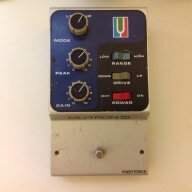
I have used an old trick I saw a sound guy do a long time ago (pre sampling/triggers). A gate on the kick can be used to trigger another gate which is on a low frequency oscillator set to a low level. Both the gated kick and gated oscillator mixed together sounds pretty good for a kick that is mostly attack and not much whoomph.
- Jan 27, 2010
- 4,141
- 471
- Disclosures
- Endorsing Artist: Genz Benz Amplification
That's a good old school trick. If you set the oscillator's gate to a longer decay it's a perfect recreation of the 808 "hip hop" kick drum.I have used an old trick I saw a sound guy do a long time ago (pre sampling/triggers). A gate on the kick can be used to trigger another gate which is on a low frequency oscillator set to a low level. Both the gated kick and gated oscillator mixed together sounds pretty good for a kick that is mostly attack and not much whoomph.
Getting the kick sound should be in relation with other instrument, esp bass....Another noted old trick is 'ducking' effect using a compressor/gate sidechain for kick and bass to tighter them.. Mix Tips For Kick & BassI have used an old trick I saw a sound guy do a long time ago (pre sampling/triggers). A gate on the kick can be used to trigger another gate which is on a low frequency oscillator set to a low level. Both the gated kick and gated oscillator mixed together sounds pretty good for a kick that is mostly attack and not much whoomph.
Not true.
better samples, higher sample rate, can have the same latency as the worse one. Only it needs smaller buffer than the worse one to be played at the same latency, which force the DAW (hardware) to work harder.
Until you run into the limit of what your hardware can do, in which case, you'll have to limit the sample size in order to minimize latency. If your samples are small enough, sure you can have minimal latency. If the samples get big enough, better samples=more latency. Or worse, the whole system hangs up and stutters.
It's been a few years since I did anything with triggering so maybe the power of computers has gotten to the point where this isn't an issue anymore . . . .?
^^^Until you run into the limit of what your hardware can do, in which case, you'll have to limit the sample size in order to minimize latency. If your samples are small enough, sure you can have minimal latency. If the samples get big enough, better samples=more latency. Or worse, the whole system hangs up and stutters.
It's been a few years since I did anything with triggering so maybe the power of computers has gotten to the point where this isn't an issue anymore . . . .?
No, I mean like this, for example:
Say, we take two of same sample snare sounds, same length, same computer, same devices, same DAW...
Sample A is better, has higher sample rate (say 96 KHz @24 bit) while another - Sample B - is worse (say 44 KHz @16bit).
(of course we have to test this at different time with different DAW & device settings for each)...
Now, to be played (triggered) at the same latency - it's possible to play them at exactly the same low latency - the Sample A need smaller buffer than Sample B.
But the computer, has to work harder when to play the Sample A than when to play the Sample B.
Computer power (and other hardware) is the limit, true.
The power of computers has gotten to the point where the high end of them are so powerful, true. But still it's limit can be found.
Sorry my English is not good enough


