

Enjoy the benefits of a premium membership!
Upgrade Account
-
TalkBass has been independent since 1998. Add your voice.
Create a free account to reply to discussions, view embedded media, and browse with fewer display ads.
Join free Log in
Want zero display ads or expanded classifieds tools? Compare plans.
You are using an out of date browser. It may not display this or other websites correctly.
You should upgrade or use an alternative browser.
You should upgrade or use an alternative browser.
Gibson 3 Point Bridge Loathing
- Thread starter BassDaddy77
- Start date
More options
Who Replied?

My experience also. My JC has not moved in the five years I’ve had it.To be clear, do you recommend the front post on a 3 point bridge to be higher or not? I have an Epiphone JC and an EB3 that I’ve always set up so the front post is slightly above the 2 back ones, I believe I read that on TB, and never had an issue with the inserts pulling out. Maybe I’ve been lucky? I also don’t want to be repeating bad advice.
if the front pin is lower, you lose break angle. If the 3 pins are level they could rattle and you don’t know where the pressure is located.
Front pin up, the front mount is taking it’s fair share of the levering moment. The back hooks are angled so that the lowest edge of the squared loop is contacting the posts. As much as a quarter inch lower than if it’s sitting on the top edge of the hooks when the front pin is low or even level. So we have ensured the rear lever point is as low on the back pins as possible and all three pins are bearing string pressure.
Turn the front pin up until the rear hooks bind in the grooves.
Last edited:
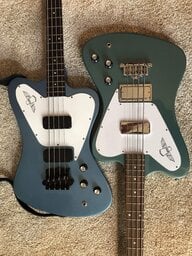
Yep. Titebond works for this, just let it cure really well for a few days. Be patient. Also,the bridge ground is on the G side. Make sure you have proper contact with the tiny wire and the insert/post.Excellent... thank you!
In my travels I found this thread out of the UK that also speaks to the problem, and had my doubts about epoxy.
https://www.thefretboard.co.uk/discussion/136397/bass-bridge-problem-gibson-3-point-type
I’ve always relieved some of the string tension before making adjustments at the the bridge height.
This may do absolutely nothing, but it makes me feel better
And this.
Particularly if your raising it. But I relieve tension whenever I do any adjustment.
I currently have three Gibbys, two with Babicz and one with a three a three point. I have four Epis with the three point design, three have the three point and one has a Hipshot. I prefer the Babicz and Hipshot. On my three points, I set the center post only slightly higher than the sides.

My experience also. My JC has not moved in the five years I’ve had it.
if the front pin is lower, you lose break angle. If the 3 pins are level they could rattle and you don’t know where the pressure is located.
Front pin up, the front mount is taking it’s fair share of the levering moment. The back hooks are angled so that the lowest edge of the squared loop is contacting the posts. As much as a quarter inch lower than if it’s sitting on the top edge of the hooks when the front pin is low or even level. So we have ensured the rear lever point is as low on the back pins as possible and all three pins are bearing string pressure.
Turn the front pin up until the rear hooks bind in the grooves.
And I think that’s what @Turnaround is saying in his post but I wanted to make sure I understand what he wrote.

pull 'em all the way out (shouldn't be that hard), slather thoroughly with regular wood glue like titebond original, stuff 'em back in and wait a dayAnyways, what are some solutions the DIY luthier community here has tried? Will pulling and re-installing the posts do the trick? Do I drop in a little wood glue before re-inserting? Do I re-hydrate the holes before re-installing? I've got some skills but would be interested in both successes and failures before running my own trial & error session
ideally with the three posts level the string pull should all be on the back two posts; the little front post should just be controlling the angle of the bridge. that front post should easily turn even when the bridge is under full string tension.if the front pin is lower, you lose break angle. If the 3 pins are level they could rattle and you don’t know where the pressure is located.
you shouldn't have to "fix" the problem by tilting up the bridge to the point the posts start to bind in the bridge itself, that starts to alter the actual string radius
Walter, it’s not a crazy angle. When I say bind in the grooves, I should have said stop slightly before they bind.
if you see canting the plate up as a huge problem, so be it. Anecdotal evidence from many owners here seems to uphold the theory that it works.
Yes, the three pointer is flawed, but it’s not a deal breaker either. Unless the user insists it is.
if you see canting the plate up as a huge problem, so be it. Anecdotal evidence from many owners here seems to uphold the theory that it works.
Yes, the three pointer is flawed, but it’s not a deal breaker either. Unless the user insists it is.

Turnaround
Commercial User
A bit higher on the front post is fine as long as it's only a modest amount. I would only adjust it higher than level if the string was rattling on the saddle. The additional angle of the string over the saddle in such a case may be enough to stop the rattle.
A bit higher on the front post is fine as long as it's only a modest amount. I would only adjust it higher than level if the string was rattling on the saddle. The additional angle of the string over the saddle in such a case may be enough to stop the rattle.
Thanks. Always appreciate your advice and experience.
I do not like the 3 point bridge because of the pull on the posts and the short distance string ball ball anchor to saddle. So I did this:
SG Bass mod for bridge
(Still, I prefer Babicz + trapeze: allows individual string height set-up).
SG Bass mod for bridge
(Still, I prefer Babicz + trapeze: allows individual string height set-up).
Thank God for Hipshot is what I have to say about the Gibson bridges. The first thing I replace is that 3 point thing.

To me, the only really bad 3 point bridges were the ones that came with Vantage basses made from about 1979-82 (around that time). Those bridges were completely mismatched to the basses and had the a and d strings be at a completely different radius than the fretboard. These pot metal copies would deform over the years to the point of being unable to be adjusted in height.
Gibson-wise probably the ones that were on the grabber/ripper basses in the 70s, mostly as a result of the design decision to have those basses be string through + a gibson 3 point. What ended up happening was one needing extra-extra long scale strings to both string through the body and clear over the ol' oil rig to reach the string posts.
Gibson-wise probably the ones that were on the grabber/ripper basses in the 70s, mostly as a result of the design decision to have those basses be string through + a gibson 3 point. What ended up happening was one needing extra-extra long scale strings to both string through the body and clear over the ol' oil rig to reach the string posts.
Last edited:


