• TalkBass has been independent since 1998. Add your voice.
    Create a free account to reply to discussions, view embedded media, and browse with fewer display ads.
    Join freeLog in
    Want zero display ads or expanded classifieds tools? Compare plans.

Double Bass Gnarly bridge-bending causes

I'm currently renting my bass, and recently had to take it into the shop to repair an open seam. The issue is with the loaner bass I was given to use for the period of repairs.

Anyway, I just noticed that the bridge on the loaner bass seemed to be bent downwards:
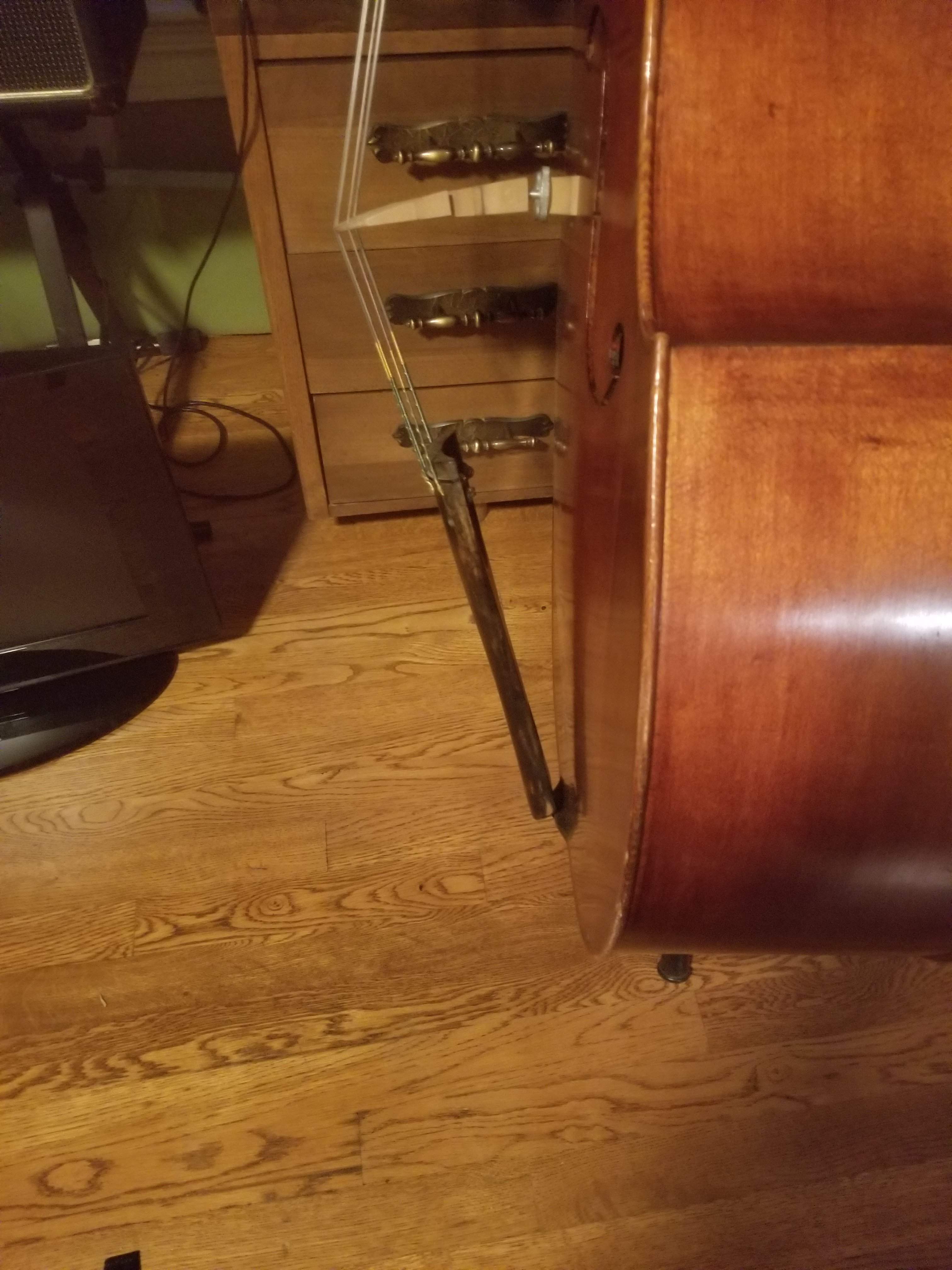
20190225_184238.jpg

After taking the bass home from the violin store, I set the action to where I was comfortable (13mm-16mm for steels). The action was significantly lower before, so the adjusters were extended pretty far. It was two days after that I noticed the bridge being warped. Once I noticed it, I lowered the adjusters as far as they would go without the strings touching the fingerboard, which is what can be seen in the picture.

My question for those more experienced than myself: could my adjustments to the bridge have caused the warping, or is it more likely that it happened on its own, or even before I took the loaner out?

Thanks for any input!

 
The adjusters are upside down, and if that's the lowest setting there should be much less thread showing.. Generally I have to manually push the top of the bridge a little to vertical as the strings are brought to tension (since they should definitely be de-tuned before turning the bridge adjusters) no matter how much graphite is in the string slot. But it usually goes toward the fingerboard..
 
Thanks! It always made sense to me to detune when raising the action so that the tension wasn't too high, but it never occured to me to also detune when lowering. Does this mean if I push the bridge back in place i can raise the action again?
 
That's the idea. You can tune the strings way down one at a time and pull them out of the bridge slots, rub some pencil in there for lubrication, then watch the position of the bridge as you tune it back up, making adjustments as needed. You can use the edge of the lower bout as a kind of reference straight-edge when looking at it from the side.
 
  • Like
Reactions: craigie
Thanks! It always made sense to me to detune when raising the action so that the tension wasn't too high, but it never occured to me to also detune when lowering. Does this mean if I push the bridge back in place i can raise the action again?

You can if you keep it straight, but it looks like those adjusters are not done properly and there won't be much thread into the wood at the string height you want. But 13mm on the G? That sounds painful..
 
You can if you keep it straight, but it looks like those adjusters are not done properly and there won't be much thread into the wood at the string height you want. But 13mm on the G? That sounds painful..
Haha yeah I have gut D/G on my own axe, so steel that high isn't super comfy, but i'm used to to the sound and feeling of high action in general, so I prefer it that way.
 
That does not happen in two days unless the bridge was surrounded by hot steam most of the time.
The bridge might have been mounted the wrong way (but I doubt that).

The bass needs a new bridge immediately. They should not take money for the time they gave the bass to you in that condition. I'm pretty sure that the bridge was warped before they gave you the instrument. I have never seen a bridge being warped towards the tailpiece, it was always towards the fingerboard (because strings stretch and the friction between string and bridge pulls the bridge towards the fingerboard/pegbox when you need to bring the stretched string back up to pitch.). It is a good idea to check the bridge angle before you start to play and if needed pull the bridge top back towards the tailpiece.
 
That does not happen in two days unless the bridge was surrounded by hot steam most of the time.
The bridge might have been mounted the wrong way (but I doubt that).

The bass needs a new bridge immediately. They should not take money for the time they gave the bass to you in that condition. I'm pretty sure that the bridge was warped before they gave you the instrument. I have never seen a bridge being warped towards the tailpiece, it was always towards the fingerboard (because strings stretch and the friction between string and bridge pulls the bridge towards the fingerboard/pegbox when you need to bring the stretched string back up to pitch.). It is a good idea to check the bridge angle before you start to play and if needed pull the bridge top back towards the tailpiece.
Don't worry, the repairs and loaner are covered by warranty so I'm not being screwed over. Somewhat confounding that the shop didn't notice the state of the bridge since it is a reputable establishment with a bass specialist. Do you concur with the idea of pushing the bridge back to a normal angle before the strings are brought to tension as unbrokenchain said (apologies if I misinterpreted what he was saying)
 
I’m no expert but it should be ok to push it back to vertical- it’s strongest that way. I’d lower the action though.

Two things wrong here: bent bridge and bending at the risers because they’re installed wrong.
 
Do you concur with the idea of pushing the bridge back to a normal angle before the strings are brought to tension as unbrokenchain said (apologies if I misinterpreted what he was saying)
When bringing the strings tension up I start with a middle string, best might be the D because it is closer to the soundpost, then you can push the bridge back easier than with the friction of four strings, go up to pitch and correct when I see the bridge leans over. Then the other middle string, less correction needed because the friction of the first one holds the bridge better in place. Then the third string even less correction needed because of the friction of two strings against one string that needs to slip on the bridge when tuned up. Then the last one (in case you have four). The tuning of the strings goes down due to the pressure on the top which goes down a bit.
When you tune the strings up, check the bridge and correct because all four strings (or at least three of them) need to be tuned up a bit or a bit more. Correct th bridge, retune, check and correct the bridge if needed.
With new strings every time you need to tune up check th bridge. If the strings got stable after a few days, checking the bridge once a week should be enough, but at the beginning when the strings stretch the most, frequent checking and correction is needed. My bridge is still straight after 30 years.
 
  • Like
Reactions: unbrokenchain
Why do you guys think the adjusters are installed wrong? All of my basses have them installed that way: threaded portion in the bridge, non-threaded in the feet. The main problem I see here is that the top and feet are not squarely aligned. Taking that into consideration, the bridge isn't that badly warped.
 
But why has the bridge top such a bad angle to the adjusters?
Either the threads of the adjusters are hardly in the counterparts of the bridge top (dangerous to kill the thread) or the insert/thread in the top part of the bridge is angled in a bad way.
The top part is indeed not that much bent, but why does it sit in such an angle on the adjusters.

I would put the bass down on its back (onto a bed or sofa to avoid falling of the soundpost), loosen the strings and try to put the bridge top straight. Watching the adjusters and feet if they stay in place (contact with the bass top) or get angled (then the adjusters need to be refitted or the bridge replaced). But since thus is a loaner the shop should better do that.
 
But why has the bridge top such a bad angle to the adjusters?

I'm not a luthier, but it's been my experience that bridges with adjusters can flex a whole lot more than those without. The adjusters provide an easy place for for everything to pull/pivot up or down. And it looks like there isn't much thread in the bridge leg to stop the flexing... I'm guessing that those adjuster wheels will take a lot of strength to turn at the moment, but if the bridge gets righted, they'll be much easier, even if the bridge is still a little warped.

If this were a fixed bridge, I'm guessing it'd be toast but this one will probably still be okay once returned to it's proper position. Should be fine for a rental anyhow...
 
Some people like threads up, some like threads down. It's a personal thing and you'll get heated arguments for one or the other depending on which luthier you talk to.

The bridge doesn't look super warped to me. Once you return it to it's proper position, I'm guessing it won't be too bad.

Just my 2 cents, as always.

Good to know, I guess I've just never seen them the thread-up way, didn't mean to spread misinfo about what's "correct."
 
The other thing I wonder about is where the sound post is positioned on this bass. I would really take it back to the shop and ask them to fix the setup. I have had the warping bridge problem with a couple of cellos, despite my checking every time I played. I can tell you that the instrument sounded and played a whole lot better with a nice, straight, perpendicular bridge.
 
The angle of the bridge between the top and tailpiece side of bridge should be 90 degrees. You can check this with a ruler. It shurely looks like your running out of threads in the top of the bridge, and this makes the whole machine very unstable. I play guts and high-ish action, and had a new bridge fitted last december. My luthier used a 4/4 bridge as the 3/4`s he had were meant for lower action and were sub-optimally constructed for high action ( heart too close to strings etc ). I had tried just about every kind of setup with my ex-bridge, and it looked like that with guts-high-action, just without the warping.

Take the bass to the luthier! And if this is not possible,

you need to, at least, to straighten the bridge. First, tune the strings down a bit, then push the upside towards the nut. Repeat until straight, tune the bass and check once more. If the bridge remains warped, check the degree under the warping.

IMO and YMMV, 13mm`s under the G with regular steels is a total overkill if the bass has anywhere near normal mensure. For something like 1/8 bass it would make sense with 3/4 strings. Why not play the steel stringed bass like they are played, with medium action, and save the high action playing for low tension stringed bass? It`s a different approach and technique, I know, but with that sort of thing you obviously hurt the bass and most propably hurt yourself if you play any stopped notes