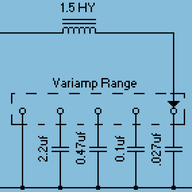
I decided to try swapping a 0.047 cap on the tone control of my Classic 50s P (which was a "swap" itself, as the stock cap for those reissues is 0.1) with a Greasebucket mod kit I bought, which includes a 0.022 cap acting as "tone value", bridged to a 4.7 k resistor and a separate 0.1 cap. I'm not explaining the diagram here.
For everyone's reference, I recorded a rather famous theme (no points for naming it, lol) before and after the swap, as an audio comparison.
The same theme has been played 3 times with each component:
- tone fully open
- tone at 50%
- tone fully off
The samples are:
- all 3 tone settings with the standard 0.047 cap value, played in sequence
- all 3 tone settings with the Greasebucket mod, played in sequence
- tone fully open comparison between the two components
- tone at 50% comparison between the two components
- tone fully off comparison between the two components
The bass is a Classic 50s P with a Duncan SPB1 and roundwounds (Elixir nanoweb, not new) going completely D.I. in the interface and unforgivenly unprocessed in the DAW save for a gate - it's not flattering for your playing, especially with the tone open, but I think it makes more sense for this kind of raw comparisons. All the tracks feature the same gain stage and have not been normalised.
My own very fresh conclusions, as I did the swap less than 1 h ago:
- The Greasebucket has a cap value of 0.022, so it cuts way less frequencies by design, and it's pretty obvious in the samples.
- Using that cap/resistor combo, it cuts at a higher midrange frequency without having that tiny boost when fully off which ends up sounding a bit like Donald Duck. I tried a 0.022 by itself in the past and I think this mod brings better results.
- For this kind of playing, I think the mod retains better clarity and articulation removing the "unwanted" clankly bit. You could argue this is not the kind of bass usually associated with these music parts, and that's true... but I like swimming against the stream, masochistically, lol.
- Without any sort of processing, the mod sounds "colder" with the tone off. However, my personal use of the tone most of the times is primarily to tame some harshness if needed, so I think this mod can help.
- The standard cap wiring on a P bass when off sounds warm and woody when recording in the bedroom, especially for parts which are less articulated, but IME is usually boomy and muddy with no definition when playing loud through an amp in rock settings - rehearsals and live.
- YMMV and mine too, as a real judgement and opinion might take some time and I might keep the mod as well as revert it in a few weeks, I don't know. I usually track parts with my tone open and leave the shaping to the DAW, anyway.
- Horses for courses.
For everyone's reference, I recorded a rather famous theme (no points for naming it, lol) before and after the swap, as an audio comparison.
The same theme has been played 3 times with each component:
- tone fully open
- tone at 50%
- tone fully off
The samples are:
- all 3 tone settings with the standard 0.047 cap value, played in sequence
- all 3 tone settings with the Greasebucket mod, played in sequence
- tone fully open comparison between the two components
- tone at 50% comparison between the two components
- tone fully off comparison between the two components
The bass is a Classic 50s P with a Duncan SPB1 and roundwounds (Elixir nanoweb, not new) going completely D.I. in the interface and unforgivenly unprocessed in the DAW save for a gate - it's not flattering for your playing, especially with the tone open, but I think it makes more sense for this kind of raw comparisons. All the tracks feature the same gain stage and have not been normalised.
My own very fresh conclusions, as I did the swap less than 1 h ago:
- The Greasebucket has a cap value of 0.022, so it cuts way less frequencies by design, and it's pretty obvious in the samples.
- Using that cap/resistor combo, it cuts at a higher midrange frequency without having that tiny boost when fully off which ends up sounding a bit like Donald Duck. I tried a 0.022 by itself in the past and I think this mod brings better results.
- For this kind of playing, I think the mod retains better clarity and articulation removing the "unwanted" clankly bit. You could argue this is not the kind of bass usually associated with these music parts, and that's true... but I like swimming against the stream, masochistically, lol.
- Without any sort of processing, the mod sounds "colder" with the tone off. However, my personal use of the tone most of the times is primarily to tame some harshness if needed, so I think this mod can help.
- The standard cap wiring on a P bass when off sounds warm and woody when recording in the bedroom, especially for parts which are less articulated, but IME is usually boomy and muddy with no definition when playing loud through an amp in rock settings - rehearsals and live.
- YMMV and mine too, as a real judgement and opinion might take some time and I might keep the mod as well as revert it in a few weeks, I don't know. I usually track parts with my tone open and leave the shaping to the DAW, anyway.
- Horses for courses.
Last edited: