• TalkBass has been independent since 1998. Add your voice.
    Create a free account to reply to discussions, view embedded media, and browse with fewer display ads.
    Join freeLog in
    Want zero display ads or expanded classifieds tools? Compare plans.

Double Bass Gut strings height at nut

Hello,
I'm curious to know how is the gut strings height at nut; the right measure. I remember that with traditional steel strings (Spirochore) the height is just enough to put under the strings a visit card (I remeber the picture on the Rufus Reid book). Is this height to low for gut? Better higher heights? Gut users, what is your strings height at nut? Now if I try to put a visit card under my gut strings at nut, it falls.
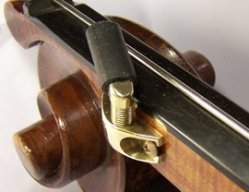
 
Can I resurrect this thread to ask about string height at the nut?

When I bought my bass, I had it set up by a really good luthier. The bass was then 16 year-old handmade German, now 26 years-old. 106cm string length. Strings are Spiro weich E-A-D, Oliv G.

I've been lately experimenting with my string height (bridge adjusters) to see how it affects my playing and sound, and the trade-offs involved.

I just measured my string height at the nut with feeler guages. I have 0.020"/0.503mm at the nut on the G string, and 0.021"/0.533mm on the E string.
I just measured a couple of business cards (business cards? Where do you find those?) with a micometer - they're coming in at 0.300-0.350mm, with one really sexy business card coming in at 0.400mm.

Is my nut string height too high? Will I gain a little by filing out my nut 0.10-0.15mm?
 
I’m not sure 0.02mm is enough to feel.

But @Anthony White is referring 0.1 mm, not 0.02.

So clearance is 0.15-0.2 mm greater than the thickness of a basic business card (I have piles of them everywhere, from decades). I would say yes, you might benefit from a little closer.

Without using the somewhat imprecise "thickness of a business card," would it not be possible to measure mathematically based on intonation and length from nut? Recently I deepened nut grooves based on what I was hearing where I thought the half step and full step should be.
 
  • Like
Reactions: Anthony White
I press down the string to the fingerboard an inch or two from the nut. By looking and tapping the string, I get a quite good idea how much clearence there is to the board, and how it matches with the other strings. For me, I like to go "as low as possible without buzzing". Once I had a buzz on all four open strings. My luthier and I were quite convinced it was from somewhere else, but he then found out I had "gone to low" on all four strings. He remounted the nut with a thin shim (a business card?), and everything was perfect.
 
  • Like
Reactions: Anthony White
Thanks for these replies. I recently played someone else’s bass - the strings were too soft for my liking, and I didn’t feel I could dig in playing pizz the way I can on my bass. But the string height at the nut was almost nothing, and that was an interesting feel.

Is there a measurement luthiers aim for when setting but string height (ideally in mm or thousands of an inch rather than in business cards)? Or does it all vary too much by bass to be that specific?

[edit: typos]
 
Last edited:
I'm glad you posted ^this^ update, I was going to mention something about that but I was being shy.

If your strings are thick and particularly if you primarily pizz and/or slap, you may find especially the E and sometimes the A are best almost right down against the fingerboard at the nut. And then, action at the bridge end of the fingerboard will be higher than one would normally want for higher tension strings, especially higher tension metal strings as used for classical and/or newer forms of jazz.

At the nut, my DB's E string is right at the fingerboard, you can't slip a business card up to the nut, and the A string is just barely high enough very tightly to fit a card up to the nut. And that is by design; I was worried about it so I had a very experienced DB luthier check it out for me -- for the strings I use and for the genre I play, he has said he wouldn't change a thing.

So like for so many other things DB, it depends...
 
  • Like
Reactions: Anthony White
The clearances only really affect the first two "frets". If you are finding these notes difficult to form clearly then do some lowering but keep in mind what is happening at the other end of the fingerboard too. If things are low there they might be relying on the nut clearances to avoid unintentional slapping on the fingerboard.
 
  • Like
Reactions: Anthony White
The lower the nut height, the less the tension when pressing the strings. If you aren't afraid to experiment, use a round jeweler's file and take some wood out of the nut slots. And, test playability often...also, be prepared to replace the nut if you go the ultimate distance (too far down), or shim it with a business card. It does make it comfortable when your nut is not too high. If you like it the way it is, leave it. If your left hand is aching from squeezing, lower it. I don't measure, just test it a lot when performing this nut enhancement.
 
  • Like
Reactions: Anthony White
I found a half hour last night while watching the Walking the Changes documentary to file some wood out of the nut slots. I used a 0.35mm feeler gauge to make sure I didn't cut too deep lower, and did it one string at a time. Filed down until the file scratched the feeler gauge, took about 0.2mm of material out.

The difference is subtle, but really nice. Just less tension in half and first position. Walking in those first couple of positions at circa 280 is feels usefully more relaxed.

Now I almost want more. "Could I go lower?" I think to myself. I'll leave it for a few weeks and see how it works. Haven't played arco with the lower nut height yet.