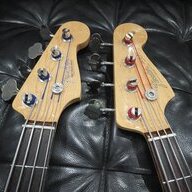
Yep!I would rather play Chromes or another brighter sounding flatwound than a semi-flat.

TalkBass has been independent since 1998. Add your voice.
Create a free account to reply to discussions, view embedded media, and browse with fewer display ads.
Join free Log in
Want zero display ads or expanded classifieds tools? Compare plans.
Yep!I would rather play Chromes or another brighter sounding flatwound than a semi-flat.


I use the light set of the Brite Flats (45-56-77-98) and don't find them "INCREDIBLY stiff and tense" or "brutal to play". Their stiffness allows a nice low action, and with the right setup they're quite comfortable to play on and very nicely balanced across all four strings both in tone and feel.GHS brite flats WOULD be awesome if they weren't so INCREDIBLY stiff and tense. The tone is good but they are absolutely brutal to play.

Life is crazy.Have to take your word for it. It's been 30 years ... Candi
Agreed on all three points!1) “they’re sticky, grabby!”
Rub them with isopropyl alcohol and problem solved.
2) “they feel rough! I hate the feel of them!”
No. They feel very much like flatwounds.
3) “they sound awful!”
If you want deep fundamental, a rich tone with useable top end… half rounds will give you that.



I have D'Addario half rounds on one of my Jazz basses and absolutely love them on that bass. I have D'Addario tapewounds on a PJ, love those strings on that bass. Have D'Addario rounds on two other Jazz basses and a Precision, love those strings on those basses, and D'Addario Chromes (flats) on my acoustic and love those strings on that bass.They've been around forever but seems they never really caught on, on paper they look like best of both worlds. Gonna try them for the first time on my jazz bass and see what they’re like. I use TI flats on my P and thought I’d try these for my jazz bass. Anybody here use them? thanks
Now that I have the Brite Flats on my SR650E, I intend to put the EB Group IV back on my P bass. Semi-flats on a reverse PJ and (real) flats on my P... It will be an interesting comparison.I just ran out of patience, and wanted to try the EB Group IV flats anyway. The Brite Flats would have probably played in fine, had I given the usual 8 months trial period.

i tried them a few times --- each time i thought they had to be the "best of both worlds." i really tried to love them. i ended up thinking of them the same as @KenD = "worst of both worlds!"on paper they look like best of both worlds

i used them for a bit, years ago. they didn't work for me. at the time, i wanted something less abrasive (i was generally playing harder and i wanted some relief, some help). i didn't like the feel or the sound. i thought the d'addarios sucked. YMMVAnybody here use them?


GHS Pressurewounds are great -- they retain the full mass of the string, instead of half of it being ground off. More mass = stronger signalI never bonded with bass half-rounds (which is technically a D'Addario product name). They are kind of sticky/coarse feeling, just in a different way than rounds. Tone wise they sound far more like rounds and I would actually struggle to assign much of any flatwound tone factor to them, other than reduced string noise. I did however find the Half-round 6 string electric guitar strings to have some likable qualities. I like them more than roundwound guitar strings but I don't love them as much as I love flatwounds, so they didn't quite win me over in that arena either.
If you're looking for a best-of-both worlds option, I would recommend GHS Pressurewounds (which aren't ground down rounds, but rather rounds with the outer winding pressurized to an oval sort of shape if you looked at a cross-section) which have a nice nickel-round-esque top end, but legitimately pack that big low-mid punch that I love in flatwounds OR Ernie Ball Cobalt flatwounds, which are true flatwounds but almost the same amount of bright top end sparkle as rounds.

I use both the Pressurewound and the Brite Flats, both of which are Alloy 52 (nickel-iron). They do have very different tonal characters, but in terms of overall output, they're equally strong.GHS Pressurewounds are great -- they retain the full mass of the string, instead of half of it being ground off. More mass = stronger signal