I'd like to share a tool that I have found valuable in evaluating finishes, but haven’t seen discussed here.
One way to rank the hardness of materials is to show what scratches what. If a material scratches another material, then it is harder. Check out the Wikipedia page on Mohs hardness testing if you want some general history on scratch testing with minerals: Moh's Hardness Scale
Pencil scratch testing (AKA Wolff-Wilborn, or pencil hardness) is an old-school tool for “quantifying” the hardness of coatings. It’s cheap, it’s been around forever, and there’s even an ASTM technical standard for it (D3363).
It turns out that artists pencils are perfect for scratch testing coatings. Pencils are made of a blend of soft clay and hard graphite. Soft pencils have more clay, hard pencils have more graphite. Artists pencils are graded from softest to hardest: 9B, 8B, 7B… B, HB, F, H, 2H, 3H…9H. Not sure why they slip in the HB and F, but that's tradition... In the American system for writing-pencils the good ol' #2 is the same as HB.
It goes like this:
Start with a set of artists pencils, Sharpen the pencils and grind the sharp tips flat with a couple of strokes against fine sandpaper. Then, one at a time, test each pencil against the coating by pushing the flattened tip into the coating at a 45 degree angle using gentle/firm pressure. Hold the pencil just like you are writing, but use a pushing motion and a little more pressure. Try to use consistent angle/motion/pressure as you proceed. I start with soft pencils and move up in hardness one grade at a time until one of them scratches the coating. It’s pretty obvious when this happens; you can see it, and with practice you will start to feel it cutting the surface. The pencil hardness of a coating is the hardest pencil grade that cannot scratch the coating. Think of it as the hardest grade the coating can resist.
Elcometer sells equipment to do pencil testing exactly following the ASTM standard, and they have a nice video showing the technique here: Elcometer. But you do not need their $560 kit to do the work. A $20 artists set works just fine.
I use this technique to test new coating options because I’m always looking for a very hard coating for maximum protection. But it’s also really useful to understand how my coating is drying and when it’s OK to buff it out. I like to coat a piece of scrap wood when I spray the finish and use that to test the hardness every now and then while it’s drying. I’ll start sanding/buffing when the coating reaches its maximum hardness.
There are a few things to look out for.
1. Different brands of pencils may give you slightly different results, so be careful if you compare results with other people. I have a Derwent set (9B-9H), only because it’s the brand my local art store carries. I would stay away from no-name brands, store brands etc, stick with the European companies that have been making artists pencils for centuries (Faber-Castell, Derwent, Staedtler). They have it really dialed in.
2, The pencil grades are at distinct intervals, while real hardness is “continuous”. So, for example, there is no 2.345H it’s either 2H or 3H. It’s just a limitation of the test. The pencil grades are spaced in very useful intervals for coating testing, but sometimes it can be hard to tell if the measurement is one grade or the next because the actual hardness is right on the line (wait a day and try again).
3. When I test a new coating, I always fill the grains first to make a flat surface. I use epoxy, which happens to be pretty hard, so it's a nice base layer. If you don't fill the grains, then the pencil tip will get caught in the depressions, and make it hard to interpret the results - it will feel like its cutting, but it's just getting stuck... I also will spray at least 5 coats. The test surface needs to be thick enough so that you are not really testing the epoxy!
4. Finally, the differences between grades are probably not linear. In practice this is not really an issue, but it’s good to keep in mind that F to H might be a bigger change than 8H to 9H…
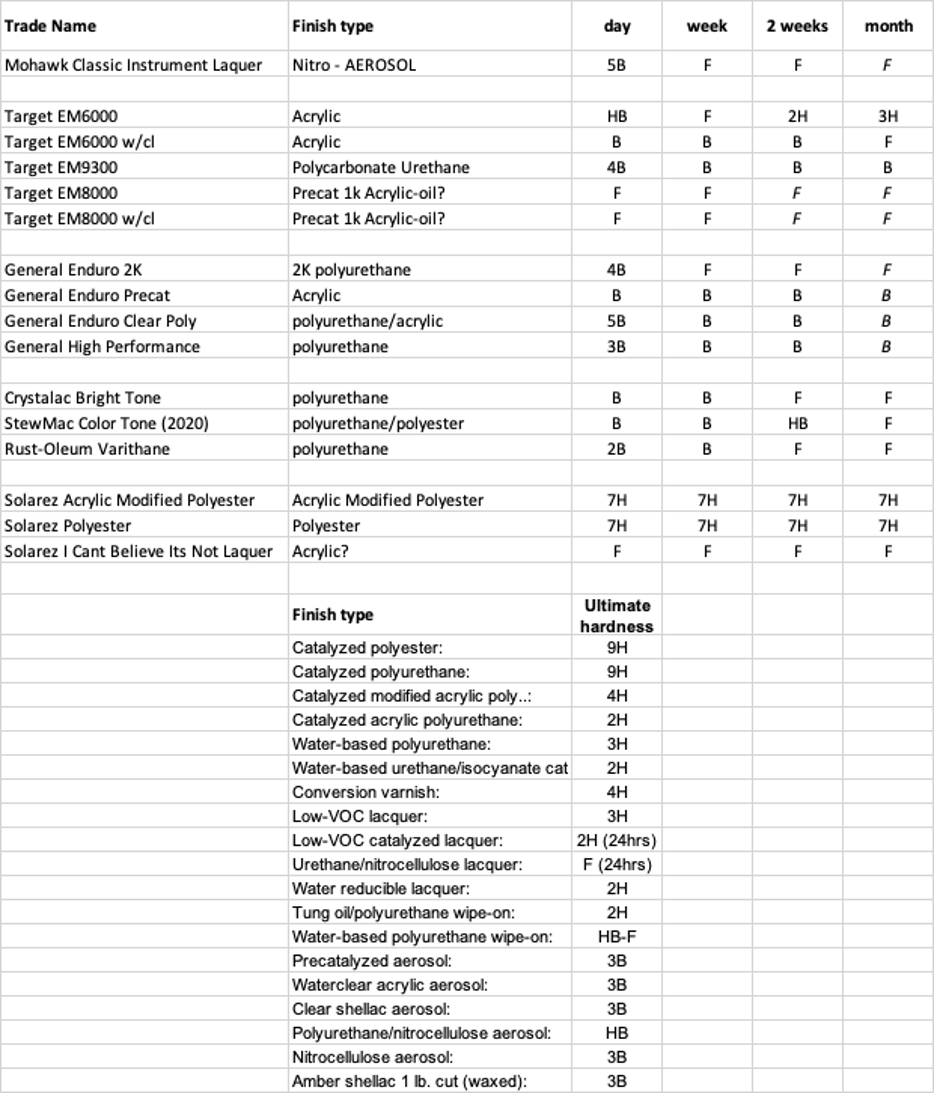
Look at the tables for some pencil scratch testing results.
The first table is my data, the second table is data that I have seen referred to in several discussions on-line. It looks pretty believable, but I do not know its ultimate source. If it's yours, then please claim credit!
When you look at my data, please keep in mind that I measured these coatings after spraying them with my equipment, at the temp and humidity that my basement happened to be at the time. The batch I bought might have been fresh from the factory or it might have been sitting in a warehouse for years. I mixed them following the manufacturer's directions as well as I could. All that to say - there is no guarantee that you would get exactly the same results in your basement, etc...
For what it's worth I have used Target EM6000 (without cross linker) for the 25 or so guitars and basses I have finished. I like it because it's the hardest water bourn finish I have found, and it's easy to spray & buff out. BUT I don't like a few things about it (adhesion, and chemical resistance) so I have been looking for an alternative.
Fun fact:
I can easily scratch a B hardness coating with my thumbnail.
I can scratch an F hardness coating if I really work at it.
I cannot scratch a 3H surface with my thumb nail.
Sorry this got so long... Hope its readable.
One way to rank the hardness of materials is to show what scratches what. If a material scratches another material, then it is harder. Check out the Wikipedia page on Mohs hardness testing if you want some general history on scratch testing with minerals: Moh's Hardness Scale
Pencil scratch testing (AKA Wolff-Wilborn, or pencil hardness) is an old-school tool for “quantifying” the hardness of coatings. It’s cheap, it’s been around forever, and there’s even an ASTM technical standard for it (D3363).
It turns out that artists pencils are perfect for scratch testing coatings. Pencils are made of a blend of soft clay and hard graphite. Soft pencils have more clay, hard pencils have more graphite. Artists pencils are graded from softest to hardest: 9B, 8B, 7B… B, HB, F, H, 2H, 3H…9H. Not sure why they slip in the HB and F, but that's tradition... In the American system for writing-pencils the good ol' #2 is the same as HB.
It goes like this:
Start with a set of artists pencils, Sharpen the pencils and grind the sharp tips flat with a couple of strokes against fine sandpaper. Then, one at a time, test each pencil against the coating by pushing the flattened tip into the coating at a 45 degree angle using gentle/firm pressure. Hold the pencil just like you are writing, but use a pushing motion and a little more pressure. Try to use consistent angle/motion/pressure as you proceed. I start with soft pencils and move up in hardness one grade at a time until one of them scratches the coating. It’s pretty obvious when this happens; you can see it, and with practice you will start to feel it cutting the surface. The pencil hardness of a coating is the hardest pencil grade that cannot scratch the coating. Think of it as the hardest grade the coating can resist.
Elcometer sells equipment to do pencil testing exactly following the ASTM standard, and they have a nice video showing the technique here: Elcometer. But you do not need their $560 kit to do the work. A $20 artists set works just fine.
I use this technique to test new coating options because I’m always looking for a very hard coating for maximum protection. But it’s also really useful to understand how my coating is drying and when it’s OK to buff it out. I like to coat a piece of scrap wood when I spray the finish and use that to test the hardness every now and then while it’s drying. I’ll start sanding/buffing when the coating reaches its maximum hardness.
There are a few things to look out for.
1. Different brands of pencils may give you slightly different results, so be careful if you compare results with other people. I have a Derwent set (9B-9H), only because it’s the brand my local art store carries. I would stay away from no-name brands, store brands etc, stick with the European companies that have been making artists pencils for centuries (Faber-Castell, Derwent, Staedtler). They have it really dialed in.
2, The pencil grades are at distinct intervals, while real hardness is “continuous”. So, for example, there is no 2.345H it’s either 2H or 3H. It’s just a limitation of the test. The pencil grades are spaced in very useful intervals for coating testing, but sometimes it can be hard to tell if the measurement is one grade or the next because the actual hardness is right on the line (wait a day and try again).
3. When I test a new coating, I always fill the grains first to make a flat surface. I use epoxy, which happens to be pretty hard, so it's a nice base layer. If you don't fill the grains, then the pencil tip will get caught in the depressions, and make it hard to interpret the results - it will feel like its cutting, but it's just getting stuck... I also will spray at least 5 coats. The test surface needs to be thick enough so that you are not really testing the epoxy!
4. Finally, the differences between grades are probably not linear. In practice this is not really an issue, but it’s good to keep in mind that F to H might be a bigger change than 8H to 9H…
Look at the tables for some pencil scratch testing results.
The first table is my data, the second table is data that I have seen referred to in several discussions on-line. It looks pretty believable, but I do not know its ultimate source. If it's yours, then please claim credit!
When you look at my data, please keep in mind that I measured these coatings after spraying them with my equipment, at the temp and humidity that my basement happened to be at the time. The batch I bought might have been fresh from the factory or it might have been sitting in a warehouse for years. I mixed them following the manufacturer's directions as well as I could. All that to say - there is no guarantee that you would get exactly the same results in your basement, etc...
For what it's worth I have used Target EM6000 (without cross linker) for the 25 or so guitars and basses I have finished. I like it because it's the hardest water bourn finish I have found, and it's easy to spray & buff out. BUT I don't like a few things about it (adhesion, and chemical resistance) so I have been looking for an alternative.
Fun fact:
I can easily scratch a B hardness coating with my thumbnail.
I can scratch an F hardness coating if I really work at it.
I cannot scratch a 3H surface with my thumb nail.
Sorry this got so long... Hope its readable.