• TalkBass has been independent since 1998. Add your voice.
    Create a free account to reply to discussions, view embedded media, and browse with fewer display ads.
    Join freeLog in
    Want zero display ads or expanded classifieds tools? Compare plans.

Harmonics when muting

I use alternate 1st and 2nd fingers when playing. If I (say) play a note with my 1st finger but want to then mute it before playing the next note on the same string, I bring my 2nd finger to rest on that string prior to using that finger to play the next note. (I've seen this technique suggested on a YouTube video). Occasionally when I do this I get a harmonic ring out when I rest the finger on the string to mute it. Am I doing it wrong? Any thoughts anyone?
 
If you try to mute the string at harmonic nodes (i.e., at fractions 1/2, 1/3, 2/3, 1/4, 3/4, etc. of the virbrating length), then you mute other frequencies but not the harmonic, so you end up with the harmonic sounding. That may also happen with left hand muting. If you mute with the whole hand (instead on only one finger), then you usually mute all vibrations.
 
...
Occasionally when I do this I get a harmonic ring out when I rest the finger on the string to mute it. Am I doing it wrong? Any thoughts anyone?
...

Good muting is usually acheived through combinations of technical elements according to the specific demands of the problem. For this particular problem you need to make sure that you are not attempting to mute over a node on a ringing string. The easiest way of doing this is to mute with at least two contact points on the string. Floating thumb won't help as you are not crossing strings. Try lifting your left hand finger at the same time, but keep at least two touchpoints on the string. So lift just enough to allow the string to move off the fret or fingerboard whilst staying in contact with the string. You could use two or more left-hand fingers, or add in, say, ring finger from your right hand.

It will be tempting to stick with what you are doing and use just the right hand finger you are about to play with in combination with the added left-hand muting. But there is one other thing to consider. If you are muting over a node, and then go on to play that same note on the same string at the same place with the muting finger, then you are also plucking at a node. This tends to change the timbre of the note. To maintain more consistency in your tone, your right hand should, ideally, track the movement of your left hand moving up and down the neck. In doing so, if you start off not over a node, then no matter what notes you are playing you should never find your right-hand playing over a node.
 
  • Like
Reactions: RichBass55
Thanks everyone for all the helpful suggestions. I do release pressure on the fretting finger at the same time (is that what you are referring to a left hand muting?) - perhaps I'm just not doing it very well. The idea of using 2 right hand fingers to mute the note sounds worth a try. Getting the left hand to track the movement of the right hand is also something I will try as well as muting all strings with the palm of my hand.
 
  • Like
Reactions: SteveCS
A further thought that occured to me is that I tend to use the edge of the fingerboard at the bottom of the neck as my 'go to' thumb rest position, whereas many people on videos I've watched recommend resting the thumb on the edge of a pickup. I was wondering if my way is a really bad idea as I'm possibly more likely to hit nodes with my hand in that position compared to nearer the bridge. What do you guys think?
 
Rest stroke a bit harder to stop the harmonic.
Also use left hand muting.
Was it you?... I think it was you... that presented the "rest stroke" several months (a few years?) back. Maybe before covid. If it was, I just want to say thank you. I've incorporated it into my right hand technique. And while I don't use it all the time I am now using it more and more. It just has this sound and feel. It is particularly nice on with my BTB675. And while a longer wider bass it just help make things so much easier.

One of the things I noticed about using the rest stroke is that the angle of attack somehow creates something like its own anchor as the vector of the plucking finger isn't pulling up, but sort of pushing down and in. So the bass itself more or less becomes the resistance (anchor) [ @10emmanuel manuel, you might want to take note.] It's a little harder to use with narrower spacing, but I think it just takes a few minutes and some (mental?) adjustment after I get used to working with a wider spacing.

So if you were the culprit that brought this to my attention, thank you. You did a good job. If not, I owe whomever presented it.
 
Was it you?... I think it was you... that presented the "rest stroke" several months (a few years?) back. Maybe before covid. If it was, I just want to say thank you. I've incorporated it into my right hand technique. And while I don't use it all the time I am now using it more and more. It just has this sound and feel. It is particularly nice on with my BTB675. And while a longer wider bass it just help make things so much easier.

One of the things I noticed about using the rest stroke is that the angle of attack somehow creates something like its own anchor as the vector of the plucking finger isn't pulling up, but sort of pushing down and in. So the bass itself more or less becomes the resistance (anchor) [ @10emmanuel manuel, you might want to take note.] It's a little harder to use with narrower spacing, but I think it just takes a few minutes and some (mental?) adjustment after I get used to working with a wider spacing.

So if you were the culprit that brought this to my attention, thank you. You did a good job. If not, I owe whomever presented it.
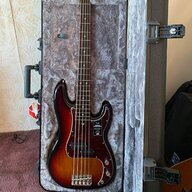
where do you rest it exactly?