
IMHO...Fender has been trying to play catch up for decades now..."doing it the way Fender Should have" all along!
I personally like the ability to chose through the body or top loading....

TalkBass has been independent since 1998. Add your voice.
Create a free account to reply to discussions, view embedded media, and browse with fewer display ads.
Join free Log in
Want zero display ads or expanded classifieds tools? Compare plans.
IMHO...Fender has been trying to play catch up for decades now..."doing it the way Fender Should have" all along!
I personally like the ability to chose through the body or top loading....
I don't see that at all. In addition, my Jazz Special has its P pickup in the same place as my Highway 1 Precision: 10.5 inches from the 12th fret.

I believe it is 10.5" from the 12th fret to the front edge of the E/A side of the pickup.10.5 inches to what? The E/A poles, the edge of the E/A pup half, the split point between the halves, where precisely?
Expiring minds want to know...
Thanks! This helps a lot! I'm working on making a PJ out of an SX 32" Jazz, and now I can figure out where to put the P pup.I believe it is 10.5" from the 12th fret to the front edge of the E/A side of the pickup.
And thank you. I've been curious about how far misplaced the P pickup is on the Fender Urge. You've inspired me to measure, do the math, and find out!Thanks! This helps a lot! I'm working on making a PJ out of an SX 32" Jazz, and now I can figure out where to put the P pup.
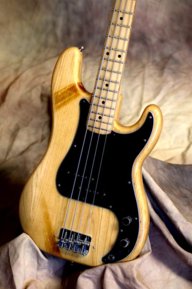
IME, the closer to the neck the pickup is, the less "punch" it will have. Pups closer to the neck tend to exhibit a "blooming" attack, while pickups toward the middle or bridge have a more immediate attack response and faster decay. Pickup type will obviously determine the ultimate result, but as far as P's and J's go, I thought this was widely accepted as a predictable result.
I have always thought of "punch" as an immediate attack with a faster decay, but that's just my definition.
If I did the math right, on a 32" scale P bass, the front edge of the pickup should be 9.88" from the 12th fret. The P pickup on the Urge is sitting at 11.125." In 34" scale terms, the Urge P pickup is shifted about 1.3 inches too far back towards the bridge. I knew the P pickup was more punchy and full of midrange than a normal P bass. I bet this is a big part of the reason why.Thanks! This helps a lot! I'm working on making a PJ out of an SX 32" Jazz, and now I can figure out where to put the P pup.

IMHO...Fender has been trying to play catch up for decades now...
Has anyone ever explained how this delivers more "punch?" And I'm not talking about some basement warrior deliberating over an oscilloscope readout, I'm talking about in the mix.
The bass end is actually in the exact same spot as a standard P. The treble is moved up, and it's not for more punch. It's for a more balanced tone across all strings.
The Jazz Bass Special has the P pickup located in the usual spot, it's just the lack of a pickguard that may throw off your perception about the location as it just floats out there in the middle of the body, with no pickguard reference points.I think the Power Jazz Bass Special is much different than the Jazz Bass Special. But again, I'm probably wrong about the pickup placement on the JBS.

...The MH comes with an SPB-3...that's a really hot pick-up. That's where your punch is coming from. Also, you get more punch by playing closer to the bridge, not the neck, so moving the pickup closer to the neck won't give more punch. Also, the MH is a SIGNATURE model with his spacing requirements...compare a P to a flipped P, not a P to a signature jazz with a P p-up.Closer to neck = more bass, assuming more bass is your definition of punch.
I have a 2014 Mark Hoppus Jazz bass and I can attest that it delivers more punch than a standard pbass. I just put a Bill Lawrence p46 in and d@mn!, too much actually, the d/g coil seems to be overpowering the e/a, but also note that that pickup is already very well balanced in standard configuration, so I may buy the old hoppus guard with standard coil arrangement. As for position, on the later models with reversed coils the e/a coil is 3/4" further towards the neck than my am std pbass.
...The MH comes with an SPB-3...that's a really hot pick-up. That's where your punch is coming from. Also, you get more punch by playing closer to the bridge, not the neck, so moving the pickup closer to the neck won't give more punch. Also, the MH is a SIGNATURE model with his spacing requirements...compare a P to a flipped P, not a P to a signature jazz with a P p-up.
I think the term precision comes from adding frets to an electric bass, [as in the original p bass.Fender has experimented with the P bass so much that quite literally, the ONLY thing that actually defines a P bass as a P bass is the fact that it says P bass on the headstock!
Over the years Fender has put a...
solitary single coil in the bass and called it a precision.
a split P and called it a precision.
a split P and a jazz single coil and called it a precision.
a dual set of humbuckers and called it a precision.
a passive tone control and called it a precision.
an active preamp and called it a precision.
The only thing precise about a precision unfortunately is the wording on the headstock.
typically i measure to the center of the pup or pup array [with a split p]. PawleePI believe it is 10.5" from the 12th fret to the front edge of the E/A side of the pickup.

pawleeP loves zombies!Zombie thread!
Can you imagine the TalkBass meltdown if Fender changed the Precision pickup position? Even if Fender simply released a poorly rendered image of the pickup moving a couple millimeters? There'd be a panic buy-up of the old stock, people would wonder if hawaiian shirts were next on the chopping block, mass bass player panic would ensue... Only for Fender to release a statement that it was a mistake, which many would say is them backpedaling, and we'd never know the truth.
I guess I can imagine it!
...please don't take this seriously. I love my P bass brothers and sisters, although I'm more of a Jazz guy.