• TalkBass has been independent since 1998. Add your voice.
    Create a free account to reply to discussions, view embedded media, and browse with fewer display ads.
    Join freeLog in
    Want zero display ads or expanded classifieds tools? Compare plans.

Double Bass Having fun with Monks Well, You Needn't

Tom Lane

Gold Supporting Member
Apr 28, 2011
3,594
5,175
Southwest Los Angeles, CA, USA
I've been working on this tune the past few weeks. It was called when I was at the Aebersold camp in my combo. I'm familiar with it; it's been called a half dozen times in different bands and I always just kind of get through it, playing the obvious basslines, either scale phrases or arpeggios reversing direction each measure. No one has ever complained, but I think I should do better. My lines were good enough so that my combo almost picked this tune for the recital, only one vote, despite my pleading that I didn't really have a "good" bass line for the tune.

If you're not familiar with the tune, it was written and recorded by Monk and another famous recording is from Miles. The two recordings have a pretty different feel:


It looks like they both recorded the tune a few times. Miles' bridge starts on II7 instead of bVI7 but otherwise the bridges are the same. The other notable difference is that Monk uses a Major 6th chord for the tonic and Miles tends to use a Dominant 7th. Here's a chart:
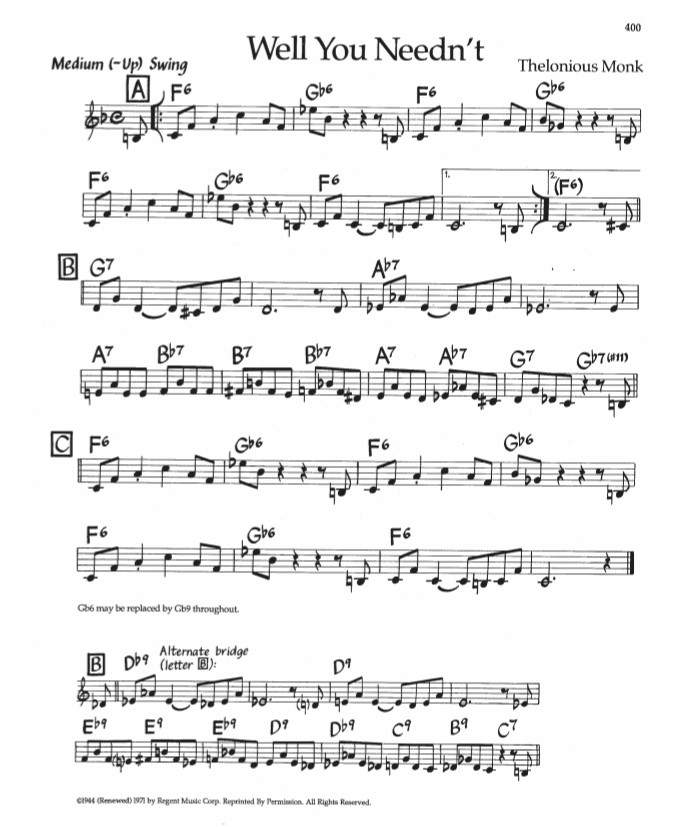
Well You Neednt.jpg


I notice that the two different bridges don't phase me one way or the other, other than the starting chord but which version the harmony player is playing compels me to follow suit and either play the minor 7 and avoid the major 7 or avoid the minor 7th and play the major 6th and 7th. Funny how one note can make such a significant difference.

Listening to different recordings, there's lots of bass lines like my simple one, but also longer single octave runs up and down making the changes every measure. Multiple octave runs too, and that's where it gets fun for me, because I can play purely scale-based lines, or mix in some arpeggios and those arpeggios can start on any chord tone and still honor the change.

I was wondering why the tune is a bit of a challenge and realized that it's because there aren't a lot of tunes that alternate key centers every measure - for the most part. So, a cool little tune. Typically elegant of Monk's compositions, and a lot of fun to walk and solo on.

Enjoy!
 
I love this tune (as all of Monk’s music) but I honestly despise the Miles Davis bridge. It seriously reminds me of that Hans Groiner/Larry Goldings video where he makes Well You Needn’t sound pretty proper. In the context of the tune it sounds so out of place to me compared to the bridge Monk intended. And apparently Monk didn’t like how a lot of people interpreted the bridge. Just my thoughts on it though. Still love this tune to death.
 
I love this tune (as all of Monk’s music) but I honestly despise the Miles Davis bridge. It seriously reminds me of that Hans Groiner/Larry Goldings video where he makes Well You Needn’t sound pretty proper. In the context of the tune it sounds so out of place to me compared to the bridge Monk intended. And apparently Monk didn’t like how a lot of people interpreted the bridge. Just my thoughts on it though. Still love this tune to death.
Interesting... why do you hear the Miles bridge so significantly? I just hear it starting on a different chord and go from there. What are you hearing that I'm not?
 
Interesting... why do you hear the Miles bridge so significantly? I just hear it starting on a different chord and go from there. What are you hearing that I'm not?
I guess what makes me prefer the Monk bridge over the Davis one is that the Davis bridge sounds a bit too stable. What I like about the Monk bridge is that it sounds off kilter and makes you really want to hear that A section, so for me the resolution to the last A is super pleasing. This is all my preference though in the end and everyone should play this tune how they please!
 
Please note that the leadsheet posted above has the melody as interpreted by Miles Davis, not the Melody that Monk plays. The book of Monk tunes transcribed by Steve Cardenas has a much more accurate version (for this tune and pretty much every other Monk tune). Another thing to note is that Monk almost always plays a chromatic line beginning on C for the A sections. Maybe this level of detail is too much to expect from a real book but the fact that the composer plays it suggests the it is a part of the composition. Anyway, great tune! Here is version by someone who really knows this music (Steve Potts is playing the chromatic line):
 
Ah, the importance of punctuation.
Not being heavily into jazz (sorry 'bout that) I've heard of Monk, but didn't recognise the name of the tune. So my poor confuzzled head read "Having fun with Monks? Well, you needn't" rather than 'Having fun with Monks' "Well, you needn't"' and wondered why you'd want to not have fun with Thelonious' work.

Having gotten that out, I'll just listen to those recordings and find out what the fuss is about...
 
Listening to different recordings, there's lots of bass lines like my simple one, but also longer single octave runs up and down making the changes every measure. Multiple octave runs too, and that's where it gets fun for me, because I can play purely scale-based lines, or mix in some arpeggios and those arpeggios can start on any chord tone and still honor the change.

I was wondering why the tune is a bit of a challenge and realized that it's because there aren't a lot of tunes that alternate key centers every measure - for the most part. So, a cool little tune. Typically elegant of Monk's compositions, and a lot of fun to walk and solo on.

And then there’s Epistrophy, which alternates every two beats. On lots of recordings the bass line stays simple, roots, 5ths, octaves. That one always feels more challenging in the moment to play more melodic bass lines, to me at least. The tune seems to want that sort of drone-like bassline quality?
 
  • Like
Reactions: Tom Lane
Weird. Walking home from work last night, I suddenly started humming Well, you needn't, and remembered I hadn't listened to it for a long time. Decided to work on it today, and then I saw this thread. Some kind of bassist mind reading. (And, as we all know, a good bass player is able to read others minds, to make sure we help them out when they mess up).
 
Ah, the importance of punctuation.
Not being heavily into jazz (sorry 'bout that) I've heard of Monk, but didn't recognise the name of the tune. So my poor confuzzled head read "Having fun with Monks? Well, you needn't" rather than 'Having fun with Monks' "Well, you needn't"' and wondered why you'd want to not have fun with Thelonious' work.

Having gotten that out, I'll just listen to those recordings and find out what the fuss is about...
Same. I think the correct punctuation would be "Having fun with Monk's 'Well, You Needn't'."
 
Love the tune. Very familiar with Monk's version, less so with Miles'.
Used to play with a sax. player who was in Mingus' band briefly, and he brought this tune to the table when i was in my mid 20's.
I never really learned it properly either, always improvised it . Maybe ill revisit it now...
 
  • Like
Reactions: Tom Lane
When it comes to walking without constant "root jumping", I think of the A section changes in a couple of ways:

1) as an aggregate "F" sound that changes from basically F Dominant to F Phrygian (where F, Bb, C, and Eb stay as common tones and the other three notes toggle from naturals to flats).

2) as an aggregate F sound that changes from F Major to Gb7#4/F (where the Bb, C, and E remain constant and the others toggle)

3) as an aggregate F sound that goes from F7 to Gb7#4/F (where the Bb, C, and Eb remain as common tones)

4) Fma-->Gbma#4/F (F, Bb, C common)

5) F7-->F minor blues

The choice between them depends largely on what the chordal instrument does WRT the 7ths of the chord, and is usually not a conscious concept in the moment, but rather an aural avoidance of unwanted clash with the voicing. But in the big picture, the harmony shifts from light to dark over and over. So a walking line can touch on the light notes during the F chords and the dark notes during the Gb/Ebmi chords without having to land on every root, which opens the door to more melodic possibilities.
 
When it comes to walking without constant "root jumping", I think of the A section changes in a couple of ways:

1) as an aggregate "F" sound that changes from basically F Dominant to F Phrygian (where F, Bb, C, and Eb stay as common tones and the other three notes toggle from naturals to flats).

2) as an aggregate F sound that changes from F Major to Gb7#4/F (where the Bb, C, and E remain constant and the others toggle)

3) as an aggregate F sound that goes from F7 to Gb7#4/F (where the Bb, C, and Eb remain as common tones)

4) Fma-->Gbma#4/F (F, Bb, C common)

5) F7-->F minor blues

The choice between them depends largely on what the chordal instrument does WRT the 7ths of the chord, and is usually not a conscious concept in the moment, but rather an aural avoidance of unwanted clash with the voicing. But in the big picture, the harmony shifts from light to dark over and over. So a walking line can touch on the light notes during the F chords and the dark notes during the Gb/Ebmi chords without having to land on every root, which opens the door to more melodic possibilities.

Thanks Chris. I completely agree that using the Major or Dominant 7th completely depends on the voicing the harmony player uses. For the Miles version I tend to use the Mixo scales throughout and actually think about those sounds every 4 beats. It makes for an interesting scaler bass line doing something like starting on F on the G string and playing F Eb D C | Cb Bb Ab Gb | F Eb D C | Cb Bb Ab Gb | F G A Bb | Cb Db Eb E | F G A Bb | C D Eb E | and mixing in some arps can be interesting too.

Another observation is that I found that I had to discipline myself to keep with the same type of bass line, really, the same bass line on all of the A sections within a chorus because I was tending to come out of the bridge and start a new concept and I don't like that because it obscures the form.

Last, for the real challenge, soloing with more than two-bar phrases is difficult for me on this tune, but I like the solos of the players who play longer ideas so I'm practicing that.

I've really come to appreciate and enjoy the tune and I'm going through a similar experience with Softly, as in a Morning Sunrise now. That tune really has a lot of legs. The simplicity of its A section works well for it, IMO. I really enjoy that feeling of coming to know and appreciate a well composed tune.
 
It makes for an interesting scaler bass line doing something like starting on F on the G string and playing F Eb D C | Cb Bb Ab Gb | F Eb D C | Cb Bb Ab Gb | F G A Bb | Cb Db Eb E | F G A Bb | C D Eb E | and mixing in some arps can be interesting too.

funny, I do a similar thing, but start on the 5th of the first chord and going scale-wise downwards end on 1st of the second chord. if you start on a C in thumb position: C Bb A G | Gb F Eb Db | etc., you can easily cover 6 bars of the A part and arrive just in time to do some chordal variance on last two bars... carry on, as you were.
 

Latest posts