• TalkBass has been independent since 1998. Add your voice.
    Create a free account to reply to discussions, view embedded media, and browse with fewer display ads.
    Join freeLog in
    Want zero display ads or expanded classifieds tools? Compare plans.

Headphones vs IEMs: muddy bandshell

Once a year I play a large outdoor gig in a tall cement bandshell. This year the subs were on the stage, and the stage sound was extremely muddy and loud ... drums, bass amp, subs, FOH, and reflections from the shell.


I use custom earplugs, and they work well for most bar/club gigs. But in this situation I had a hard time hearing the beat as a precise event. The kick and bass felt smeared across time, presumably from low-end buildup, reflections, and different arrival times from the subs, cab, monitors, and acoustic drums. The “one” felt like a wide zone instead of a clear point. Any small timing variance became hard to correct, and for much of the gig I felt like I was working just to stay locked.


I’ve tried IEMs before and found them fatiguing, even for passive listening. I’m wondering whether closed-back isolation headphones are a better solution for this kind of large-stage / low-end-smear situation.


Questions:


  1. Have any bass players here used closed-back isolation headphones instead of IEMs for loud outdoor stages?
  2. Did they help with time clarity, or did they create a different problem?
  3. Which models are actually suitable for live stage use?
  4. Would I be better off with a direct/preamp signal into a small personal headphone mixer, rather than relying on amp/cab/monitor wash?

I do need a full-band reference, not just “more bass” or only kick/snare/hat. The issue is that the stage sound was too smeared to be useful. I’m trying to get a clear, controlled monitor reference where I can hear the band and still feel the time as a precise thing instead of a low-end blur.
 
  • Like
Reactions: Wyvern and dbsfgyd1
What kind of genre are we talking here? Smooth jazz gig would probably be fine, but Twisted Sister tribute band might make those headphones feel a bit "constraining" lol. Closed-back headphones can do a decent job with sound isolation, but IEMs are still going to perform best at drowning out stage noise and room mix. The other question is "How's it getting there?", but that'll come up in answering your questions...

1) Not a stage per-say, but in rehearsals a few times. Even with great sealing material, you'll be struggling with isolation during movement and also comfort while playing. Most materials that will cut the sound and hold a good seal might be really fatiguing to wear, causing you to sweat and straining skull and adjacent muscles around your ears. Beyerdynamic's headphones are great, but they're a little heavy for performance use and the comfier velour material doesn't block out the sound as effectively on a live band mix.

2) IME, nearly any headphone or IEM solution is going to give you improved clarity. With a decent board mix, you've got much less distance between yourself and the output using them. If the seal or isolation isn't really good though, you could get bleedover from the stage volume and that can be REALLY disorienting and distracting. You'd need a good seal or things could end up worse.

3) Given the information in 1 and 2, I'd say it doesn't really matter in the end product. I'd say the higher-end Beyerdynamics for my personal choice, but plenty of other brands make great headphones too.

4) The struggle for most bassists is how we're mixed at the board, how much stage volume we can get away with, and hearing ourselves while also hearing the others in the mix properly. I don't think switching to headphones is going to solve the problem for you. Going DI to the board can be great for cleaning up stage volume, but then you're at the mercy of the Sound Engineer and what's being sent back to stage monitors for you. The safety blanket for many bassists is the amp rig that can hold its own on stage. You send a pre-EQ DI out to the board and use your own cab to hear yourself.


IMO, the best solution is to search for some quality IEMs (perhaps that do custom molds?) and keep the volume JUST high enough to drown out the ambient sound, but not fatigue your ears too much. YMMV, but that's what I think your best shot is.
 
  • Like
Reactions: Motown971
I've yet to find a pair of isolation headphones that will outperform my IEMs (64 Audio N8) in terms of isolating what's in my ears from external sounds. The best I've found are Vic Firth SIH models, and if you found IEMs fatiguing then these Vic Firth models would be even more so. Despite the added fatigue and weight, my IEMs easily surpass even the best headphones I've used for isolation.

What type of IEMs have you tried?
 
  • Like
Reactions: Bonecat
I've yet to find a pair of isolation headphones that will outperform my IEMs (64 Audio N8) in terms of isolating what's in my ears from external sounds. The best I've found are Vic Firth SIH models, and if you found IEMs fatiguing then these Vic Firth models would be even more so. Despite the added fatigue and weight, my IEMs easily surpass even the best headphones I've used for isolation.

What type of IEMs have you tried?
The iems I used were made by perfect seal. They were custom molds. It almost felt like they went too deep
 
The iems I used were made by perfect seal. They were custom molds. It almost felt like they went too deep
That's not a brand I've heard of, but their products look nice on the website. Getting accurate custom molds by a qualified audiologist is crucial to a good user experience with custom IEMs. Still, if you didn't enjoy the IEM experience while using customs I'm not certain you'll love them even with a better fit. A local player and friend of mine went the custom IEMs route and then later went back to universal fits. For him the softer universals were a better match. You might give that a shot as another data point.
 
That's not a brand I've heard of, but their products look nice on the website. Getting accurate custom molds by a qualified audiologist is crucial to a good user experience with custom IEMs. Still, if you didn't enjoy the IEM experience while using customs I'm not certain you'll love them even with a better fit. A local player and friend of mine went the custom IEMs route and then later went back to universal fits. For him the softer universals were a better match. You might give that a shot as another data point.
Thanks. I may do that.
 
IEMS usually have better isolation. I do not know what it is called but it's a thing that touches your back or the fancy one that's on the floor, so you can feel the beat. EA use to also sell something you sat on for studio work,

In the Studio headphones are great, less fatigue and allows you to hear the band somewhat. I think the FOH and maybe even the monitor mix is something you can work with. Ref Rocks in Colorado is still great sounding.
 
What u used to do at difficult listening gigs is plant my foot right in front of the bass drum. Like touching it!

After a bit of that my brain would decode the acoustic smear and I’d be ok for the set’s duration
 
  • Like
Reactions: cxc
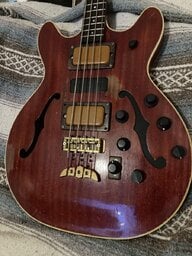
image.jpg

I’ve used these for 50 or so gigs. Cumbersome maybe. But they sure sound good.
 
  • Like
Reactions: gravesbass
Keyboard player in my band uses a pair of clothed back audio Technicas that work great for her. Looks a little silly on stage maybe.

I use a budget set of KZ drivers with aftermarket tips (comply), and upgraded flexible cable, and they do a great job for around 40 bucks all told. Good isolation, on par with decent studio headphones from Sony, beyer, etc I actually very much like their sound.
 
I play a similar genre (can you tell from my profile pic? :-)) and my experience is that the thing I don't like about using headphones is that they are terrible at sealing out lows and low mids. IEMs work much better, but they are very dependent on the seal you get. I started out with universals 25 years ago from Future Sonics and UE, moved to custom Future Sonics and then settled on Sensaphonics 2XS and also the 3DME system. They have really excellent isolation. However, I tried the Plunge Audio Stage IEM universals (not the dynamics, which have a lot more leakage) and they are really good. Not crazy expensive in the IEM world and sound very nice. My Neumann NDH20s, various Beyerdynamics, and Audio Technical sealed headphones don't hold a candle to the Sensaphonics or the Plunge Audio IEMs when it comes blocking out the big and boomy. I would still love to get some over the ear headphones that would compete, but my budget has been blown for headphones for a while (my latest mixing phones are the Slate VSX Immersion Ones, which are truly wonderful, but they are open back so absolutely no isolation).


The first thing I would do is make sure your IEMs are really sealing properly. If they have vents like the Plunge Unity Dynamics, all bets are off.
 
The point of IEM's is that you don't need amps or wedges to hear what you (and everyone else on stage) are playing - you take the amps and wedges off the stage, and with a decent amount of isolation (earbuds with a good seal will outdo headphones, but on a quiet stage, either will work fine) then you put in your ears what you want/need to hear, starting with a quiet enough background that you have freedom in how loud you want to hear things. Done that way, once your learn how to make a good in ear mix, you will be able to hear yourself and others FAR better than you even have on a loud stage - there is simply no comparison. If you're trying to do in ears or headphones with a bunch of blaring amps and wedges on stage, you've kinda missed the point of an in ear/ampless stage.
 
My first few experiences of playing larger stages were similar... A band that was locked in playing clubs, suddenly was struggling when we picked up a bigger gig.

The problem is latency... if what you're hearing is delayed by 20ms, then you notice it. Drummers and bass players may be even more sensitive (personally I can play guitar with that latency, but playing bass with 20ms kills me as I'm locking in). The problem is sound only travels 7 meters (do the maths yourself if you need that in furlongs, chains or other dumb units), which is about the distance you might be from the other sound sources on a big stage. Basically if the stage is bigger than 7meters across you've got a problem, and it gets dramatically worse as the stage gets bigger. 7m is an OK stage, but not massive.

The old fashioned fix was that everyone got their own monitor wedges, which just about works if you stay fixed to your spot (and the stage is big enoug you don't get spill from everyone else's monitors - medium stages might actually be the worst!), but if you step out of your area, then you're hearing a mix of everyones montitors, and amps, plus the live drums (and potentially FOH, though less of an issue outdoors) - you don't stand a chance. That's exactly the smearing you're hearing. It's not down to the mix, or volume. Earplugs won't fix it. The sound is literally offset in time by varying amounts, so when the drummer hits the one, you hear it at 5 different times.

IEM's or Headphones receive their signal electronically/wirelessly. The wireless (or wired) transmission is essentially instantaneous, so you hear everything at once regardless of how you move around. Once my band switched to all IEM's big stages became fun!

I've tried the Vic Firth headphones and found them to have really great attenuation, and would recommend them for a drummer. Regular IEM's just take a few tried to get used to. As others have pointed out, the real benefit of IEM/headphones isn't just the isolation, but that you don't need wedges and other sound sources messing up the sound on stage. Silent stage solves all the problems.
 
My first few experiences of playing larger stages were similar... A band that was locked in playing clubs, suddenly was struggling when we picked up a bigger gig.

The problem is latency... if what you're hearing is delayed by 20ms, then you notice it. Drummers and bass players may be even more sensitive (personally I can play guitar with that latency, but playing bass with 20ms kills me as I'm locking in). The problem is sound only travels 7 meters (do the maths yourself if you need that in furlongs, chains or other dumb units), which is about the distance you might be from the other sound sources on a big stage. Basically if the stage is bigger than 7meters across you've got a problem, and it gets dramatically worse as the stage gets bigger. 7m is an OK stage, but not massive.

The old fashioned fix was that everyone got their own monitor wedges, which just about works if you stay fixed to your spot (and the stage is big enoug you don't get spill from everyone else's monitors - medium stages might actually be the worst!), but if you step out of your area, then you're hearing a mix of everyones montitors, and amps, plus the live drums (and potentially FOH, though less of an issue outdoors) - you don't stand a chance. That's exactly the smearing you're hearing. It's not down to the mix, or volume. Earplugs won't fix it. The sound is literally offset in time by varying amounts, so when the drummer hits the one, you hear it at 5 different times.

IEM's or Headphones receive their signal electronically/wirelessly. The wireless (or wired) transmission is essentially instantaneous, so you hear everything at once regardless of how you move around. Once my band switched to all IEM's big stages became fun!

I've tried the Vic Firth headphones and found them to have really great attenuation, and would recommend them for a drummer. Regular IEM's just take a few tried to get used to. As others have pointed out, the real benefit of IEM/headphones isn't just the isolation, but that you don't need wedges and other sound sources messing up the sound on stage. Silent stage solves all the problems.
Yes this is exactly the situation. But huge subs on stage and 2 drummers complicates the issue even with no wedge/monitors. It sounds like IEMs are the way.
 
  • Like
Reactions: edwinhurwitz
IEM’s aren’t the issue here. I’ve been using custom IEM’s (exclusively) for 13+ yrs now and TWICE I have experienced what the OP describes. It’s the venue, the reflections, the subs and…. All rolled into a singular instance where the stage/PA volume obliterate the bass in your ears.
It causes total loss of bass definition so you cannot distinguish what notes you are playing, the “1’ or anything else. It’s like being lost in a desert looking for water. Very disconcerting.
For me it was specific songs in a specific key at the same venue each time. Weird!
 
  • Like
Reactions: ijump206 and hgregs