

Enjoy the benefits of a premium membership!
Upgrade Account
-
TalkBass has been independent since 1998. Add your voice.
Create a free account to reply to discussions, view embedded media, and browse with fewer display ads.
Join free Log in
Want zero display ads or expanded classifieds tools? Compare plans.
You are using an out of date browser. It may not display this or other websites correctly.
You should upgrade or use an alternative browser.
You should upgrade or use an alternative browser.
heavier bass = better tone?
- Thread starter woaheasylang
- Start date
More options
Who Replied?
Factual? No. Anecdotal? Sure.
How it all plays out depends on the pickups as some have such a strong tonal characteristic on their own that wood choices are more aesthetic.
The idea that heavier=better was started by guitards. I'll leave it at that.
How it all plays out depends on the pickups as some have such a strong tonal characteristic on their own that wood choices are more aesthetic.
The idea that heavier=better was started by guitards. I'll leave it at that.

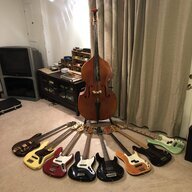
Anybody have any theories or factual information on whether lighter or heavier wood basses sound better? Thank you.
Nobody has proven anything on this subject beyond a doubt, or difference of opinion, so it looks like discoveries and uncharted research are still open to your finding them. I, and the rest of TB anxiously await your Underwriter's Laboratories or Bell Laboratories- verified findings. When can we expect it?

Musical instruments are not exempt of the Universal First Law Of Thermodynamics And Conservation Of Energy. *
I will try to keep this simple - but that's asking a lot of me.
Since the wood of a slab guitar isn't active and contains no stored energy it can only attenuate (diminish by absorption) sounds/vibrations and is not therefor additive. {see footnote 1}
If the body absorbs mostly only certain ranges of frequencies or is resonant to one or just a few of them, then the non-absorbed frequencies sound more forcefully to the hearer.
An instrument may be 'resonant' - but is only passively so and in logical orders of magnitude.
Since most people falsely believe that solid wood bodies can add to 'tones' or gloriously amplify certain ranges or frequencies, one can find themselves in a heated debate about wood/woods/wood qualities and other untenable yet glorified and nebulous factors.
If the body then can be caused to vibrate at a certain frequency - where did that energy to excite it come from and at what cost?
Think about it - in the realm of musical instruments - the wood is passive and only subtracts from and cannot add to any sound generation by and of itself.
The wood is dead.
It cannot of or by itself add to anything without the use of some form of outside energy input, ie: you don't get something for nothing.
That energy would only be taken from the plucked/oscillating string.
Energy can neither be created nor destroyed - it can only be converted or changed from one form to a different one.
That is an inviolate truth.
The somewhat limited capacity of the slab body to resonate does however act as an absorptive wooden 'sponge', taking away certain ranges of frequencies according to it's density, moisture content, shape, position of string attachment, contour and thickness, and molecular composition thereof - to only resonate within a narrow range of frequencies.
Finishes, paints, coatings, wax, hardware, bridges and even screws in the body all also act as absorptive devices. These too cannot 'add' to- but only subtract from- the sound emanating from the instrument.
These only serve to alter the subjectively perceived sounds in a diminished capacity since they would require energy to cause them to vibrate (that requires energy to set them in motion - and is one of the universal physical laws of energy conservation) - and they too will decrease or eliminate the sound quantity or quality.
The only mechanism whereby a body could be made to vibrate is from the energy in the oscillating string and since the physical laws of the universe are 'universal' in nature - they also must apply here too and the act of sharing that energy can only diminish the sound production.
Any time you absorb a frequency or 'tone', the unattenuated frequencies or 'tones' may sound larger or louder and thus people think the body is adding to those perceived sounds when it is actually taking away sounds on the other side of their listening spectrum.
Hollow body instruments are included in the same physical laws of the universe, but have other harmonic and orders of magnitude and frequent-resonance factors that come into play; these are not as evident in a slab-body instrument.
The laws of the universe are inviolate - except to those who falsely believe otherwise.
*NOTE: First Law of Thermodynamics
The first law of thermodynamics is often called the Law of Conservation of Energy. This law states that energy can be transferred from one system to another in many forms; it can not be created or destroyed.
Footnote 1: ATTENUATE: to become weaker or to be made to be weaker in strength, value, or magnitude.
Nutshell observation: Wood taketh away, not addith-to the sound of you bass. SurferJoe 1:1
this is possibly the greatest post I've ever read, well done.
one mans great tone is anothers worst tone. totally subjective.
I have 9 Precision basses, from light to gawdawful heavy. the one that plays the best is one of my 78's, it's also the heaviest, weighs a ton. I don't care much about the wood except for esthetics and whether screws strip easily in it. I won't buy another basswood body because it's too soft imo, I had one and the bridge screws stripped out, never again.

better tone is subjective as hell. If heavy is the indicator of good tone, then the best sounding bass should be made out of a lump of lead, following this logic.

i dont know if they have better sound, but it seems they are more durable, like they have more balls..
Since the wood of a slab guitar isn't active and contains no stored energy it can only attenuate (diminish by absorption) sounds/vibrations and is not therefore additive.
Not totally true.
While the material will attenuate frequencies, additive support/reinforcement also occurs for the same reason...the complex phase relationships of the waves passing through the material.

I think the issue is that heavier instruments can sound better compared to a lighter version with the same electronics. The idea that you have to have an instrument that is heavy to sound good isn't true though. If the electronics are designed and voiced to be installed in light instruments, then you can have a great sounding bass without the weight. Lots of instruments out there have this design goal, with Skjold basses being just one. I can assure you those instruments don't sacrifice anything in tone even though they are extremely light, some in the 7 lb range.
Note these two phrases:
"Heavy Wood"
"Heavy Metal"
Coincidence? I think not...
so you don't like "heavy metal", we get it.

Brad Johnson and JimmyM, both nailed it
On the other hand, have you ever tried playing a 4hr gig or a 6-8hr rehearsal with a heavy bass? I have and IME a medium or light weight bass with GREAT tone will do the trick as much as the heavy bass
I do it quite frequently. My newest bass is 12 lb. 9 oz. and it was a breeze to do a couple of sets with. No issue at all. Wide Levy's Leather strap does the trick for me. Plus it sounded flat out amazing which always mentally sheds a pound or two IMO.
In fact, I think an amazing sounding heavier bass feels much lighter than a blah sounding medium weight one. They call it "dead weight" for a reason.
I've played a ton of basses and haven't heard a lightweight bass that comes anywhere near any of my main basses. Not even close. If I had, I'd own one. It's no more complicated than that for me.

Are red cars faster?
The police seem to think so.
*owner of a red Accord*

The police seem to think so.
*owner of a red Accord*

Again illustrating the importance of perception.
And we haven't even touched on the importance of ergonomics on the bass as it applies to perceived vs. actual weight.


Ash and maple sound better with weight.
Alder sounds great at different weights. It's more of a personal tone preference. Lighter alder has a warmer sound and heavier Alder has a more aggressive tone.
Alder sounds great at different weights. It's more of a personal tone preference. Lighter alder has a warmer sound and heavier Alder has a more aggressive tone.


