• TalkBass has been independent since 1998. Add your voice.
    Create a free account to reply to discussions, view embedded media, and browse with fewer display ads.
    Join freeLog in
    Want zero display ads or expanded classifieds tools? Compare plans.

Help lost in the mix

Aside from all the church politics/amateur soundguy issues, which I'm sure are there, just set your mid frequency to around 250 Hz and boost it 8 or 10 db. This is the first frequency any amateur soundman learns how to cut, and they'll cut it on everything, so if you can get a bump in that range you'll at least have one spot that gets through. Probably sound bad by itself, but like someone said earlier, it's all about finding your place in the mix.

 
I will admit that although I have played bass for a long time, I don't have much experience with running direct and I'm far from an expert on EQ. I wish one of you guys were near me and could help me out. The Navigator to me sometimes seems a bit too complex. Between EQ on the bass itself and EQ on the Navigator my mind goes cloudy. Maybe I should just get a good direct box.
 
well maybe it´s me...

I recorded lots of basses (so I can say I have little experience about it) but everytime I had to record a Stingray with rounds it was nearly imposible to cut trough the mix right. Now with flats it was a pleasure...

I got the original Ernie Ball Rounds on my Fretless Stingray 5 and it sounds great. Try bumping the low-mids and mids up a notch or two and it will cut through fine.
 
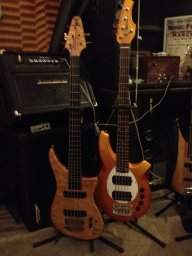
Here is a pic of my rig. I am basically set flat and darn near the same on my bass with a bit of bump on the low and mids.

From the Navigator, are you sending a POST EQ signal? So everything on the unit is affecting what the sound man is getting? Take the enhance knob and turn it back completely to the left. You are taking out a portion of the 300hz range while boosting the highs and lows on that Enhance knob. Then according to your dials, you are boosting a decent amount of low end. Basically, you are adding a lot of low end to the signal which is part of the reason your tone is a mess with the sound guy - he does not have much to work with. The low mids, 200-400hz, is a very important section to be heard with.

Since you have not fully mastered/comprehend EQ, I suggest giving the sound guy a direct signal of just the bass tone - off the Navigator pre-amp, just set it to PRE-EQ. Do not boost the bass knob on the stingray when playing live either. The sound guy will get something better to work with.
 
We've got one of these in church-except it features an acrylic roof!

In our mix, the audience/congregation can hear the bass. Plus, the 4 drum mics are turned DOWN when they begin to overwhelm!

rita_drums1.jpg
 
For church sound... I'm having an issue with the replies you've received above.

Let's start with the basics.... pictures of the room... a full description of the gear... and something about who's running it.

----

For church sound, we can normally "guess" that we're having EQ and RTA issues for the room... by far this is the toughest "rock band" sound to run as for worship, we can't just run the mains louder to overcome the room.

Starting Questions
How boomy is your room?
What is the natural tuning of the room?
What covers the walls, floors and ceiling?
Is your gear set in the optimal position (meaning not in corners etc)
 
Man I feel stupid. Just looked at my rig and I am actually sending a Pre-EQ signal to the board.
We have a professional sound guy coming in tomorrow to help out so hopefully he will straighten slot out.

Staccato, we have shields just like those pictured.

For what it's worth, we don't go for your normal "church sound" as we rock it out pretty hard and loud for the most part.
 
My experience - churches don't know how to mix bass. Vocalist are the stars and usually play acoustic guitar. Drums overpower most everything else.

Sad, but true. i do sound at multiple churches, but focus in on one, and after picking up bass, i learned that if the bass player can hear the band, he can mix himself fairly well, as a general rule. Bass players are now the only people i allow to play without being DI'd. :hiding:
 
Two things you can try without messing with EQ or volume or the mix:

Pluck the strings closer to the bridge and dig in; that will add harmonic texture to your sound. One reason bass often gets buried in the mix is that it can lack harmonics and therefore gets masked by other sounds that have more texture.

Put space between your notes, and maybe even drop out for a measure or two now and then. The ear gets sort of anesthetized to a steady drone even if it is changing pitch and especially if it is low frequency.
 
It is most likely the sound guy. However, 95% of the places anyone plays at has a terrible sound guy. I have played some fairly large venues with other bands and shared the sound guy. A house sound guy will likely have no idea what you want to sound like, and likely wouldn't care if he did know. The other bands we have played with always sounded like mushy bantha poodoo, and we didn't.

Here is why:
We weren't stepping on each others toes.

1. Playing covers is fine, but you have to realize how much work has gone into the recording/mixing/mastering process on a Pro CD release to make sure everyone can be heard. There are a lot of frequencies being cut out in the studio that are not cut in a typical live performance. The solution is to EQ it on your end before it gets to the PA.

2. Original music. We had a soprano vocalsist, one guitar, bass, and drums (with some synths sent to the PA from the click track). No one is going to walk all over a soprano, one guitar isn't going to walk all over the bass (especially when properly EQed on your end and with more focus on the highs and mids than the lows - the lows are for the bass).

3. Have enough punch on your end to overpower the drums if need be. Get good vocal pre-amps before the signal is sent to the PA. Have guitar and bass amps that can be cranked if need be. Never start out with it cranked. Let the sound guy do his sound check with half volume on your amp. If it is too quiet during the show, turn it up. At least half stacks for the guitars in a small venue, and 300+ watt amps for the bass. Use good mics.

4. Use a wireless sytem and take a walk out into the crowd. Hear what the crowd is hearing (often totally different than what you are hearing on stage through monitors) When the song is over, tell the sound guy what needs to be done.

5. Have one person (with the best ears) in the band do the crowd walk and volume adjustments (using hand signals between sings or during easy parts) and discussions with the sound guy.

The point is, if the sound guy isn't cutting it you can fix it.

I have several live recordings of shows we have done. Everyone else sounds like mud. We sound like a pro recording.
 
Hi there, I'm not an expert but have been playing/running PA in a variety of churches for a long time.

I've seen things like this go two ways. One is for the bass player to get an ever bigger cab and ignore the sound engineer. At one church I was at two of the bass players had huge Ampeg fridges and we had to set everything else relative to them. It often rocked however the number of complaints from the congregation...

The other way to go is to try and get the stage volume as low as possible. This normally means dealing with the drummer - at the most extreme getting them to play an electric kit - but otherwise surround them with as much absorbing material as possible. Then insist bass is DI'ed and guitarists are using isolation cabinets. Once the stage volume is low the sound engineers only have to deal with whats coming out of the main speakers - still too much of a challenge for some but at least it's a start.

Mind you sometimes the only thing to do is make sure you sound good to yourself and then just despair about what anyone else might hear!

(BTW I once told John Thatcher of "Delirious" to turn his Bass down - that was fun!!)
 
...95% of the places anyone plays at has a terrible sound guy.
That's hyperbole, of course, and nowhere near numerically correct. There are of course incompetent sound engineers in every market, but a house guy that knows his gear and mixes a lot of bands can be a real asset to a band, even if you bring your own FOH guy. To say that 95% of them are bad and that they don't care about their work is an unfair characterization, and it's just not so.

To walk in off the street as a complete unknown to the sound engineer expecting him to make you, the third band in a five band bill, sound like your best imagined studio recording would be asking a whole lot of anybody.
 
That's hyperbole, of course, and nowhere near numerically correct. There are of course incompetent sound engineers in every market, but a house guy that knows his gear and mixes a lot of bands can be a real asset to a band, even if you bring your own FOH guy. To say that 95% of them are bad and that they don't care about their work is an unfair characterization, and it's just not so.

To walk in off the street as a complete unknown to the sound engineer expecting him to make you, the third band in a five band bill, sound like your best imagined studio recording would be asking a whole lot of anybody.

95% is the norm in my experience. I have played a lot of venues, and opened for many big names. They max everyone out until they clip and call it a night.

I made the same point on the sound guy. They have no idea what you want to sound like. That part is not their fault. Not giving a crap is.
 
95% is the norm in my experience. I have played a lot of venues, and opened for many big names. They max everyone out until they clip and call it a night.

I made the same point on the sound guy. They have no idea what you want to sound like. That part is not their fault. Not giving a crap is.
Your experience is limited, then. There are plenty of good sound engineers out there who are competent and take pride in their work. I am one of them.
 
Well the pro sound guy that came in this past Sunday obviously knew what he was doing because our sound was much better. You could actually hear the notes I was playing.:D Turns out they originally had everything running thru the subs. Now the only thing going thru them is the bass and kick.
I did bump my mids a bit and it helped. Not the tone I like in my ear monitors but sounds good in the house.
 
Your experience is limited, then. There are plenty of good sound engineers out there who are competent and take pride in their work. I am one of them.

As am i, however, i agree with most of what the guy is saying. i refuse to do a bad job, and if someone on the band isn't letting me to my job right, i walk up and adjust their stuff to sound how i need it to sound out front.

but the vast majority of sound guys in church situations just don't care. they're only there to make sure the vocals and guitar are heard. everything else can DIAF.

oh, and before we throw around credentials, i've worked in churches in four states, and three countries. :P
 

Latest posts