• TalkBass has been independent since 1998. Add your voice.
    Create a free account to reply to discussions, view embedded media, and browse with fewer display ads.
    Join freeLog in
    Want zero display ads or expanded classifieds tools? Compare plans.

Double Bass Help me bring this Clevinger back to life...

Hello all,

I have recently acquired a Clevinger by Robert Lee EUB purportedly from 1986. It came in an anvil case with a seriously degraded foam interior, all of which seemed to stick to the bass. After cleaning it up:
img_09333.jpg


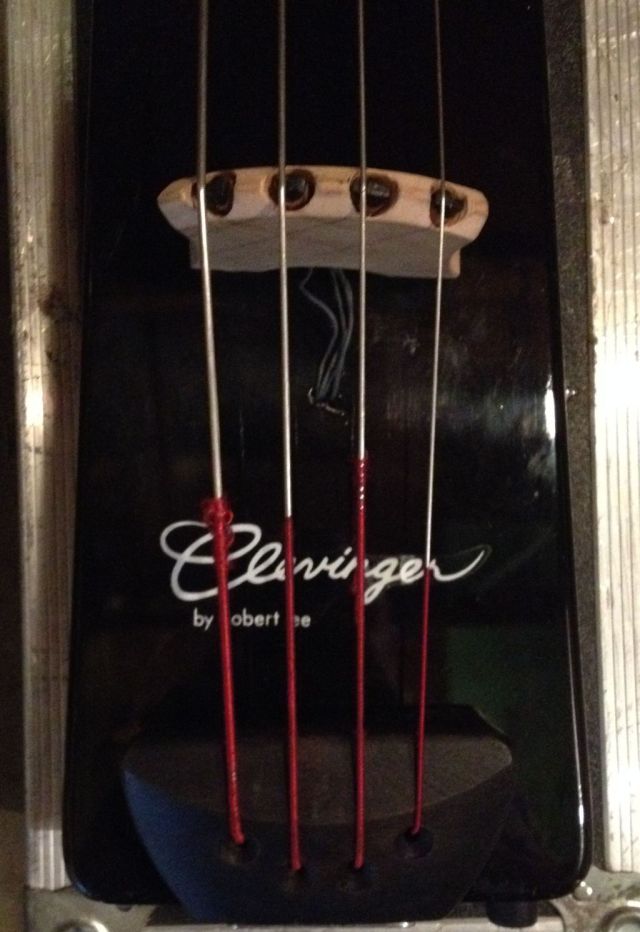
A bit closer:
img_09251.jpg


I think the bridge is mounted too high, since the scale length measures about 39 inches, which is 1/2 size scale. I'm pretty sure these basses are 3/4 scale length. I suspect the bridge should probably cover the wire cavity below where it is now.

The bass sounds pretty good plugged in, except for a scratchy volume pot. The 'A'-string pickup does not work though- it only produces a dull thud when plucked. The bridge is a 'Virtuoso Near-Field Pickup'. From reading the Clevinger threads on here, I understand that this bridge has the strings directly over the discrete piezo transducers for each string. Hope I got that right. I would love to get this working but am totally clueless on how to proceed with fixing it. If it were an e-bass, it'd be easy to swap out pickups. These seem to be individually mounted into the bridge on a dowel-like piece of wood. Are they individually replaceable? The string transducers don't want to move out of the bridge when the strings are loosened so this could be an all-or-nothing fix.
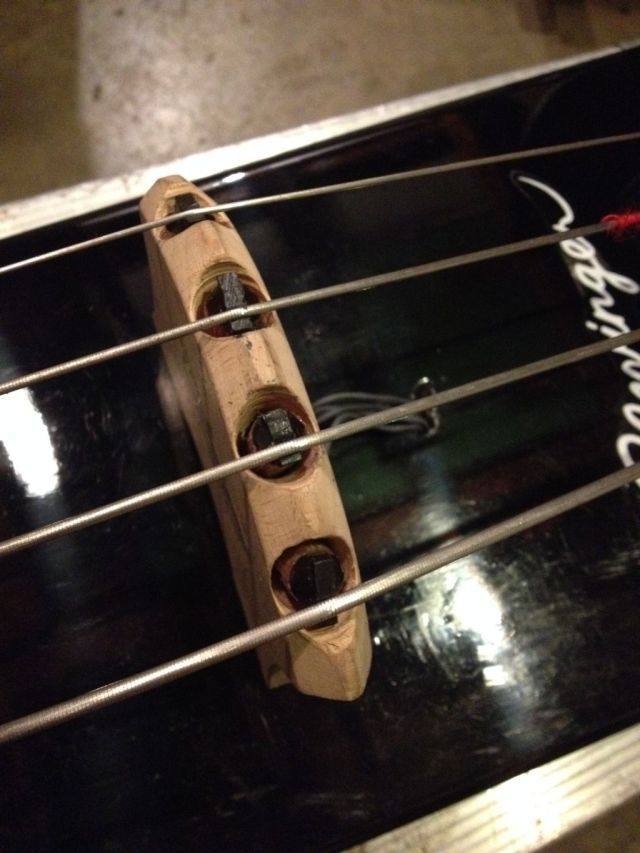
img_09212.jpg


Also perplexed about how this bass is played- is it a stick bass that lives on a drum tripod or can you play it with a long pole like an Eminence or BSX Allegro? I've played those extensively and it's nice to play loose like a double-bass instead of fixed to a tripod. The pole attached to it is cut off, with a shaft that holds it into a block on the back. Easy enough to replace an aluminum tube, but how long is it supposed to be?
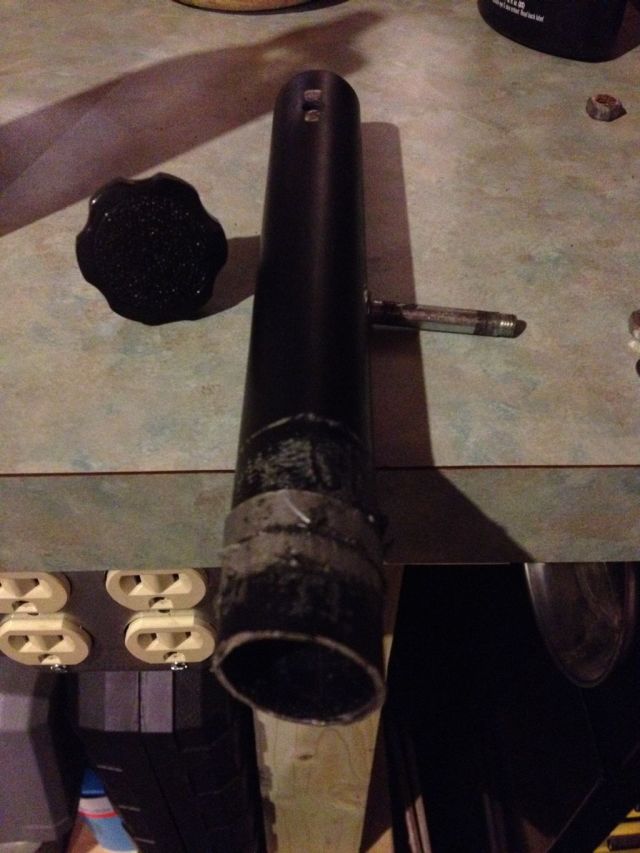
img_09232.jpg


The back is a mystery, but I think those plastic mounts with holes on the left and right are for the body ribs for a leftie or a rightie. The bass came with no other hardware so I'm going to have to figure out how to procure a right-handed rib. Clevinger's site seems to only sell left-handed ribs. Maybe they're interchangable? Can't find any pics of this bass with the hardware attached. Saw a pic on the Elderly Instruments page of a Clevinger Concerto with the tube flipped upward and attached with the knob, with a walking cane pole inserted, likely to play it true double-bass style.
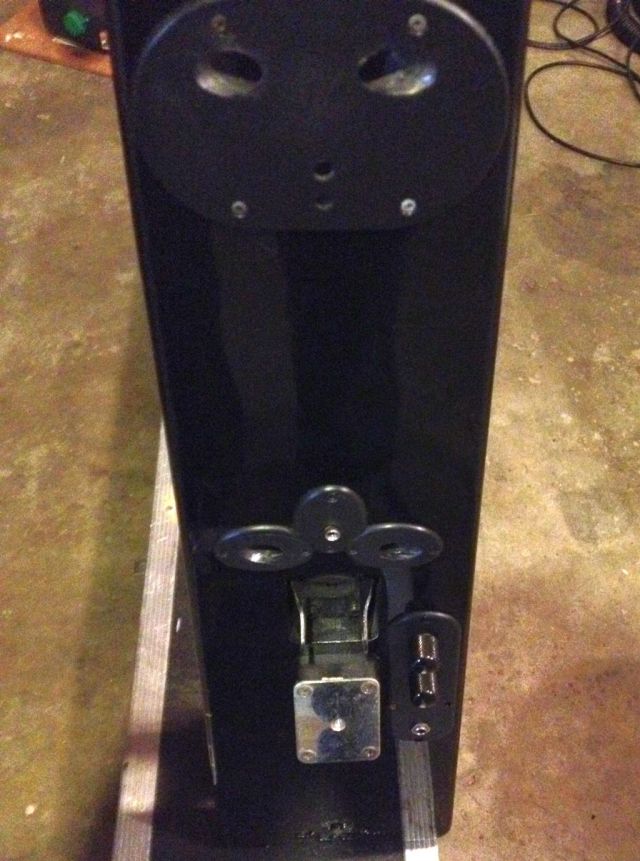
img_09262.jpg


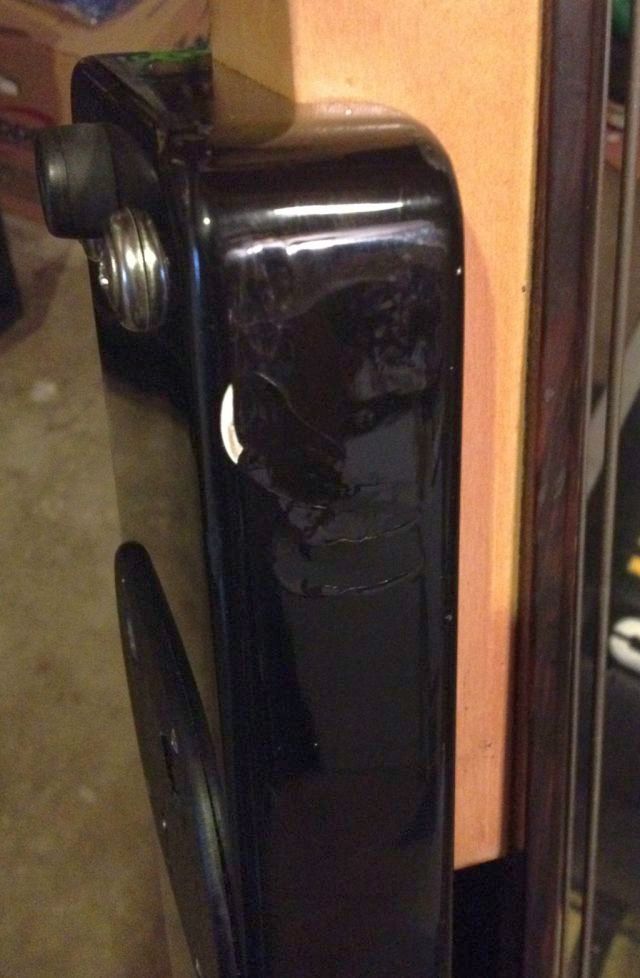
Finally, it has some pretty good paint chips dinged out of it, and the shoulder paint is shattered:
img_09293.jpg


Not sure how to seal that up so the paint doesn't flake off. It's easy enough to buy matching nail polish for the small chips, but not sure how to fix a bigger issue like this.

I know that's a lot of questions, but I hope the Clevinger owners on here are willing to help. Thanks in advance!!
 
  • Like
Reactions: mjm0
I might be help you out with some pictures in the next few days. My instrument is probably much older, the bridge is completely different (much simpler and I modified it, because the solution was not good) and no raised saddle, so I will concentrate on (end-)pin and body separator (rib replacement). The pots are on the front on my instrument and I only can use the body separator on the right side (which is OK for the right-handed me). I have one more piece of hardware for the lower left hole, probably of use when playing in a sitting position, but I never use it.
For your bridge, consider to get a new one and a new pickup if you cannot get the pickups out of the bridge. I have a purely wooden bridge with two pickups under the legs (like the Realist or Shadow NFX) which works fine for me. At least consider replacing all piezo crystal of the bridge pickup o get an equal sound out of each string.

The Clevinger uses one leg on the back of the instrument. Yours of course has been shortened, maybe for mounting on a tripod, maybe for a sitting position. The joint of the leg with the instrument is made by a screw between the oval and the rectangular plates with threads. In the tube is a hole where the wheel-screw can hold the tube in parallel to the instrument (for transport) or down for playing. Inside the tube is a slightly smaller tube with threads on one side for adjustment of the leg length. Of course one hole in the outer tube where a screw gets into one of the inner tube threads for locking. The inner tube ends in a rubber foot. Length of the outer tube about 60 cm (24 inch), the inner tube needs to be a bit shorter because of the locking screw for the leg.
The body separator is made of a thick bent metal rod (probably aluminium) that goes into one upper and lower hole on the back. I don't think you can make one yourself if you are not a metal worker.
I would suggest to ask Clevinger for a replacement foot and body separator. It isn't worth the energy and time you need to put into this instrument to build something yourself.

BTW, I put a tube of rubber foam (made for the steering fork (?) of a bicycle) over the body separator (filled with spiral wound stripes of the seconond tube in between) to get a larger surface and better grip to the body.
Once I forgot to put the body separator in the case and left without to a rehearsal. Even pizzicato it was hard to play, so get one if you don't want to get upset because you don't have one. Arco was impossible. The foot construction makes it hard enough to play arco (unless you have a very little weight bow playing).

Here are some pictures of my reworked bridge and maybe one of a similar to yours:
Clevinger Action Adjustment

And here some of a different Clevinger pickup:
Clevenger Keyhole Bass/Repairing The Diamond Sonance Pickup
 
Last edited:
I hope these pictures might help you a bit. Sorry for the last pic, the camera could not focus correctly so close, but I think you can get the idea.

The aluminium plates (oval and electonics) are replacements made by me.

The leg sits in a cup of a stand (reworked microphone stand) and as I said, the body separator has a (probably non-original) coating by a rubber foam tube.
BTW, my bridge is original (stamped "Clevinger") but very different from yours, much simpler as you can see in the other thread mentioned before.

I really disliked what the passive electronics did to the sound, so if yous is passive too, it might be a good idea to build an impedance buffer and put it between piezo and passive electronics or throw out the electronics and directly connect the piezo to the output. Just connecting one piezo directly to the output sounded so much better.
The passive electronics was desinged for a magnetic pickup and does not work well with the high impedance piezo.

100_7595.JPG

100_7596.JPG
100_7598.JPG
100_7599.JPG
100_7597.JPG
 
For some reason I couldn't edit my previous posting with the pictures, so here is some more text:

Since I live in Europe I thought that replacing the leg fixing screw by a metrical one would be a good idea in case the original one (with a wheel) would get lost. So this part and the two threads under the plates are not original too.

The passive electronics was designed for a magnetic pickup and does not work well with the high impedance piezo.
 
Wow DoubleMIDI, thanks so much for your helpful posts! Those pics are pretty helpful. I assume the cup that the foot is in is for a bass stand like this:
kb550.gif


I've been very very busy and only last night could devote some time to this. I've written Clevinger for the foot and body bout, and also to see if I can get a replacement piezo. Not sure how I could source the pickup otherwise. Only the E string comes out, and they're interesting, being mounted on a common wood dowel:
img_1051.jpg


The wiring in the control cavity is also interesting. The individual piezos are on small two-conductor wires, and they are split so the grounds are ganged and so are the hots:
img_1049.jpg


That tape held the ganged grounds onto the pot, then the attached blue wire is soldered to the shielding. I think that grounding connection needs to be soldered to the tone pot, but correct me if I'm wrong.

The shielding paint in the cavity is done well with an overlap onto the surface, but the copper tape does not touch the paint overlap, so it's not entirely effective. It seems best at this point to get the instrument working like it was designed, but I am considering wiring the piezos directly to the output; not sure how that's done. However, if I can't get a replacement A string pickup I will go with a Realist or the like. I am not sure if this kind of pickup will work as well on a solid bodied instrument as on an acoustic one. I welcome your input.
 
Very interesting this dowel mounted pickup. Try to take the A pickup out, the piezo might have got loose from the dowel and just needed to be reglued to it.

The electronics look similar to mine. Same pot values and same kind small ceramic capacitor. Since I only had two pickups (one of them for the fifth highest string only), I only connected one of them directly. Connecting several piezos in parallel without preamplification (of the current by a J-FET), the sound got worse, so for my two pickup system I made a preamp with two independant inpt stages (two J-FETs), mixing the amplified signals together (using a pot for blending) and then mixing this signal into the original passive RC-tone shaping and volume control. The B250K is the volume pot, so you got an inital load of the piezo(s) of 250 KOhms. Not a good load for a thin piezo element.

The shielding of the pots is still there over the mounting on the copper shielding. No need to solder the ground onto the pot.

If you want a replacement pickup better get a two element one like the Shadow SH-965NFX. Then you already have an impedance buffer (preamp) with it.

BTW, the cup of my stand for the endpin looks similar to the one of your picture, but mine was not made for a DB, but a redesigned microphone stand. Since I got this stuff used and not from the last owner but a friend of his, I don't know who and how this thing was done. but there might be better solutions than my stand.
 
Last edited:
Hello all,

I have recently acquired a Clevinger by Robert Lee EUB purportedly from 1986. It came in an anvil case with a seriously degraded foam interior, all of which seemed to stick to the bass. After cleaning it up:
img_09333.jpg


A bit closer:
img_09251.jpg


I think the bridge is mounted too high, since the scale length measures about 39 inches, which is 1/2 size scale. I'm pretty sure these basses are 3/4 scale length. I suspect the bridge should probably cover the wire cavity below where it is now.

The bass sounds pretty good plugged in, except for a scratchy volume pot. The 'A'-string pickup does not work though- it only produces a dull thud when plucked. The bridge is a 'Virtuoso Near-Field Pickup'. From reading the Clevinger threads on here, I understand that this bridge has the strings directly over the discrete piezo transducers for each string. Hope I got that right. I would love to get this working but am totally clueless on how to proceed with fixing it. If it were an e-bass, it'd be easy to swap out pickups. These seem to be individually mounted into the bridge on a dowel-like piece of wood. Are they individually replaceable? The string transducers don't want to move out of the bridge when the strings are loosened so this could be an all-or-nothing fix.
img_09212.jpg


Also perplexed about how this bass is played- is it a stick bass that lives on a drum tripod or can you play it with a long pole like an Eminence or BSX Allegro? I've played those extensively and it's nice to play loose like a double-bass instead of fixed to a tripod. The pole attached to it is cut off, with a shaft that holds it into a block on the back. Easy enough to replace an aluminum tube, but how long is it supposed to be?
img_09232.jpg


The back is a mystery, but I think those plastic mounts with holes on the left and right are for the body ribs for a leftie or a rightie. The bass came with no other hardware so I'm going to have to figure out how to procure a right-handed rib. Clevinger's site seems to only sell left-handed ribs. Maybe they're interchangable? Can't find any pics of this bass with the hardware attached. Saw a pic on the Elderly Instruments page of a Clevinger Concerto with the tube flipped upward and attached with the knob, with a walking cane pole inserted, likely to play it true double-bass style.
img_09262.jpg


Finally, it has some pretty good paint chips dinged out of it, and the shoulder paint is shattered:
img_09293.jpg


Not sure how to seal that up so the paint doesn't flake off. It's easy enough to buy matching nail polish for the small chips, but not sure how to fix a bigger issue like this.

I know that's a lot of questions, but I hope the Clevinger owners on here are willing to help. Thanks in advance!!
I might be help you out with some pictures in the next few days. My instrument is probably much older, the bridge is completely different (much simpler and I modified it, because the solution was not good) and no raised saddle, so I will concentrate on (end-)pin and body separator (rib replacement). The pots are on the front on my instrument and I only can use the body separator on the right side (which is OK for the right-handed me). I have one more piece of hardware for the lower left hole, probably of use when playing in a sitting position, but I never use it.
For your bridge, consider to get a new one and a new pickup if you cannot get the pickups out of the bridge. I have a purely wooden bridge with two pickups under the legs (like the Realist or Shadow NFX) which works fine for me. At least consider replacing all piezo crystal of the bridge pickup o get an equal sound out of each string.

The Clevinger uses one leg on the back of the instrument. Yours of course has been shortened, maybe for mounting on a tripod, maybe for a sitting position. The joint of the leg with the instrument is made by a screw between the oval and the rectangular plates with threads. In the tube is a hole where the wheel-screw can hold the tube in parallel to the instrument (for transport) or down for playing. Inside the tube is a slightly smaller tube with threads on one side for adjustment of the leg length. Of course one hole in the outer tube where a screw gets into one of the inner tube threads for locking. The inner tube ends in a rubber foot. Length of the outer tube about 60 cm (24 inch), the inner tube needs to be a bit shorter because of the locking screw for the leg.
The body separator is made of a thick bent metal rod (probably aluminium) that goes into one upper and lower hole on the back. I don't think you can make one yourself if you are not a metal worker.
I would suggest to ask Clevinger for a replacement foot and body separator. It isn't worth the energy and time you need to put into this instrument to build something yourself.

BTW, I put a tube of rubber foam (made for the steering fork (?) of a bicycle) over the body separator (filled with spiral wound stripes of the seconond tube in between) to get a larger surface and better grip to the body.
Once I forgot to put the body separator in the case and left without to a rehearsal. Even pizzicato it was hard to play, so get one if you don't want to get upset because you don't have one. Arco was impossible. The foot construction makes it hard enough to play arco (unless you have a very little weight bow playing).

Here are some pictures of my reworked bridge and maybe one of a similar to yours:
Clevinger Action Adjustment

And here some of a different Clevinger pickup:
Clevenger Keyhole Bass/Repairing The Diamond Sonance Pickup
Just give Martin Clevinger a call. He is always more than happy to help. Martin can be reached at 510 444-2542.
 
Also, I"m not impressed with the $349 price tag on his site for a gig bag. I think there has to be a reasonably priced gig bag that will fit this bass. Does anyone have ideas on this? I have searched under quite a few search terms to locate a bag for sale that will fit this bass but am frustrated to not find any useful information.
 
The gig bag I have is from Blue Heron. Got it with the bass used, so I never dealt myself with them. It it a nice bag, probably specially made. The only little drawback is that the bow fits in only naked or in a thin sleeve (which I prefer). There is no special room for the body support, but since I put it mostly rubber foam around it (from bicyle accessories), I just put it between body fingerboard and bridge and it fits more or less. The bag is well padded, only on top you have to take some care when closing the zipper around the headstock.
But this might not be much cheaper than yours.
I still know the last name of the previous owner who might have got that bag for this instrument. Perhaps it might help if they still have stored the dimensions for that bag somewhere with his name.
 
Thanks to your help, I was able to talk to Martin about a month ago and sent him my pickup and control panel for upgrades. We determined that my bass is from 1992, and had been to his shop once in the past for service. Being the craftsman that he is, it is taking time but I am hopeful that it will be worth the wait. Since it's a later model, the right bout currently in production will fit, so that's on the way as well as a Clevinger gig bag (he offered me a discount). The pouch for the bout sold me on buying it, since I wasn't sure how to deal with that. I took the entire bass apart after dismounting the electronics, compounded the paint on the body and will be cleaning the fingerboard before I reassemble it. My idea for a walking cane as endpin turned out to be a good one, as that was his suggestion. He suggested a steel can 1" in diameter, and the only steel canes I can find are lightweight 'bariatric stainless steel canes' made for obese patients. Cutting and drilling holes in stainless for mounting should prove interesting. May try a machine shop to do the work.
 
So was it originally a 39" scale? I know he made at least one model that was.

I'm in no great rush to get another EUB but if something like this came along I'd be right on it. Good score.

This tube drilling guide might be something to consider rather than paying a machine shop. Cutting stainless tubing only requires a hardened hack saw blade...even regular economy ones work for a few cuts.
 
It measured 39" when I got it but the bridge was pushed up about two inches from the access hole for the electronics, so pushing the bridge back to where it looked right made it 41" on the nose. I had no idea a regular hacksaw blade would cut through it- thanks! Thanks also for the drilling guide. I've wondered how to get the holes drilled true on the apex of the curve.
 
My older version had a scale about 40 inches. The bridge was screwed to the body, so it was not able to move. After my modification dividing the string angle in half (I don't have a raised saddle on my instrument) the scale was exactly 105 cm (a bit less than 41 inches).

I just want to add that I am not happy with the angled endpoint when bowing. I removed the raised and angled plate where the endpoint leans against temporarily and bowing is much easier with the endpin in parallel to the body. Also the feel is more double bass like. I might change that in a more or less restorable way next year. Since you have to find a solution for your endpin, I thought you should know what I found out for me. Of course the straight endpin might need to be a bit longer, so the this into your consideration of endpin length.