
Enjoy the benefits of a premium membership!
Upgrade Account
-
TalkBass has been independent since 1998. Add your voice.
Create a free account to reply to discussions, view embedded media, and browse with fewer display ads.
Join free Log in
Want zero display ads or expanded classifieds tools? Compare plans.
You are using an out of date browser. It may not display this or other websites correctly.
You should upgrade or use an alternative browser.
You should upgrade or use an alternative browser.
Help Me Design My Next Test!
- Thread starter -=DanAtkinson=-
- Start date
More options
Who Replied?

The simpler the better IMO. Less variables, the better result. Ideally, whatever test you run, run it on the SAME BASS.
For example, I'd LOVE to hear a BAII bridge vs. standard Fender bridge installed on the same bass A/B comparison
For example, I'd LOVE to hear a BAII bridge vs. standard Fender bridge installed on the same bass A/B comparison

I think just the fact that you're willing to do the tests in the first place is awesome.
In general, just try to keep as many variables as possible the same between two different tests. Same brand of string (I'd use nickle roundwound as a basis), swap neck, pickups and bridge when testing different bodies, and use the same body, bridge and electronics when testing different necks, etc.
In general, just try to keep as many variables as possible the same between two different tests. Same brand of string (I'd use nickle roundwound as a basis), swap neck, pickups and bridge when testing different bodies, and use the same body, bridge and electronics when testing different necks, etc.

How about this test:
Same bass, 3 different players. I bet the "tone" will be different for each player.
THIS ONE!
I'd like to hear single notes played and let "ring out" for each wood type. Similar to sustain test, but not looking for length of note, but perhaps any resonance the wood is contributing to feedback on the strings. Playing notes in quick succession may hide some tonal variation because you are hearing only the attack portion of the tone, which to me always sounds fairly similar. I've noticed bigger differences with the "swell" and finish tone in my personal tests.
Also, I'd like to hear the same bass played with three people. People make more of a difference in tone than the instrument. Give any monster a crappy bass and they will still be a monster.
Also, I'd like to hear the same bass played with three people. People make more of a difference in tone than the instrument. Give any monster a crappy bass and they will still be a monster.
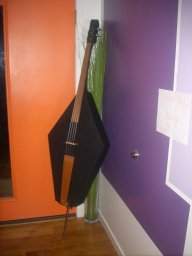
Build two basses of identical spec except for one very drastic wood change. Bodies would be the simplest. Paint the bodies (of course the wood would be less likely to be able to communicate with the tone spirit through it's pores, the tone spirit being the force which might tell the wood how to sound). Recruit local players to play with the same band, all knobs flat (amp) or wide open (bass). Same cable, same everything. Record songs twice, either just record the bass or solo the bass out of the mix. As an added bonus ask the bass player if he could hear any difference. Oh, and don't tell him/her it's a wood test.
Select the songs to show a range of playing, then random-ish-ly select a portion of each song (same portion for all samples) and present those to the jury. The more samples you can get, the more representative the test can be. Make sure not to monkey with the levels when you make up your samples, and for the true skeptics offer to provide your raw data files (whole recordings) and data sheets (what order the data was taken in, etc) for further careful analysis...
You'll still get haters but without devising some mechanical way to excite the strings you'll never get consistency enough for those guys. Hell, if we can't hear the difference between a properly constructed bass and a plank of wood with a neck bolted to it and they're not satisfied I'm not sure what would do it.
That's a lot to ask, though. I wouldn't wish it on anyone!
Select the songs to show a range of playing, then random-ish-ly select a portion of each song (same portion for all samples) and present those to the jury. The more samples you can get, the more representative the test can be. Make sure not to monkey with the levels when you make up your samples, and for the true skeptics offer to provide your raw data files (whole recordings) and data sheets (what order the data was taken in, etc) for further careful analysis...
You'll still get haters but without devising some mechanical way to excite the strings you'll never get consistency enough for those guys. Hell, if we can't hear the difference between a properly constructed bass and a plank of wood with a neck bolted to it and they're not satisfied I'm not sure what would do it.
That's a lot to ask, though. I wouldn't wish it on anyone!

I dunno. 95% of what I loved about the other thread was the lumberbass.
Not sure a thread comparing actual bass bodies has anything for me.
Not sure a thread comparing actual bass bodies has anything for me.
mod deleted
This, ladies and gentlemen, is a perfect example of the treatment I've received from the "Wood Matters" crowd. Absolutely stunning.

I simply cannot understand why some people get so insanely emotional about BASS WOOD TONE, for Pete's sake. I'd hate to see how they react in person to stuff that really matters.
Furthermore, this just goes to show how closed-minded they are. Here I am offering them the opportunity to provide input on how to make my "flawed" tests more useful, and the found of the "Wood Matters" club tells me to die.
You'll still get haters but without devising some mechanical way to excite the strings you'll never get consistency enough for those guys.
Ebow?
Why not just hook the basses up to an oscilloscope and show that each note on the basses/variables in question is the same (or not)? That should be proof enough for anyone who is even vaguely interested in truth.

I'm in "the tone is in the decal" camp so I'd like to hear a bass with a real Fender decal go up against one with a fake Fender decal. You could use any old(or new) Fender as long as the original from the Fender factory Fender decal is still on The Fender bass(with or with out a cig burn on the Fender decal on the Fender headstock, that extra bit of the mojo on the Fender bass shouldn't make much of a difference to the Fender sound) and then put a fake Fender decal on any other bass(doesn't really matter could be an Alembic, Fodera, or a Hondo). You could slap a funky one on a track and play finger style on another. Just don't use a pick whatever you do, I mean come on it's a bass. Right? Anyways... I'm not a decal snob or nothin'. I figure as long as it says Fender, who am I to judge. Really lookin' forward to hear this and challenge my ears.
Thanks and keep on keepin' on!!
Thanks and keep on keepin' on!!

This, ladies and gentlemen, is a perfect example of the treatment I've received from the "Wood Matters" crowd. Absolutely stunning.
I simply cannot understand why some people get so insanely emotional about BASS WOOD TONE, for Pete's sake. I'd hate to see how they react in person to stuff that really matters.
They wouldn't react like anything in real life. It's the same people that would wet their pants and run if physically confronted on the street.
If the internet has showed us anything, it's that the weakest people try and act like the toughest individuals from the comfort of their own home/office while sitting behind a keyboard and a monitor.
Now, back to the tests!


Personally, I've been really interested in your tests. Kudos!
I'm with Nino on the idea of testing different necks with the same body. I've heard a number of people here (long before your recent test) claim that neck wood matters far more to tone than body wood.
But the lumber bass was badass, regardless. I'd rock that sucker!!!
I'm with Nino on the idea of testing different necks with the same body. I've heard a number of people here (long before your recent test) claim that neck wood matters far more to tone than body wood.
But the lumber bass was badass, regardless. I'd rock that sucker!!!

Just heard the recordings from your previous test and honestly it was obvious to me that X and Y were different than Z but I have never played a pine lumber bass so I couldn't identify the alder bass. (by the way, that lumber bass sounds pretty decent to me!  )
)

Exactly!
For the next test, make it simple and upload four clips, two (A and B) "real world" clips and two clips without the drums and guitars (C and D). A whole maple bass should sound very different than an alder/rosewood neck bass, indeed.
)The simpler the better IMO. Less variables, the better result.
Exactly!
For the next test, make it simple and upload four clips, two (A and B) "real world" clips and two clips without the drums and guitars (C and D). A whole maple bass should sound very different than an alder/rosewood neck bass, indeed.
I have no idea what kind of resources you want or are able to put into the test, but here's what I would do:
Use a number of different bodies, but the same neck/pups/hardware (and the same string brand/type, but not the same set of strings). Ideally more than one body of each type of species being compared (3 of each?) to allow comparison between different pieces of the same species. Leave the bodies unfinished, so thickness of finish isn't a variable. Record one sustain test for each and post a lossless file type along with a screencap of the recorded wav with time scale for comparison. Record one "real world" test in a mix, preferably using all strings on the bass and post that along with a solo version. Keep any recording settings (preamp level, gain in the mix, etc.) the same for each sample so volume can be compared, as well as tone.
As far as species selection I'd go with 3 different species that are purported to be very different sounding and include a hard wood and a soft wood. Alder and Walnut maybe with...Basswood, Ash, Mahogany, Maple?
Don't know how realistic that is, but I would think having as few variables outside the body wood and as big a sample as realistically possible, including comparison between multiple pieces of the same species, would be ideal. Going by what some of the more on topic and reasonable complaints from the scrap wood thread were. It's not like you can utilize a bass playing robot, so there's always going to be some human variable in there, but that's a pretty reasonable variable, since I'm assuming we're all humans who play bass.
Use a number of different bodies, but the same neck/pups/hardware (and the same string brand/type, but not the same set of strings). Ideally more than one body of each type of species being compared (3 of each?) to allow comparison between different pieces of the same species. Leave the bodies unfinished, so thickness of finish isn't a variable. Record one sustain test for each and post a lossless file type along with a screencap of the recorded wav with time scale for comparison. Record one "real world" test in a mix, preferably using all strings on the bass and post that along with a solo version. Keep any recording settings (preamp level, gain in the mix, etc.) the same for each sample so volume can be compared, as well as tone.
As far as species selection I'd go with 3 different species that are purported to be very different sounding and include a hard wood and a soft wood. Alder and Walnut maybe with...Basswood, Ash, Mahogany, Maple?
Don't know how realistic that is, but I would think having as few variables outside the body wood and as big a sample as realistically possible, including comparison between multiple pieces of the same species, would be ideal. Going by what some of the more on topic and reasonable complaints from the scrap wood thread were. It's not like you can utilize a bass playing robot, so there's always going to be some human variable in there, but that's a pretty reasonable variable, since I'm assuming we're all humans who play bass.

I'd be interested to know the effect the weight of the body has on the lows, mid, and highs. Maybe use a frequency analyzer plugin to judge this? I like light basses but would like to know when a body becomes too light.

I think I'm going make a bass out of dried dog turd and then do this test under the guise of both basses being different type woods.
I wonder what the reaction would be when every couldn't tell the difference between a dried dog turd and alder. "Tone Wood" is in the same category as high end cable snake oil scams. How do I know that? I've done this test already.
I took a Lyon bass made out of plywood, and took off every part off the original body and installed them in an finished alder body. (I hated the lyon's paint job). Tonal difference = 0%.
I wonder what the reaction would be when every couldn't tell the difference between a dried dog turd and alder. "Tone Wood" is in the same category as high end cable snake oil scams. How do I know that? I've done this test already.
I took a Lyon bass made out of plywood, and took off every part off the original body and installed them in an finished alder body. (I hated the lyon's paint job). Tonal difference = 0%.
Thanks everyone for the input! There are some great ideas.
However, maybe I wasn't clear in my original post. For this test I'm planning to use 2 Precision basses: one with an Alder body and all Rosewood neck, and one with a Maple body and all Maple neck.
With those test subjects, how do you think I should conduct a tone test?
However, maybe I wasn't clear in my original post. For this test I'm planning to use 2 Precision basses: one with an Alder body and all Rosewood neck, and one with a Maple body and all Maple neck.
With those test subjects, how do you think I should conduct a tone test?
Thanks everyone for the input! There are some great ideas.
However, maybe I wasn't clear in my original post. For this test I'm planning to use 2 Precision basses: one with an Alder body and all Rosewood neck, and one with a Maple body and all Maple neck.
With those test subjects, how do you think I should conduct a tone test?
use the same PU's, electronics, hardware, and maybe even nut on both...
Latest posts
-
 Uber Eats class action lawsuit alleges their priority delivery is a scam
- Latest: The Golden Boy
-

-

-

-
 Post a funnier picture than the one above - Parallel Universe Edition
- Latest: buldog5151bass