
• TalkBass has been independent since 1998. Add your voice.
    Create a free account to reply to discussions, view embedded media, and browse with fewer display ads.
    Join freeLog in
    Want zero display ads or expanded classifieds tools? Compare plans.

Help me understand Warwick?

Bass Ape

Aping the Bass since 1986
Supporting Member
Mar 9, 2017
1,305
3,217
Midwest US
Hey TB fam, I’m looking for something a bit different than an FSO and my eyes have been gravitating toward Warwick over the last few days. I’m about 3 months away from actually purchasing a new bass so I’m starting to investigate now.

I was a Spector NS-2 player for about 15 years and never had a need to look at the warwicks, and back then the shapes seemed unrefined. Spector is still on my shortlist for my next instrument but my tastes have changed a bit.

I get the models
Streamer
Corvette
Thumb

And the series
Rockbass
Pro/teambuilt
Masterbuilt

What I don’t get is all the idiosyncrasies in each series. For example, I don’t need or want extra jumbo frets. How to tell the size of frets on a listing find it’s not itemized. It seems like specs are all over the place. Maybe I need to go play some in person and buy from what I play instead of looking in the classifieds.

 
Hey TB fam, I’m looking for something a bit different than an FSO and my eyes have been gravitating toward Warwick. . It seems like specs are all over the place. Maybe I need to go play some in person and buy from what I play instead of looking in the classifieds.
In person preview is best, especially with Warwick. Specs and feature sets of current models are the tip of the iceberg, as older models vary from current, too. Feature sets, weights, and ergonomics are all over the map between new and old. Find a Warwick you like? You can be happy playing it a long time.
 
Hey TB fam, I’m looking for something a bit different than an FSO and my eyes have been gravitating toward Warwick over the last few days. I’m about 3 months away from actually purchasing a new bass so I’m starting to investigate now.

I was a Spector NS-2 player for about 15 years and never had a need to look at the warwicks, and back then the shapes seemed unrefined. Spector is still on my shortlist for my next instrument but my tastes have changed a bit.

I get the models
Streamer
Corvette
Thumb

And the series
Rockbass
Pro/teambuilt
Masterbuilt

What I don’t get is all the idiosyncrasies in each series. For example, I don’t need or want extra jumbo frets. How to tell the size of frets on a listing find it’s not itemized. It seems like specs are all over the place. Maybe I need to go play some in person and buy from what I play instead of looking in the classifieds.

Having owned a MIG Active Warwick Corvette STD 5 string ( babinga body ) for a little short of ten years,. I would highly recommend paying it first and standing while you play it. IMO, it played very well, the neck was not wide or particularly fat at the nut. It had a two band EQ (treble & Bass boost/cu)t, volume and blend controls. In passive mode there was no tone adjustment. One thing I thought was odd was the nine volt battery is only restrained by the wire that connects to it and the cover. But it's pretty loose in there. The neck was very stable.

Finally, the street value on these at the moment is ridiculously low considering how well made they are made.One of these made in the early 2000's that retailed for over $2,000 can be had for $800 to $1,000 used in good to great condition.
 
I'm not such a big "regular" Warwick fan, I own and LOVE a 2011 Star Bass (Korean ProSeries, awesome value, built briefly -3 years?-, rare in the 2nd hand market, at least here in the EU). It doesn't have a tone usually associated with Warwick, more of a thick/warm Jazz Bass, lovely and "wooly". I like how Corvettes and Dolphins sound tho'. Also like the Jack Bruce model. I don't like the sound of pickups too close together, at all, so I dislike Thumbs. There's no way around trying them and deciding what tone AND features you like, their offer is pretty diverse.

Personal tone thing aside I'm not one to care much about this or that Warwick line/price range. All Warwick instruments I've ever played were nothing short of awesome in every aspect. I see German ones go for really cheap 2nd hand 'round here. I'd prefer more recently manufactured ones over '90s thick necked and heavy exemplars. But even the RockBasses are damm good. I've played MANY RockBass Star Basses back when I was fishing for mine and I can't tell a difference from my MIK ProSeries. They weight, feel, and sound exactly the same.

The problem with RockBasses is they're raising prices too high up to be justifiable if there's reasonable Warwick 2nd hand market in your region. Same thing happens with SBMM (they've gone mad, they sell basses for as high as 2000€ new, when you can have a used EBMM for 1300€).
 
Last edited:
  • Like
Reactions: five7 and Bass Ape
Warwick is a brand that I have to see in person before buying.

What concerns me before even plugging it in are the glue joints (on the bodies and necks that are all exotic species - ovangkol, bubinga, wenge, etc).

I sat in a store with a fabulous older fretless Thumb that I loved on the spot. I walked away from it because I saw separation in some of the glue lines in the neck and headstock. I've done a lot of repairs, but those are not issues I feel like dealing with.

Checking out other Warwicks, it's the first thing I look for and it's disappointing how often I find it.

If you watch Warwick factory tour videos, you'll see that they do a superb job with their gluing processes. But a lot of the time they're using a one part PVA type glue that may or may not be up to the task. There are a lot of industrial PVA formulations out there. The glue they use must have decent rigidity because I seldom find creep in the glue joints. But the adhesion properties may not be what they should be, hence the glue lines opening up.

They also appear to use a lot of pressure with their clamping and pressing processes and may be using too much pressure for the glue in use. Overclamping is common with adhesives like PVA and epoxy.

Prepping the gluing surfaces is also important with exotics and I can't tell if Warwick does a good job with that or not.

I don't have a Warwick at the moment, but if I came across a good one that I liked, I would definitely consider buying it. Regardless of the things I mentioned, the wood selection is excellent (other than the small added slips glued to the side edges of the headstock).
 
  • Like
Reactions: Bass Ape
Warwick is the one brand of bass that disagreed with me the most.
No slight on them as they make quality gear and I’ve heard folks make great music on them.
But to me, they just did not feel, play, or sound good in any way.
I’m at the opposite end of the spectrum in that I love Fenders and Fender style instruments. They are just home to me in every way and that could explain it.
 
Hey TB fam, I’m looking for something a bit different than an FSO and my eyes have been gravitating toward Warwick over the last few days. I’m about 3 months away from actually purchasing a new bass so I’m starting to investigate now.

I was a Spector NS-2 player for about 15 years and never had a need to look at the warwicks, and back then the shapes seemed unrefined. Spector is still on my shortlist for my next instrument but my tastes have changed a bit.

I get the models
Streamer
Corvette
Thumb

And the series
Rockbass
Pro/teambuilt
Masterbuilt

What I don’t get is all the idiosyncrasies in each series. For example, I don’t need or want extra jumbo frets. How to tell the size of frets on a listing find it’s not itemized. It seems like specs are all over the place. Maybe I need to go play some in person and buy from what I play instead of looking in the classifieds.
So it doesn’t look like you’re getting much of a response for your actual question versus opinions, so let me see if I can help a little bit with some basic info 🥴. I own both Warwick’s (20+ yrs) and new to Spectors (NS5X, LT and CST this year) so I’ll try to give you a couple of differences just to help you as you look. The Warwick owners club is super active as well with tons of knowledge there and folks are really good about answering questions about the different models. They went through some confusing naming around where the instruments are made… team built models, are kind of like the Spector Euros in terms of where they’re made, the pro series and custom shop are made in Germany and the Rockbasses are made in Asia (generally).

You got the popular models and the lines correct, there are a few more models too (Dolphin, Infinity, Katana, etc) but there are not different sizes of frets just different fret metal. The standard on Germans is typically bell bronze and you’ll find on some models (Rockbass, some GPS, etc) they used nickel. They use the hidden frets just like Spector.

Depending on whether or not you’re looking at a four stringer of five string there are some pretty standard pickup configurations (depending on the # of strings) as well and they use the MEC electronics for the most part (pickups and preamp). The bridges are absolutely the most adjustable of any manufacturer I’ve ever encountered. They are completely three-dimensional in terms of adjustment up down tilted, lateral string, spacing, etc. and they’re really fantastic and standard string facing is very similar to the Spector with 16.5 to 17 mm and again these are laterally adjustable.

Contrary to comments, they are not all heavy, and this is based on the type of wood that’s used for the body. I’ve had Streamer LX models with Ash bodies and they were right around 8 pounds. I’ve also had a six string Bubinga body with Wenge neck that was close to 13 pounds. My Thumb 5 Bolt On with Bubinga body is just under 10lbs.

IMO used German models are not super expensive and offer the best value.

The Streamer is the closest to the Spector in terms of the small body and he radiused back, so it’s pretty comfortable like a Spector. The Thumb also has the curved back, but the Corvette is flat so not nearly as comfortable. They have a bolt on (LX) and neck through (NT or Stage 1/2 on Streamers) for all bodies. There’s two types of materials that are used for the just-a-nut, they are either a composite material known as Tedur or brass, which is preferable.

Hopefully this helps a little, don’t hesitate to post to the owners club for more info.
 
Last edited:
So it doesn’t look like you’re getting much of a response for your actual question versus opinions, so let me see if I can help a little bit with some basic info 🥴. I own both Warwick’s (20+ yrs) and new to Spectors (NS5X, LT and CST this year) so I’ll try to give you a couple of differences just to help you as you look. The Warwick owners club is super active as well with tons of knowledge there and folks are really good about answering questions about the different models. They went through some confusing naming around where the instruments are made… team built models, are kind of like the Spector Euros in terms of where they’re made, the pro series and custom shop are made in Germany and the Rockbasses are made in Asia (generally).

You got the popular models and the lines correct, there are a few more models too (Dolphin, Infinity, Katana, etc) but there are not different sizes of frets just different fret metal. The standard on Germans is typically bell bronze and you’ll find on some models (Rockbass, some GPS, etc) they used nickel. They use the hidden frets just like Spector.

Depending on whether or not you’re looking at a four stringer of five string there are some pretty standard pickup configurations (depending on the # of strings) as well and they use the MEC electronics for the most part (pickups and preamp). The bridges are absolutely the most adjustable of any manufacturer I’ve ever encountered. They are completely three-dimensional in terms of adjustment up down tilted, lateral string, spacing, etc. and they’re really fantastic and standard string facing is very similar to the Spector with 16.5 to 17 mm and again these are laterally adjustable.

Contrary to comments, they are not all heavy, and this is based on the type of wood that’s used for the body. I’ve had Streamer LX models with Ash bodies and they were right around 8 pounds. I’ve also had a six string Bubinga body with Wenge neck that was close to 13 pounds. My Thumb 5 Bolt On with Bubinga body is just under 10lbs.

IMO used German models are not super expensive and offer the best value.

The Streamer is the closest to the Spector in terms of the small body and he radiused back, so it’s pretty comfortable like a Spector. The Thumb also has the curved back, but the Corvette is flat so not nearly as comfortable. They have a bolt on (LX) and neck through (NT or Stage 1/2 on Streamers) for all bodies. There’s two types of materials that are used for the just-a-nut, they are either a composite material known as Tedur or brass, which is preferable.

Hopefully this helps a little, don’t hesitate to post to the owners club for more info.
All of your questions can be answered over in the Owners club by folks who collect and play a wide variety of models. And here is a cool unofficial history of Warwick models:

 
So it doesn’t look like you’re getting much of a response for your actual question versus opinions, so let me see if I can help a little bit with some basic info 🥴. I own both Warwick’s (20+ yrs) and new to Spectors (NS5X, LT and CST this year) so I’ll try to give you a couple of differences just to help you as you look. The Warwick owners club is super active as well with tons of knowledge there and folks are really good about answering questions about the different models. They went through some confusing naming around where the instruments are made… team built models, are kind of like the Spector Euros in terms of where they’re made, the pro series and custom shop are made in Germany and the Rockbasses are made in Asia (generally).

You got the popular models and the lines correct, there are a few more models too (Dolphin, Infinity, Katana, etc) but there are not different sizes of frets just different fret metal. The standard on Germans is typically bell bronze and you’ll find on some models (Rockbass, some GPS, etc) they used nickel. They use the hidden frets just like Spector.

Depending on whether or not you’re looking at a four stringer of five string there are some pretty standard pickup configurations (depending on the # of strings) as well and they use the MEC electronics for the most part (pickups and preamp). The bridges are absolutely the most adjustable of any manufacturer I’ve ever encountered. They are completely three-dimensional in terms of adjustment up down tilted, lateral string, spacing, etc. and they’re really fantastic and standard string facing is very similar to the Spector with 16.5 to 17 mm and again these are laterally adjustable.

Contrary to comments, they are not all heavy, and this is based on the type of wood that’s used for the body. I’ve had Streamer LX models with Ash bodies and they were right around 8 pounds. I’ve also had a six string Bubinga body with Wenge neck that was close to 13 pounds. My Thumb 5 Bolt On with Bubinga body is just under 10lbs.

IMO used German models are not super expensive and offer the best value.

The Streamer is the closest to the Spector in terms of the small body and he radiused back, so it’s pretty comfortable like a Spector. The Thumb also has the curved back, but the Corvette is flat so not nearly as comfortable. They have a bolt on (LX) and neck through (NT or Stage 1/2 on Streamers) for all bodies. There’s two types of materials that are used for the just-a-nut, they are either a composite material known as Tedur or brass, which is preferable.

Hopefully this helps a little, don’t hesitate to post to the owners club for more info.
Thanks for the detailed answer here. What I gather is I need to go play some first before making a decision.

I read somewhere about extreme jumbo frets which is something that gave me pause thinking there were different size frets. Thanks for clearing g that up.
 
Last edited:
If you were an NS-2 player, an older Streamer should make you feel at home. Or very close to it.

With that being said, out of the "ordinary" Warwicks, Thumb would be the one to try and verify whether you can get along with it, IMO. Nothing sounds quite like it - and I absolutely loved the way mine sounded - but it can be a tricky bass to play from an ergonomic standpoint. That's the main reason I let both of mine go, many decades ago with zero regret.

My $0.02 only...

Happy hunting.
 
  • Like
Reactions: Bass Ape
If you were an NS-2 player, an older Streamer should make you feel at home. Or very close to it.
They have similarities, esp between NS-2 and Streamer. But many more differences. In my own playing, my Warwicks are not seeing any play time lately. I just prefer a more round P-like tone, and MEC preamps tend to bring the upper mids more forward…even with the same EMG pickups.

Pictured below, my NS-1 within the 1st 100, late ‘77, and then my Streamer (not even called Stage 1 yet), #164, 1984.

Inspired by, absolutely. A cool thing to do given the uniqueness of the NS shape in the marketplace?, absolutely not. But exact copy? In my opinion not at all.
 

Attachments

  • IMG_1213.jpeg
    IMG_1213.jpeg
    4.1 MB · Views: 30
  • IMG_1214.jpeg
    IMG_1214.jpeg
    4.5 MB · Views: 25
  • IMG_1215.jpeg
    IMG_1215.jpeg
    5.2 MB · Views: 26
Inspired by, absolutely. A cool thing to do given the uniqueness of the NS shape in the marketplace?, absolutely not. But exact copy? In my opinion not at all.

I'll bow to your voice of experience since you own both and I've never owned a Spector. However, *to me personally* the older NS-2 Spectors did feel very similar - apart from the neck shape - when compared to an early Streamer I owned at the time. That was also more than 35 years ago so my memory could be just a bit cloudy...;)
 
  • Like
Reactions: Bass Ape
They have similarities, esp between NS-2 and Streamer. But many more differences. In my own playing, my Warwicks are not seeing any play time lately. I just prefer a more round P-like tone, and MEC preamps tend to bring the upper mids more forward…even with the same EMG pickups.

Pictured below, my NS-1 within the 1st 100, late ‘77, and then my Streamer (not even called Stage 1 yet), #164, 1984.

Inspired by, absolutely. A cool thing to do given the uniqueness of the NS shape in the marketplace?, absolutely not. But exact copy? In my opinion not at all.
Wow…that Streamer is THIN! Nice pair!
 
  • Like
Reactions: Barticus
It seems like specs are all over the place. Maybe I need to go play some in person and buy from what I play instead of looking in the classifieds.
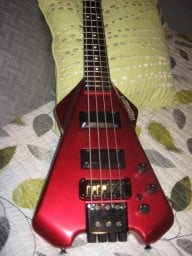
Yes to both. I had a 2012 Corvette and it must have been some sort of transitional model. It had a slimmer wenge neck (not ovangkol) and the adjustable nut was brass (not plastic). It was just a basic model but it had the features of a more expensive line. It also had a noticeable dead spot at the 7th fret on the G string (I bought it online) so it definitely helps to try before you buy.