• TalkBass has been independent since 1998. Add your voice.
    Create a free account to reply to discussions, view embedded media, and browse with fewer display ads.
    Join freeLog in
    Want zero display ads or expanded classifieds tools? Compare plans.

Help me understand

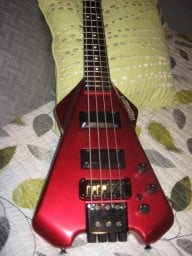
Welcome to TB Inkdork. Judging from your picture you have a later model Grind NTB (neck through). I believe this bass has a scale of 35" nut to bridge, so until you become more familiar with it i would do as most suggested and have it re strung at a music store. This bass has passive "soapbar" pick up's with a volume and a tone control for each. As far as i can remember they are on the heavy side but play great with nice low action. I preferred the original made in Vietnam models with the scalloped lower horn but they had very iffy QC. I once played a 5 string version with very light gauge strings and it killed for chordal work. Good luck to you.:)
 
No, don't be sorry. I think you're spot on. My other instruments I basically chose one I liked, and jumped in (which is why I have 5 ukes), but I like having information too.

I'm not overly concerned with things like "did I get a good bass" or "will people think it's cool" (haha don't even care) but how to best enjoy it. And for me that means learning about different things related to it.


"How to best enjoy it", that's the key, the rest will fall into place.
 
  • Like
Reactions: Inkdork
<internet history>
What's funny to long-time Net users like myself is that the meaning of "troll" has completely transformed from its early usage (I recall reading it in newsgroups around the mid 90s). It originally was used as the verb "troll" which refers to a manner of baited fishing. When someone was just egging people on, you'd see comments like, "ignore this guy, he's just trolling", i.e., he's just baiting you, trying to get a response... get you to bite, as it were. But some people would use the noun form and refer to a certain post as "a troll", i.e., a baited fishing line, and... well, lots more people think of a troll as those fantasy creatures than as baited fishing lines. :)
</internet history>
Wait! What? Trolls are fantasy creatures? I don't think so!

The above is an example of how a thread can get derailed around here.
It happens a lot. You'll find that you have to wade through it sometimes to get to the real meat of the discussion.

Then there are those who just like to turn a phrase or have some fun with something. I (ahem) can not point to anyone specifically right off the top of my head. :woot:

I have learned an awful lot of good info here, as opposed to learning a good lot of awful information here.
For me, the entertainment factor is a big plus as well. You may find that you come for the learning, and stay for the fun.

And in case someone else hasn't warned you yet. There is also such a thing called a PJ bass.
It's the best, or worst, depending on who you ask, of both worlds.
It has both a Precision bass style split pickup and a Jazz bass type of "pup." (Pup, short for pickup.)

Anyhows... welcome to TB, and that is an extremely nice looking bass you have. May you have many hours of enjoyment with it.

BTW, if haven't done so, what amp are you getting? Many of us here are gearheads, and obsess about the equipment sometimes more than we do about playing it. And gearhead is not the same as being an equipment snob. I own a Squier bass, so snobbery is not an option. We just like to see what others are using and also discuss the more technical aspects.
 
Last edited:
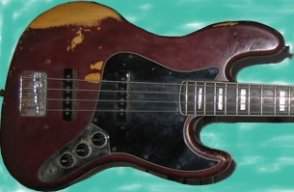
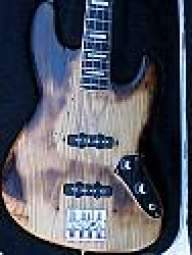
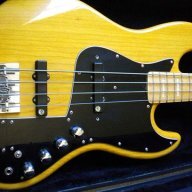
I must politely, but firmly, disagree with this notion. I feel it's the body-type that determines the bassic classification. To whit, can you tell me which of my basses are "Jazz Basses"? (Spoiler Alert: They're all Jazz basses, because of the offset body-shape, not because of the differing pickups each has. I use a similar analogy to cars. It doesn't matter what's under the hood of my Jetta…it's still a "Jetta". ;))

70sJazz03_zpsfe9979b9.jpg

DSCF0670_zpsnehdd8h5.jpg

JB62-All%20Black%2011_zpsprfxbeld.jpg

ProjektBlue04_zpscaf8d716.jpg
Fender agrees with you, but the rest of the world sees it as being determined by the pickup configuration.
 
Fender agrees with you, but the rest of the world sees it as being determined by the pickup configuration.

So I'll defer to the people who actually created it. As far as "the rest of the world" goes, I think some others on this thread alone have already bucked that blanket statement. But to expand upon my notion, does a Jazz body without any additional routing become "suddenly no longer a Jazz body" when you carve out something other than two, narrow channels?

I'm not trying to be argumentative or combative, especially in someone else's thread. I'm just putting out my thoughtful conclusion and trying to back it up with some easy logic. People can call my previously-pictured Jazzes whatever they want…

…but I know they're Jazzes. ;)
 
It would seem there are two opposing camps when it comes to tort.
It either belongs in discussions with the world's finest literature or paintings by the masters.
Or it is the most repulsive thing ever set eyes upon and must be immediately banished to the depts of hell.
There really is little wiggle room to be had here on the subject. And of course it's all in fun... I think. :whistle:
 
I posted an intro thread in the appropriate section, but thought this would be a better place to ask some questions.

I bought my first bass last night, a Peavey Grind 4 string, and aside from the fact it's beautiful, I don't know anything about it.

A friend who plays bass said it's a jazz bass - what does this mean? How is it different from whatever other types?

If I need to put new strings on it, how do I even begin to choose? I briefly looked in the shop section here out of curiosity and holy crap. I noticed aside from different weights, there are also extra long strings? So much easier choosing strings for my ukes!

I'm sure I'll have more questions soon. I have an order in with Sweetwater for a cable, stand, and strap which will arrive Wednesday. Bf is letting me use his old bass amp.

Theres a little sight out there known as YouTube.com that would answer all your questions.
Just look up
Peavey grind 4 bass review . Good luck.
 
  • Like
Reactions: Inkdork
So I'll defer to the people who actually created it. As far as "the rest of the world" goes, I think some others on this thread alone have already bucked that blanket statement. But to expand upon my notion, does a Jazz body without any additional routing become "suddenly no longer a Jazz body" when you carve out something other than two, narrow channels?

I'm not trying to be argumentative or combative, especially in someone else's thread. I'm just putting out my thoughtful conclusion and trying to back it up with some easy logic. People can call my previously-pictured Jazzes whatever they want…

…but I know they're Jazzes. ;)
That's fine and I wish you the best of luck on getting the rest of the world to fall in line with you, Mr Quixote.

I am not arguing about what is right, merely pointing out what the general consensus is out there, and why her friend erroneously described her bass as a jazz bass.
 
That's fine and I wish you the best of luck on getting the rest of the world to fall in line with you, Mr Quixote.

I am not arguing about what is right, merely pointing out what the general consensus is out there, and why her friend erroneously described her bass as a jazz bass.

I'd love to continue this discussion, but I have a hot date with a rather fetching windmill! :wacky: :D
 
  • Like
Reactions: HolmeBass
Here she is.... Lousy photo- the color is too dark in it. Our house has terrible lighting.

peaveygrind.jpg

That sure is a nice looking bass and I can see why someone would refer to it as a jazzer based on the offset body shape even though it isn't quite exactly like the Fender Jazz Bass body shape...it has that leaning forward going fast look (when it is strapped on to you) as opposed to the Fender Precision Bass squared off equilibrium look....and based on retailer sites and Peavey's site it is a 35-inch scale. If you ever wonder about that just measure from the nut to the bridge.

I've bee here a week and I am having a blast. I bought my first bass in May 2013 and I agree with a lot of statements here...just play, play, play and don't sweat the details....you'll learn all that as time goes by and talk to other bassists like here at TB.....plus about amps and pedals.....whole 'nother realm really

I've always been curious about UKEs and see that you're a UKE player first. When I saw that they had 4 strings I thought wow, I should check one out and then I learned that the tuning is gCEA as well as aDF#B and then dGBE for larger UKEs. When I found this out it pretty much scared me away from trying one, even a cheapie one. How is transitioning to EADG on a bass working? Playing with fingers or a plectrum? One finger, two fingers, three fingers?

Anyway, welcome......any aspirations to be the next Suzi Quatro? In other words....who is your fav bass player or what is your fav bass sound on any particular song and what prompted you to try the bass? Just the four string similarity or are there some friends of yours from your UKE playing who you can jam with? Having some one to jam with really helps too...regardless of your playing level....
 
Last edited:
  • Like
Reactions: Malak the Mad
Hi ... after reading a couple pages ... i have a quick comment on strings ...

since you play Ukes ... they have nylon strings .. ? correct .?

if you want a similar type feel for your bass ... you could try some ' tapewounds ' ... they are a variety kinda in the ' flats ' family , because they feel smooth ... ( like your Uke strings ) ... they might be a bit easier on your finger tips as you get started .. ! ??

have fun .. !!

check out Kala U basses .. !
 
  • Like
Reactions: Inkdork
There are several interpretations of whar a Jazz bass means. First off, it is the proper name of a Fender model.

Some people refer to any bass with two single coil jazz-style pickups as a Jazz bass. The Peavey grind is available with that pickup configuration as well as with at least one other non-jazz configuration. That is likely what your friend is referring to. I do not agree with calling anything with two jazz pickups a jazz bass btw.

Another interpretation of jazz bass is one that has a similar body style to the Fender Jazz bass. The Peavey Grind does not.

Either way, Jazz bass doesn't mean what genre of music it is applied to. Jazz basses can be used for all kinds of music.

As for strings there are two basic styles to choose from, flatwound and roundwound.

Flats are smooth (tactile) mellow, and thumpy, whereas rounds are more coarse (tactile), bright, and livlely. You will hear an infinite amount of terms used to describe one versus the other, but the above should suffice for now.

Length should match the bass. I believe the Grind is a standard 34" bass which for most string packaging is considered long-scale.

As for thickness I would stay with a set that ranges from 105-45 gauge until you decide there is a compelling reason to go lighter or heavier. My assumption is that the bass is currently setup with normal or average strings.

Brand is a matter of taste, as is material (nickle, steel, etc.)

There are an infinite set of choices, but it mainly comes down to taste. If you have a favorite bass sound that you like I would post that information (player/song/link) and people can likely give some recommendations for strings that would work towards that sound.
Get a good teacher.
Learn standard notation.
The details you are asking don't matter right now, but the will be very important on time.
 
  • Like
Reactions: Inkdork
Get a good teacher.
Learn standard notation.
The details you are asking don't matter right now, but the will be very important on time.

....especially a teacher who plays bass as his bread and butter....not a guitar player who teaches bass....you'll learn a lot of things you'll need to unlearn later....
 
  • Like
Reactions: Les Ismoor
I posted an intro thread in the appropriate section, but thought this would be a better place to ask some questions.

I bought my first bass last night, a Peavey Grind 4 string, and aside from the fact it's beautiful, I don't know anything about it.

A friend who plays bass said it's a jazz bass - what does this mean? How is it different from whatever other types?

If I need to put new strings on it, how do I even begin to choose? I briefly looked in the shop section here out of curiosity and holy crap. I noticed aside from different weights, there are also extra long strings? So much easier choosing strings for my ukes!

I'm sure I'll have more questions soon. I have an order in with Sweetwater for a cable, stand, and strap which will arrive Wednesday. Bf is letting me use his old bass amp.

I think they may have called it a jazz bass because the peavey grind looks kinda fancy with the bare wood finish and all :) as you've found, that's not what you have there, but there's no reason you couldn't jazz it up with that bass, other than not knowing how.

That's a great beginner bass, assuming the neck is properly adjusted. I've always really liked peavey's entry and mid level guitars. I tell all my new students who are clueless about string selection to get Daddario EXL170 strings. They are strings. They go on bass, make bassy sounds. Over the years you'll experiment with different brands, the ones I recommend are readily available, easy enough on the fingers, and only cost $20 or so. You'll probably want to change the strings that came on the bass, they're probably dead as door nails if it was hanging in a shop. If it's brand new in the box, the strings it shipped with would probably be fine to get going.

Not to sound biased since I am a teacher, but get a teacher :-) Even just 1 session to get your bass set up and learn good fundamentals from the beginning. I'm not talking an in depth bass setup, just neck and bridge adjustments to get it in decent playing shape, ask prospective teachers if they do that, most do, it only takes 5-10 minutes to make ballpark adjustments if any are needed to begin with. A bass player/teacher will often do a much better job setting your instrument up than some guitar tech in a store. And since you already play uke you've got a head start, but there are some basic physical concepts that might not be obvious when making a huge change in instrument size. Better to get it right from the getgo rather than learn bad habits.

Have fun!
 
Fender agrees with you, but the rest of the world sees it as being determined by the pickup configuration.

To me, a jazz bass is a model of Fender bass. It is a Jazz® Bass. Nothing else is a Jazz Bass.

A jazz-style bass is any bass with the same basic body shape (does not need to be exactly the same) and same pickup configuration as a Jazz® Bass (two single coil pickups placed in approximate location as a Jazz® Bass), with a neck approximately 1.5" wide at the nut (for 4 strings). There are hundreds of these and people also build them from parts. I have both a Jazz® Bass and several jazz-style basses. So the Peavey is not a Jazz Bass or a jazz-style bass. But it is perfectly good bass.

Anything else that is part Jazz® Bass/jazz-style bass and part other stuff needs additional modifying designation, such as Precision bass with a jazz neck; Jazz bass with a P neck; a PJ bass (a split-coil or "P" or Precision-style pickup in the neck and a jazz bass style narrow single coil or "J" pickup at the neck etc.) Etc.
 
Hi ... after reading a couple pages ... i have a quick comment on strings ...

since you play Ukes ... they have nylon strings .. ? correct .?

if you want a similar type feel for your bass ... you could try some ' tapewounds ' ... they are a variety kinda in the ' flats ' family , because they feel smooth ... ( like your Uke strings ) ... they might be a bit easier on your finger tips as you get started .. ! ??

have fun .. !!

check out Kala U basses .. !
I just put a set of nylon tape wounds on my bass. Replaced a set of Chromes. So I was going from flat wound Chromes to flatwound with a nylon tape wind on top. There was not a lot of difference in feel between the two, not like there is going from rounds to flats, but I like how the tapes sound right out of the box. Chromes can be kind of bright at first and seem to get "better" (if you prefer something darker) as they break in. For me the new tapes, sound like Chromes that are already broken in plus they seem to have a bit more growl to them, if you like that sound.
Bass is a heavily modded (including a high mass bridge) Squier Jag short scale played through a Fender Rumble 200 combo. All of that contributes to the sound I get. But I definitely like the tapes better than the Chromes on this rig. Both sets of strings are D'Addario, so same manufacturer in my comparison.
When you get around to needing/wanting new strings, I highly recommend Bass Strings On-line. Great prices, excellent customer service.
 
if you want a similar type feel for your bass ... you could try some ' tapewounds ' ... they are a variety kinda in the ' flats ' family , because they feel smooth ... ( like your Uke strings ) ... they might be a bit easier on your finger tips as you get started .. ! ??

have fun .. !!

S'up, Dave? :D

@Inkdork; On a similar note, I remember the strings on my first-ever bass being D'Addario Chromes of the .100-.45 gauge persuasion. When I took my bass, a used Fender Aerodyne, in for a much needed setup, a guy at the local Mom-and-Pop music store suggested them to start with.

They weren't too stiff, thanks to the slightly lighter gauge, and they produced a nice, rich sound which was a definite encouragement to practice more. Also, they're kinder to the skin of my fingertips. As time went on and I built up enough confidence to stop treating my bass like a delicate, little flower, I found I could wring a bit of "bite" out of them, despite flats being inherently mellow by nature.

Oh, since we're talking about "strings", one more tip. I've found the easiest way to get different sounds out of a bass is not changing pickups or bridges, but strings. Different strings open up different "sonic palettes", much like different types of paint bring forth different hues and colors. Some basics still apply…rounds are brighter, flats are warmer, etc…but the different sounds evoked by variations of metallurgy and engineering cannot be downplayed. Certainly, the qualities and shortcomings of different strings are subjective, but with a little time and experimentation, you just might find that magic formula that turns a so-so sounding bass into something kinda magical. ;) (…not that I'm implying your bass is "so-so", since I've never played one before)

EDIT: Oh, yeah…like Dave says, "Have fun!" :woot: