• TalkBass has been independent since 1998. Add your voice.
    Create a free account to reply to discussions, view embedded media, and browse with fewer display ads.
    Join freeLog in
    Want zero display ads or expanded classifieds tools? Compare plans.

Help me understand

I know exactly what you're going through. You got a bass. You want to play it. You're perusing the threads and you see all this information. Types of basses. Strings. Amps. Effects. It's overwhelming. There's so much.

None of it matters. You don't need to know any of that right now. Just play your bass. Get a bass teacher if you can. What kind of bass you have or what kind of strings are the last things you should be focusing on. Believe me. I did what you're doing. Lots of other beginners do it. It'll only distract you and cost you money. Just play.

Sorry for the derail but I speak from experience. This is not the time to learn about basses. This is the time to play.

I consider myself lucky to have started playing bass (and other stuff) over thirty years ago. I just bought the bass that a knowledgeable friend told me to, put on the strings he suggested and went at it. It's probably harder for a beginning to focus on actual musical stuff with the distractions of all this information.

Otto
 
  • Like
Reactions: Old Garage-Bander
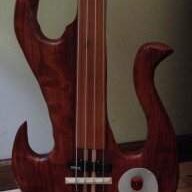
Here she is.... Lousy photo- the color is too dark in it. Our house has terrible lighting.

peaveygrind.jpg

Why has the bass been relegated to the comic book storage room??

:D
 
....especially a teacher who plays bass as his bread and butter....not a guitar player who teaches bass....you'll learn a lot of things you'll need to unlearn later....
There are good music teachers with day gigs ( I used to be one).

There are some good guitar players that play bass extremely well-
Make sure they are competent in reading bass clef- not just know the lines and spaces.
 
I just put a set of nylon tape wounds on my bass. Replaced a set of Chromes. So I was going from flat wound Chromes to flatwound with a nylon tape wind on top. There was not a lot of difference in feel between the two, not like there is going from rounds to flats, but I like how the tapes sound right out of the box. Chromes can be kind of bright at first and seem to get "better" (if you prefer something darker) as they break in. For me the new tapes, sound like Chromes that are already broken in plus they seem to have a bit more growl to them, if you like that sound.
Bass is a heavily modded (including a high mass bridge) Squier Jag short scale played through a Fender Rumble 200 combo. All of that contributes to the sound I get. But I definitely like the tapes better than the Chromes on this rig. Both sets of strings are D'Addario, so same manufacturer in my comparison.
When you get around to needing/wanting new strings, I highly recommend Bass Strings On-line. Great prices, excellent customer service.

S'up, Dave? :D

@Inkdork; On a similar note, I remember the strings on my first-ever bass being D'Addario Chromes of the .100-.45 gauge persuasion. When I took my bass, a used Fender Aerodyne, in for a much needed setup, a guy at the local Mom-and-Pop music store suggested them to start with.

They weren't too stiff, thanks to the slightly lighter gauge, and they produced a nice, rich sound which was a definite encouragement to practice more. Also, they're kinder to the skin of my fingertips. As time went on and I built up enough confidence to stop treating my bass like a delicate, little flower, I found I could wring a bit of "bite" out of them, despite flats being inherently mellow by nature.

Oh, since we're talking about "strings", one more tip. I've found the easiest way to get different sounds out of a bass is not changing pickups or bridges, but strings. Different strings open up different "sonic palettes", much like different types of paint bring forth different hues and colors. Some basics still apply…rounds are brighter, flats are warmer, etc…but the different sounds evoked by variations of metallurgy and engineering cannot be downplayed. Certainly, the qualities and shortcomings of different strings are subjective, but with a little time and experimentation, you just might find that magic formula that turns a so-so sounding bass into something kinda magical. ;) (…not that I'm implying your bass is "so-so", since I've never played one before)

EDIT: Oh, yeah…like Dave says, "Have fun!" :woot:

These aren't terrible ideas, and anything that will get you playing is the way to go, but I teach all ages and sizes of students, I don't recommend flat or tapewound strings for students, unless they are going for a specifically vintage tone. The modern standard is roundwound strings, on a properly set up bass they often feel "looser" due to less tension and therefore EASIER to play than metal flatwounds. Tapewounds are even more in the novelty vintage direction, great for recording, but definitely not a modern sound at all. Plus tapewounds can cause ground hum since the strings don't directly contact your fingers... not trying to pi** on your parade, if flats or tapes are your thing, so be it, and they will certainly be less abrasive than rounds, but in 20 years of teaching I have never recommended a student to get either. If you have a condition or injury that requires them, or just flat out like them, so be it, but the "real" reason to get flats or tapes is for their unique sound.
 
You are waiting until WEDNESDAY for an instrument cable?!! Lots of stores carry these. Besides your local music shop, even some stores like Target or Best Buy might carry a very (very!) cheap instrument cable. I think I've even seen them in Toys R Us.

Yes... LOL. I'm telling myself I can make it until then, but now I'm not so sure. I might need to go find another one for the meantime.
 
  • Like
Reactions: pcake
A bass AND a stack of longboxes? Is this... Some kind of dream...?
There are seven major and eleven minor running jokes here on TB. In time, with practice and dedication, you will master them all.

LOL MY BF is an avid comic collector.... So those are his. We also have an entire room dedicated to his Lego collection. My own non-musical pursuits are more of the yarn and bead and fabric varieties. :)

haha I'm sure I will in time!
 
Welcome to TB!!!

All very very good points so far! My little bit I'd add in would be to say, while waiting on a strap and instrument cable, you could still play your bass! One of the best things (to me and those that I teach) is to sit down with your bass, and get it into a comfortable position. Make sure you're not resting on your elbows or anything, and can freely and comfortably move around the neck. When your strap arrives, set it up so that the bass is in the same position as when you are sitting, when you are standing (...) and something I learned in High School Jazz band "If you end up playing a wrong note, play it again a few more times to make it look like it was on purpose".

Have fun with learning the bass!

Makes sense to use the same position sitting or standing. :) And LOL The wrong note thing- Sounds like me and my violin! Make a mistake? Improvise a few notes, it was totally on purpose!
 
  • Like
Reactions: Matthew_84
"You are never more than a half-step away from a right note."
Victor Wooten

That's the actual quote. He goes on to break it down just by following C major scale. He says if you mess up and hit a black key by accident, there is a white key to either side of that. The jazz band was when I was one of the only 10th graders allowed into my HS jazz band on trombone. First week or so he had everyone improvise a solo, I was new to that idea (usually just played what was written, this changed that) and he told me this in front of everyone. Needless to say, I said "to H#$% with Key signatures now, I'm doin my own thing".
 
  • Like
Reactions: Inkdork
I might be a minority voice here, I dunno. I have only 2 comments.

The first is that when I was learning I wanted to sound halfway decent as early as possible. I found that the fingers on my fretting hand created a lot of extraneous noise with roundwound strings in the beginning, something that flatwounds did not. Also, since I was a guitarist I was used to using a pick so I started out playing flatwound strings with a pick and that allowed me to sound as good as I could in the early stages. After about a year I started plucking with my fingers and also added roundwound strings later still as my fretting ability improved. I still use a pick on some songs though, especially when speed and accuracy are required. Fingers and pick are mutually better than using only one or the other exclusively.

Point is, I'm not suggesting that you play bass with roundwounds and a pick forever. Just saying that recipe allowed me to maximize the fun of playing bass early on when I was not very good at it (fun is verrry important, IMHO). Your mileage may vary. BTW, about 35%-40% of players favor a pick. The majority will prefer using their fingers.

Second point is your choice of bass. Like you, I really didn't know what to get in the beginning. I just found a good deal on an used Ibanez and ran with it. While it was a decent bass there were many aspects about it that I liked (and did not like), so that Ibanez really became the basis for what my second bass should be. I sold my first bass (and have since acquired too many extra basses since) but most bassists that actually play in front of an audience prefer having at least one extra as insurance in the event your one and only craps out. And, although not particularly common, they sometimes do crap out.

The only problem is that acquiring new or different basses can be habit-forming, a condition known as GAS (short for Gear Acquisition Syndrome). I only mention it because you'll see it a lot and it's not intuitive as to what the acronym stands for.

Otherwise, just start playing and try to have as much fun in the process as possible.

I find a using a pick difficult, but maybe because I'm just not used to it- though I do like the sound it gives on my banjolele so I use a felt one on it. And I use a hard one on my mountain dulcimer. Probably start off on the bass with just my fingers.

Yeah, totally went into this blind. But that seems to be my way- jump in with both feet, and hope I can swim!

GAS... On the UU boards we have Ukelele Acquisition Syndrome (also New Ukulele Day), and on a musical instrument subforum of a yarncraft forum, we have the more general Musical Instrument Acquisition Syndrome.
 
  • Like
Reactions: Matthew_84
Welcome to TB Inkdork. Judging from your picture you have a later model Grind NTB (neck through). I believe this bass has a scale of 35" nut to bridge, so until you become more familiar with it i would do as most suggested and have it re strung at a music store. This bass has passive "soapbar" pick up's with a volume and a tone control for each. As far as i can remember they are on the heavy side but play great with nice low action. I preferred the original made in Vietnam models with the scalloped lower horn but they had very iffy QC. I once played a 5 string version with very light gauge strings and it killed for chordal work. Good luck to you.:)
Actually its the BXP, though I have no idea what the difference between that and the NTB model is.

Yup... she's really heavy. A shock because all my other instruments feel like a bag of feathers in comparison!
 
BTW, if haven't done so, what amp are you getting? Many of us here are gearheads, and obsess about the equipment sometimes more than we do about playing it. And gearhead is not the same as being an equipment snob. I own a Squier bass, so snobbery is not an option. We just like to see what others are using and also discuss the more technical aspects.

BF is letting me use his old bass amp- its a Crate something or other- I haven't really looked at it to be honest... LOL. Of course we are assuming it works. It powers on anyway, but if its dead I guess I'll be shopping for one of those too.
 
I've always been curious about UKEs and see that you're a UKE player first. When I saw that they had 4 strings I thought wow, I should check one out and then I learned that the tuning is gCEA as well as aDF#B and then dGBE for larger UKEs. When I found this out it pretty much scared me away from trying one, even a cheapie one. How is transitioning to EADG on a bass working? Playing with fingers or a plectrum? One finger, two fingers, three fingers?

Anyway, welcome......any aspirations to be the next Suzi Quatro? In other words....who is your fav bass player or what is your fav bass sound on any particular song and what prompted you to try the bass? Just the four string similarity or are there some friends of yours from your UKE playing who you can jam with? Having some one to jam with really helps too...regardless of your playing level....

You can also put a low G string on a uke, which I've just done with my concert. It completely changes the voice. Baritones are tuned like the first 4 strings of a guitar, which makes them popular with guitar players to transition into. And I've found a lot of people who once they pick one up, find themselves hooked- unless its horribly out of tune, ukes sound fun and friendly and just sound happy. But I've heard some great metal covers on them too. I use a felt pick on my banjolele, but otherwise I prefer my fingers.

haha I honestly don't have one. I think I may have mentioned upthread I should have called myself Goldilocks- I want to try all the things looking for the perfect fit. I think there are a few members of the local uke club who play bass though. Might talk to them about it. :)
 
  • Like
Reactions: B-Mac
Actually its the BXP, though I have no idea what the difference between that and the NTB model is.

Yup... she's really heavy. A shock because all my other instruments feel like a bag of feathers in comparison!

BXP are made (I believe) in Indonesia. They're definitely not made in America. So, they are considered to not be as high in quality as the American made versions. I have a Millennium 5 BXP, and it's a very solid bass. I think the BXP line is a great value for the money - especially if you buy them used at wonderful prices.
 
  • Like
Reactions: Inkdork
Yes... LOL. I'm telling myself I can make it until then, but now I'm not so sure. I might need to go find another one for the meantime.

you know, you can play your bass without plugging it in - you can learn a lot of stuff just as well. and since you play uke, i expect you'll pick it up fast.

btw, welcome to the board and congrats on your really cool new bass!
 
  • Like
Reactions: Inkdork and Sartori