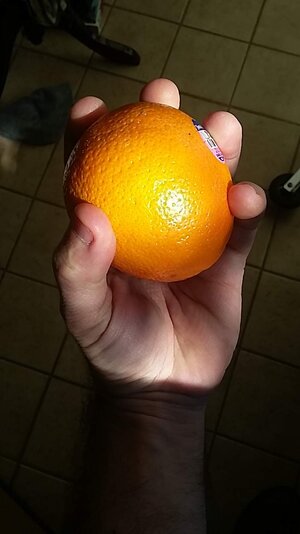
Thanks. I am not sure if my thumb position is proper at all. My thumb parallel with the back of the neck, not across it, like I see most players suggest. I don't know if this is merely a matter of my hands being shorter than your average bassist, or because of how I have played guitar most of my life, but it seems to be the natural way I am inclined.
If I make a C with my hand, and measure the inside of it from the tip of my middle finger (the longest) to the tip of my thumb, it's approximately 8 1/4 inches. This is not very long in my estimation, and may be why I'm cranking my thumb parallel to the board to get more purchase when fretting, especially when I'm playing the D and G strings or higher up the fretboard.
First, get out of your mind that the size of your hand has anything to do with anything. It doesn't. You're creating a mental block by thinking it does. My hand is no bigger than yours and I play a fairly wide 6, 35" scale 5, and a 42" upright with plenty of ease.
Second, no, the thumb should not be parallel to the neck. That restricts the motion of your fingers and makes your palm collapse. Don't press with the thumb; keep it there for stability and to maintain hand shape. Take a soda can and wrap your fingers around it, with your thumb perpendicular to the center axis of the can and your fingers spread out slightly. That's the basic shape your hand should take on the neck, thumb perpendicular to the neck and more or less opposite the middle finger, or slightly between the first and middle fingers. Keep a relaxed hand and do not mash. Pull back with the shoulder, rather than mashing with your hand. Don't let the fingers collapse flat against the board. Make sure you're pressing down right at the fret, not way back toward the previous fret. The amount of leverage required to stop the string is the lowest at the fret, not way behind it.
Much like your right hand, you have to spend time focusing on the left hand. With time it'll come more naturally. Pay attention to keep a nice rounded shape to your fingers and your wrist basically straight. This may also require you to adjust the height and/or angle of the neck. Don't be afraid to use a 1-2-4 technique on the lower frets. I do that all the time.