• TalkBass has been independent since 1998. Add your voice.
    Create a free account to reply to discussions, view embedded media, and browse with fewer display ads.
    Join freeLog in
    Want zero display ads or expanded classifieds tools? Compare plans.

Help! New to bass.

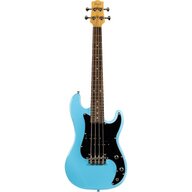
Wanting to stay in the under $300 range, what short scales are good? I see the Fender Mini Precisions, Fender Squire Sonic Broncos, Jacksons, Ibanez, Music Man... reviews are all over the place on which is "best".
That's because "best" is subjective. A lot of folks love the sound of a Stingray, and will say they're the best basses they've ever played. I've never really warmed up to them though. A lot of it just comes down to personal taste.

It's tough to know what makes an instrument the best for you when you're just starting out. I would suggest narrowing it down to a short list of options that you like the look of - I know it sounds superficial, but it is important to have an instrument that you want to pick up and play. Then from that short list, look on Reverb and see what they sell for used. If they sell for not a lot less than new, that's a good sign that you'll be able to sell it later on if you want to replace it with something else.

You also might want to think about what sort of bass sound you like. Again, this is harder as a beginner, but are there recorded bass tracks that you hear and think, "yeah, that's what I want to sound like"? If so, drop a link and we can make our best guess as to which sort of pickups will get you closest. A P bass, jazz bass, or Stingray style bass all have different tonal characteristics, and if you want the sound of a Stingray you'll find yourself disappointed with a P bass. (Keep in mind that your amplifier will also affect a lot of your tone, what sort of amp do you have or plan to get?)

With any instrument in the low budget range (and sometimes even at higher price points), there is always a chance that there is some sort of quality issue, so when you do get your instrument a few things that you should look out for include:
  • Are the fret ends along the edge of the neck sharp? Sometimes they will "sprout" out of the wood. This isn't too hard for a luthier to fix, but it will add to the total cost.
  • Are the frets well seated in the fret board, or are some of them starting to pop up?
  • Is the neck tight in the neck pocket? Is it mounted straight on?
  • Do the strings look like they're well centered on the neck, or do you notice that there is more room on one side of the fretboard? This will be most obvious at the heel of the neck, where it connects with the body.
  • Is the neck warped/twisted? I'm not talking about a little bit of curvature or bow to the neck, that is adjustable to some extent with the truss rod. A twist in the neck is a much bigger problem.
  • Are there any scuffs/dents/dings in the wood that will bother you?
  • How does it feel to turn the knobs? Do they feel loose, or do they stay where you set them? Some crackling while turning isn't necessarily a problem, but if it doesn't go away after turning the knob up and down several times, it may be a bad potentiometer.
Some of these issues can be repaired, and depending on your skill level with tools you may even be able to do some yourself. But ideally you want something that comes out of the box decent and playable with nothing more than an initial set up. As others have mentioned, you can pay to have this done, or you can learn to do it yourself with fairly inexpensive tools.
 
That's because "best" is subjective. A lot of folks love the sound of a Stingray, and will say they're the best basses they've ever played. I've never really warmed up to them though. A lot of it just comes down to personal taste.

It's tough to know what makes an instrument the best for you when you're just starting out. I would suggest narrowing it down to a short list of options that you like the look of - I know it sounds superficial, but it is important to have an instrument that you want to pick up and play. Then from that short list, look on Reverb and see what they sell for used. If they sell for not a lot less than new, that's a good sign that you'll be able to sell it later on if you want to replace it with something else.

You also might want to think about what sort of bass sound you like. Again, this is harder as a beginner, but are there recorded bass tracks that you hear and think, "yeah, that's what I want to sound like"? If so, drop a link and we can make our best guess as to which sort of pickups will get you closest. A P bass, jazz bass, or Stingray style bass all have different tonal characteristics, and if you want the sound of a Stingray you'll find yourself disappointed with a P bass. (Keep in mind that your amplifier will also affect a lot of your tone, what sort of amp do you have or plan to get?)

With any instrument in the low budget range (and sometimes even at higher price points), there is always a chance that there is some sort of quality issue, so when you do get your instrument a few things that you should look out for include:
  • Are the fret ends along the edge of the neck sharp? Sometimes they will "sprout" out of the wood. This isn't too hard for a luthier to fix, but it will add to the total cost.
  • Are the frets well seated in the fret board, or are some of them starting to pop up?
  • Is the neck tight in the neck pocket? Is it mounted straight on?
  • Do the strings look like they're well centered on the neck, or do you notice that there is more room on one side of the fretboard? This will be most obvious at the heel of the neck, where it connects with the body.
  • Is the neck warped/twisted? I'm not talking about a little bit of curvature or bow to the neck, that is adjustable to some extent with the truss rod. A twist in the neck is a much bigger problem.
  • Are there any scuffs/dents/dings in the wood that will bother you?
  • How does it feel to turn the knobs? Do they feel loose, or do they stay where you set them? Some crackling while turning isn't necessarily a problem, but if it doesn't go away after turning the knob up and down several times, it may be a bad potentiometer.
Some of these issues can be repaired, and depending on your skill level with tools you may even be able to do some yourself. But ideally you want something that comes out of the box decent and playable with nothing more than an initial set up. As others have mentioned, you can pay to have this done, or you can learn to do it yourself with fairly inexpensive tools.
I tend to lean more towards a "clean" sound. I have a Fender Rumbler 25 and a Fender Mustang Pro headphone amp that I believe are versatile enough as I grow with the bass.
 
  • Like
Reactions: Adjectives
I tend to lean more towards a "clean" sound. I have a Fender Rumbler 25 and a Fender Mustang Pro headphone amp that I believe are versatile enough as I grow with the bass.
Both good options. I have the Mustang headphone amp (not the pro version, I bought mine before that came out) and you can achieve clean tones from either. You can also get clean with any of the basses, it's more a question of how much treble, mid-range, and bass frequencies you get.

The "classic" bass guitar sound is a P bass, you've certainly heard these before. Think Motown, but also a lot of classic rock, r&b, country... strong low end with some mid-range, it's said to sit well in a mix (meaning it doesn't stand out as much against other instruments).

A mustang will sound similar, maybe just a little lower output. Lots of fundamental. Listen to Marquee Moon by Television for a good idea of how it sounds.

A jazz bass is a little more versatile due to having two pickups. It's a good option if you want to play slap bass. The pickups are single coils and will hum unless you have both of them on full, this bothers some people but they're very articulate. I love single coils. Geddy Lee played one with Rush on many of their albums.

A Music Man/Stingray type bass has a single large humbucker pickup, which won't hum. It has a punchy mid-range and will typically cut through the mix rather than sitting in it. Queen's Another One Bites The Dust is a good example of the Stingray sound. Many Stingray basses are active with an onboard preamp that requires a 9v battery - I don't know if the one you're looking at has this, but if it does, just remember to unplug the cord when you're not playing as the battery will drain if left in.
 
Plenty more knowledgeable people here already giving advice, so nothing to add there.

Now, what I think I'm hearing here is "I bought X, now what do I do"

I may have misread it, because very often that's the kind of thing newbies post (not just bass but anything). But if that is the case, I would suggest turning it around and asking: what is it you want to accomplish? and then, what device or process will get you there?

In my experience, it's best to start with the instrument that does what you're trying to do. Perhaps this bass is the thing, perhaps it isn't' depends what you want to do. But simpler is simpler, and common means less struggle with technical issues and parts, so I'd start with simple and common. If that's any help.
 
  • Like
Reactions: Adjectives
Plenty more knowledgeable people here already giving advice, so nothing to add there.

Now, what I think I'm hearing here is "I bought X, now what do I do"

I may have misread it, because very often that's the kind of thing newbies post (not just bass but anything). But if that is the case, I would suggest turning it around and asking: what is it you want to accomplish? and then, what device or process will get you there?

In my experience, it's best to start with the instrument that does what you're trying to do. Perhaps this bass is the thing, perhaps it isn't' depends what you want to do. But simpler is simpler, and common means less struggle with technical issues and parts, so I'd start with simple and common. If that's any help.
Yea, that is it in a nutshell, unfortunately.
 
Could another option be switching out the neck for a short or full scale size?
It's unlikely that you'd find a full scale neck that would fit the pocket on the body, and even if you did, the bridge on those Flight basses isn't as far back as they are on more standard basses. Not to mention setting everything up, and the position of the pickup relative to the scale would change so it would sound tighter than a normal P bass.

I also don't think that you'd find and be able to install a suitable neck for any less than just the cost of returning the Flight and getting a whole new bass.
 
  • Like
Reactions: EliasA
Could another option be switching out the neck for a short or full scale size?
My experience playing guitars and basses for 20 years says that you should buy something that is fit for purpose as it is, rather than trying to upgrade or glow something up into what you want. You save money and are happier in the long run just buying what it is you need in the first place.

The budget offerings from the major brands today are really quite good. from Fender you have the Squier Sonic Bronco Bass which is a short scale and small body, but I'd encourage you to check out the Affinity Precision Bass if you can find one. These are pretty common and are plentiful on the used market. They have the long 34" Fender scale, use the most common strings, and the advantage there would be that if you stick with bass and upgrade later, you'll already be used to the standard size and scale of most basses.

The Squier Mini instruments are available from Fender as well, but these are pretty small and are intended more for kids to learn on I believe.
 
I'm probably wrong but those gauges sound like it should be tuned BEAD. If you have it tune EADG then the tension must be very high and the neck would be bending from the pressure. Unless the shorter scale offsets the tension somehow.
It's a very short scale, imagine a 34" with a capo on the 7th fret. Tuned to EADG with those strings, the tension is equivalent to a long scale downtuned a whole tone.
 
  • Like
Reactions: FunkHead
Yea, that is it in a nutshell, unfortunately.
oh yes? well, that's good news: it means we are defining the problem more usefully.

Recently I returned a bass that wasn't working out for me. This lost me over $100 in return shipping, but *not* returning it would have lost me $800. I'm not glad to have lost money, but sometimes learning comes at a cost.

Only you can define what you want to do, and why a bass is the tool to get you there. Sounds like you just need an entry-level bass and six months to play it. If you do, you may find a world of enjoyment waiting for you; if not, you'll better understand what doesn't work for you. At least, that's how it was for me.

Cheers
 

Latest posts