
Enjoy the benefits of a premium membership!
Upgrade Account
-
TalkBass has been independent since 1998. Add your voice.
Create a free account to reply to discussions, view embedded media, and browse with fewer display ads.
Join free Log in
Want zero display ads or expanded classifieds tools? Compare plans.
You are using an out of date browser. It may not display this or other websites correctly.
You should upgrade or use an alternative browser.
You should upgrade or use an alternative browser.
More options
Who Replied?@rllefebv:
View attachment 3085045
200S with the bottom half of a 215S cab... While I wouldn't mind a 200S cab, this 1X15 brings the Thump! And yes @Stumbo an fDeck HPF is wonderful in front of it!
-robert
200S with the bottom half of a 215S cab... While I wouldn't mind a 200S cab, this 1X15 brings the Thump! And yes @Stumbo an fDeck HPF is wonderful in front of it!
-robert

Apologies in advance for not reading all 40 pages to look for an answer to my question. In short are you suggesting that a high pass filter be on the instrument line before the DI to the house subs?
Or should the unfiltered signal go to the DI so that the sound engineer at the board can decide what to do with the ultra low frequencies? Please advise.
Or should the unfiltered signal go to the DI so that the sound engineer at the board can decide what to do with the ultra low frequencies? Please advise.

Apologies in advance for not reading all 40 pages to look for an answer to my question. In short are you suggesting that a high pass filter be on the instrument line before the DI to the house subs?
Or should the unfiltered signal go to the DI so that the sound engineer at the board can decide what to do with the ultra low frequencies? Please advise.
IMO the answer to your question comes down to how much you trust your engineer at any given venue.
If the acts are all terribly boomy before me, and the engineer is having a tough time taming the room, I'd likely make sure that I give him a post-signal with at least some sort of HPF or rumble filter engaged.
If I trust the engineer, and things are sounding good, I'd consider giving him the full signal to mold as he sees fit.
If your tone sounds exactly how you want it without all of the additional low-end though, I don't see much of a reason to give the engineer any more than what's needed. A lot of it's just preference, but be forewarned, if you aren't completely confident in your tone, giving an engineer any less flexibility gives him less room to make you sound good!

Cool. I have only ever owned one amplifier with a high pass filter and it was a Hartke 2000. It was a simple switch on the back that I always left in the on position.
What are the high pass filter advocates perspective on Bag End equipment that specifically is designed to go down to 8 Hz?
Seems somewhat contrary to the idea of a high pass filter. Please advise.
What are the high pass filter advocates perspective on Bag End equipment that specifically is designed to go down to 8 Hz?
Seems somewhat contrary to the idea of a high pass filter. Please advise.
Cool. I have only ever owned one amplifier with a high pass filter and it was a Hartke 2000. It was a simple switch on the back that I always left in the on position.
I think if you dug a little deeper you'd find that many amps have some sort of low-frequency filter on them, even if it isn't highlighted or user adjustable (often for marketing purposes: "I play BASS, I WANT LOWS")!
What are the high pass filter advocates perspective on Bag End equipment that specifically is designed to go down to 8 Hz?
Which models in particularly are you referring to? Surely that must be at a significantly decreased dB level...
I'll withhold any judgement until I can look up the specific model in question, but my finger is on the BS button.

Bag End is very reputable and respected. Here is a link to the line with the flat 8hz response.
[Invalid or Expired Link Removed]
From my perspective it comes down to application. This line of products is really designed for high-end theater performances for a low rumble and even a sub hearing rumblings are desirable. They do also make musical instrument systems that have standard expected frequency response.
[Invalid or Expired Link Removed]
From my perspective it comes down to application. This line of products is really designed for high-end theater performances for a low rumble and even a sub hearing rumblings are desirable. They do also make musical instrument systems that have standard expected frequency response.
Bag End is very reputable and respected. Here is a link to the line with the flat 8hz response.
[Invalid or Expired Link Removed]
From my perspective it comes down to application. This line of products is really designed for high-end theater performances for a low rumble and even a sub hearing rumblings are desirable. They do also make musical instrument systems that have standard expected frequency response.
I thought that might have been where you were going. Correct about application, those are not marketed as musical instrument systems - for good reason!
Their bass oriented cabs have more reasonable bass oriented responses, but still - it's one thing for a cab to be over-engineered to a certain spec, it's another to use it to that spec. My Fearless cab is an excellent example of that!
Seems somewhat contrary to the idea of a high pass filter. Please advise.
On a hollow stage in a room with terrible acoustics, one would see the benefit.
Apologies in advance for not reading all 40 pages to look for an answer to my question. In short are you suggesting that a high pass filter be on the instrument line before the DI to the house subs?
Or should the unfiltered signal go to the DI so that the sound engineer at the board can decide what to do with the ultra low frequencies? Please advise.
I suggest reading/studying the OP more closely and more of the first 40 pages to gain understanding of where it fits in a signsl chain and why.
An HPF is an eq. It's used to solve a problem(s). Take it from there.
@JimmyM's post quoted in the OP on the use of H/LPFs will give you the info to answer your question about DI and HPF use.
I suggest reading/studying the OP more closely and more of the first 40 pages to gain understanding of where it fits in a signsl chain and why.
An HPF is an eq. It's used to solve a problem(s). Take it from there.
@JimmyM's post quoted in the OP on the use of H/LPFs will give you the info to answer your question about DI and HPF use.
Cool. Do you send a filtered signal through your DI to the PA? What is your usage look like? Please advise
Cool. Do you send a filtered signal through your DI to the PA? What is your usage look like? Please advise
Depends on what the FOH sound guy wants to use, and how much I trust him. Sometimes I will send the post-EQ signal from my amp, which then would include all the high pass filtering I'm applying upstream. This happens in two cases, one where I don't trust the soundguy/system/room as far as I can throw him, or two where the soundguy specifically asks for my fully affected signal to work with.
Other times I'll let them take the DI first in the chain for the cleanest possible signal for them to manipulate at FOH. I don't mind doing this when I know who I'm working with and there's a certain amount of mutual understanding.
Third option is to DI between my pedalboard and the amp, which would get some modest filtering along with compression and overdrive, but not as much as post-amp eq. The Aguilar Tonehammer "Drive" control really narrows the bandwidth a lot once the signal hits the amp.
Last edited:

I darn sure do. Some of these younger guys, I can't trust to roll off the lows like I like and they make me sound like the inside of Snoop Dogg's car trunkCool. Do you send a filtered signal through your DI to the PA? What is your usage look like? Please advise

Find the tone you like and send it to the board. Whether that is with the HPF or not will be determined by what it takes to get the tone you like.Thanks. What about you Stumbo? Please describe your last show as far as signal chain and whether or not a filtered signal was sent to the PA.
I darn sure do. Some of these younger guys, I can't trust to roll off the lows like I like and they make me sound like the inside of Snoop Dogg's car trunk
Do you think they can make you smell like the inside of Snoop Dogg’s trunk? Jk
Interesting this topic.
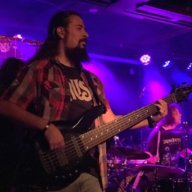
I did noticed I use my HPF really high on my D-800+, and found out that's the best tone with no booming or mud. Sometimes I kinda like to back it to "noon", but never less than that. And this is using a (Bongo) 6 string bass doing some prog-metal.

I did noticed I use my HPF really high on my D-800+, and found out that's the best tone with no booming or mud. Sometimes I kinda like to back it to "noon", but never less than that. And this is using a (Bongo) 6 string bass doing some prog-metal.

I guess the first earliest experiences I ever had (at least with a hard-set HPF filter in an amp that I was aware of and could control to some extent) was with QSC PLX Series power amps (the 30Hz/50Hz HPF switch settings). However, before that, I first got turned on to tunable HPF+LPF functionality in a rackmount, fully parametric 5-band EQ around early to mid 90's. It was pretty eye opening for me - and I've been using HPF+LPF religiously since then.
However, since getting away from heavy rack gear & power amps and generally downsizing around 2005, I was on a quest for something in a pedal format if possible, which led me to Carl Martin Contour & Boost. Been using this pedal format for the past 13yrs and I love it & I won't play a gig without it - it's a keeper. I can obtain better & more natural sounding clean tones than all the tweaking in the world on a standard 10-band EQ.
It's definitely a magic box of sorts in my eyes. For me, it's an Always-On device. It's like a preamp/HPF/LPF unit all in one. It's also unique in the sense that you can boost or cut the volume level of the Lows and Highs independently from each other after adjusting your HPF and LPF frequencies. The quality of tones to DAW have never been better either.
The manual doesn't state what filter order is being employed (gonna assume 2nd order based on Gain settings?), but it's extremely transparent to my ears and musical sounding. The lowest HPF cutoff is at 65Hz which may be high for some, but others are okay with it. For me, it's perfect - especially at gigging volumes. IME, freqs below 50hz or so are not my friends during a live performance of any decent volume level or in a room with poor acoustics, floor coupling effect occurring, etc.
I play 5-string passive instruments almost exclusively these days & I love the powerful tone sculpting (contour) it offers and I do find the LPF very useful for both setting the center cutoff freq of my highs and then boosting/cutting from there with the Gain knob.
As the OP stated earlier in the thread - the bass tone ends up so much more polished, powerful and professional sounding in a live room (or to recording). Count me as a die hard user of HPF/LPF - glad to see other bass brethren doing the same.

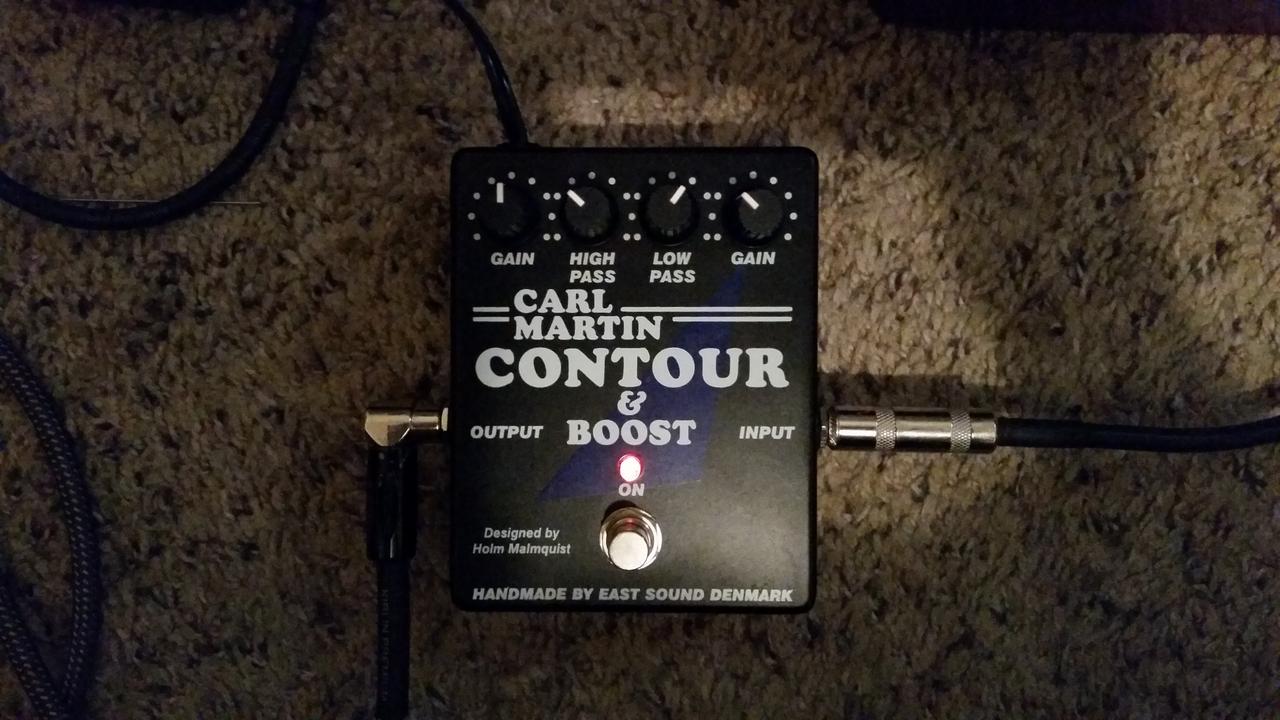
The manual states:
Carl Martin Contour & Boost is especially designed to boost up, and change the sound (contour) of electric guitar/bass.
The Contour & Boost circuitry is of phase linear design, using high quality components. This ensures sonic clarity and midrange emphasis which is so important for electric guitar.
The Contour & Boost is designed as a High Pass (low cut) and Low Pass (high cut) filter, with a fixed X-over frequency at 440Hz. The High Pass filter operates from 65Hz to 440Hz, and the Low Pass filter from 440Hz to 8kHz.
Both filters are individually sweepable, with a boost range of up to 12dB. With these two filters it is possible to change the sound (contour) in any way your creativity allows you.
The Carl Martin Contour & Boost has a built in, regulated (+-12V) power supply which enables us to design circuitry of the highest quality with maximum headroom.
Power consumption: 2.4 Watts
S/N ratio: 80 dB
Input impedance: 1M Ohm
Output impedance: 100 Ohm
THD distortion: 0.01% at 0 dB
Please note that when using this unit with other effect devices, always place the Contour & Boost after any distortion units, otherwise the distortion unit will limit what you can achieve with the Contour & Boost.
However, since getting away from heavy rack gear & power amps and generally downsizing around 2005, I was on a quest for something in a pedal format if possible, which led me to Carl Martin Contour & Boost. Been using this pedal format for the past 13yrs and I love it & I won't play a gig without it - it's a keeper. I can obtain better & more natural sounding clean tones than all the tweaking in the world on a standard 10-band EQ.
It's definitely a magic box of sorts in my eyes. For me, it's an Always-On device. It's like a preamp/HPF/LPF unit all in one. It's also unique in the sense that you can boost or cut the volume level of the Lows and Highs independently from each other after adjusting your HPF and LPF frequencies. The quality of tones to DAW have never been better either.
The manual doesn't state what filter order is being employed (gonna assume 2nd order based on Gain settings?), but it's extremely transparent to my ears and musical sounding. The lowest HPF cutoff is at 65Hz which may be high for some, but others are okay with it. For me, it's perfect - especially at gigging volumes. IME, freqs below 50hz or so are not my friends during a live performance of any decent volume level or in a room with poor acoustics, floor coupling effect occurring, etc.
I play 5-string passive instruments almost exclusively these days & I love the powerful tone sculpting (contour) it offers and I do find the LPF very useful for both setting the center cutoff freq of my highs and then boosting/cutting from there with the Gain knob.
As the OP stated earlier in the thread - the bass tone ends up so much more polished, powerful and professional sounding in a live room (or to recording). Count me as a die hard user of HPF/LPF - glad to see other bass brethren doing the same.
The manual states:
Carl Martin Contour & Boost is especially designed to boost up, and change the sound (contour) of electric guitar/bass.
The Contour & Boost circuitry is of phase linear design, using high quality components. This ensures sonic clarity and midrange emphasis which is so important for electric guitar.
The Contour & Boost is designed as a High Pass (low cut) and Low Pass (high cut) filter, with a fixed X-over frequency at 440Hz. The High Pass filter operates from 65Hz to 440Hz, and the Low Pass filter from 440Hz to 8kHz.
Both filters are individually sweepable, with a boost range of up to 12dB. With these two filters it is possible to change the sound (contour) in any way your creativity allows you.
The Carl Martin Contour & Boost has a built in, regulated (+-12V) power supply which enables us to design circuitry of the highest quality with maximum headroom.
Power consumption: 2.4 Watts
S/N ratio: 80 dB
Input impedance: 1M Ohm
Output impedance: 100 Ohm
THD distortion: 0.01% at 0 dB
Please note that when using this unit with other effect devices, always place the Contour & Boost after any distortion units, otherwise the distortion unit will limit what you can achieve with the Contour & Boost.
Attachments

Last edited:
Woooooo super thread
I am currently reading it during metro transportation ( only currently at page 23 )
For info I play an aggro geddy/flea style, not so much big fat suby low end wanted
I bought the broughton HP and am very happy of it. Use it in my GK MB 500 FX LOOP ( known to have big lows ). At my home my GK CX 210 cab is on the floor and in a corner room, so I can't play it loud without rumbling everything. With HPF set at 100 Hz it is suuuuper clean ! I can now use the E string.
I Will test it with my reharsal GK NEO 410 (on a room corner .. u_u ) and GK MB500 which I find a boomy configuration ! Sure it will be great with the band and clean lows in our giga poor room.
So basicaly I use the HPF in an audible way , to clean lows from rumbles and counterbalance the boomyness of amp + cab + room. Goes so well with my playing style
I am even thinking about buying a second HPF to put it in FRONT of my pedalboard.
Why ? I use basses with Aguilar OBP-1 preamp ( bass at 40 Hz ) and like to be able to switch configuration on the fly ( between the jazz passive mode and the active aguilar AG4M + OBP-1 mode of my moded geddy Lee bass ). Those 40 Hz make too much differences. Also they hurt my SD studio comp and trigger it too much ( in a bad way on other frequencies, it sounds like dull on trebles )
I will use my boss GEB-7 before buying, reducing the large 50 Hz band to see if I can achieve what I want with what I have.
Sorry very long message
I am currently reading it during metro transportation ( only currently at page 23 )
For info I play an aggro geddy/flea style, not so much big fat suby low end wanted
I bought the broughton HP and am very happy of it. Use it in my GK MB 500 FX LOOP ( known to have big lows ). At my home my GK CX 210 cab is on the floor and in a corner room, so I can't play it loud without rumbling everything. With HPF set at 100 Hz it is suuuuper clean ! I can now use the E string.
I Will test it with my reharsal GK NEO 410 (on a room corner .. u_u ) and GK MB500 which I find a boomy configuration ! Sure it will be great with the band and clean lows in our giga poor room.
So basicaly I use the HPF in an audible way , to clean lows from rumbles and counterbalance the boomyness of amp + cab + room. Goes so well with my playing style
I am even thinking about buying a second HPF to put it in FRONT of my pedalboard.
Why ? I use basses with Aguilar OBP-1 preamp ( bass at 40 Hz ) and like to be able to switch configuration on the fly ( between the jazz passive mode and the active aguilar AG4M + OBP-1 mode of my moded geddy Lee bass ). Those 40 Hz make too much differences. Also they hurt my SD studio comp and trigger it too much ( in a bad way on other frequencies, it sounds like dull on trebles )
I will use my boss GEB-7 before buying, reducing the large 50 Hz band to see if I can achieve what I want with what I have.
Sorry very long message

I know Broughton will change the jack locations, has anyone tried to get a pedal made with a 24db/oct HPF instead of the 12? Alternatively, anyone know if fdeck has considered doing a HPF/LPF combo?


