I am an older beginner and am having the following problem: in playing certain patterns higher up the neck I will accidentally also fret the G-string when playing directly on the D-string above it. For example, on a simple pattern of 1-3-5-6-8 ascending from D-string up to G-string (using the typical fingering of middle, index, pinky, index, pinky and down again), I tend to simultaneously accidentally compress and sound the octave 8 on the G-string with my pinky as it plays the 5 on the D-string on the way down. This does not happen down the neck. The bass I have has (to me) a comfortable neck, with a 10” to 14” compound radius. I have experimented with different left hand positions up the neck, and can avoid accidentally sounding the 1st string if I assume a very uncomfortable wrist bend—one that I wouldn’t want to maintain for long. So what I am unsure of is whether it is a left-hand technique problem, or if is a matter of needing a more consistent and rounder fretboard—say 9.5” or 7.25”—that would offer additional space between fretboard and playing finger and thus avoid fretting the G-string on the way down. I don’t have access to other basses to try, so I am interested if others have encountered this problem, and what helped. For what it is worth, I have played a 5-string banjo with a completely flat fretboard for many years, and never have had an issue like this anywhere on the neck. Thanks for any suggestions or links.

Enjoy the benefits of a premium membership!
Upgrade Account
-
TalkBass has been independent since 1998. Add your voice.
Create a free account to reply to discussions, view embedded media, and browse with fewer display ads.
Join free Log in
Want zero display ads or expanded classifieds tools? Compare plans.
You are using an out of date browser. It may not display this or other websites correctly.
You should upgrade or use an alternative browser.
You should upgrade or use an alternative browser.
Hitting the g-string (but not on purpose)
- Thread starter slamifa
- Start date
More options
Who Replied?

Does this happen all up and down the neck? For example, do you have the same problem starting on C at the 15th fret of the D string as you do starting on the 3rd fret of the D string?

Are you pressing the finger tip or the flat length of your fingers?
Try playing these parts slowly. Don’t worry about tempo, just a note at a time, whatever that looks like to you. If you can do it slowly without incidental double strikes, try again a little faster. Or just focus on the part where this is occurring. Repeat. Practice can change habits or enforce them. Work slowly and change the habits. You got this.
Try playing these parts slowly. Don’t worry about tempo, just a note at a time, whatever that looks like to you. If you can do it slowly without incidental double strikes, try again a little faster. Or just focus on the part where this is occurring. Repeat. Practice can change habits or enforce them. Work slowly and change the habits. You got this.
I apologize that I may have confused you, Lobster11, by misspeaking. I should have written that the 1-3-5-6-8 can begin with the tonic 1 on any fret of the A string and ascend 2-5 on the appropriate D-string frets, up to 6-8 on G-string. Coming back down is generally when the pinky will often also strike the 8 on G-string while intending to hit only 6 on D-string. If I start this pattern in the key of C, say, beginning at 3rd fret of A-string, there’s no problem. Move up to around 9th or 10th fret of A-string to begin, and that’s where I start to have problems—from there and on up the neck, and getting worse the farther up I go. Hand position feels awkward up there too, no matter whether trying such things as thumb-behind-first-finger approach or thumb-slanting-towards-headstock, or adjusting neck angles. Frustrating.
Killing Floor, you are right: if I slow down I can manage better, though the concomitant wrist bend gets uncomfortable. I try to use fingertips for fretting, mostly because, as a banjo player, it feels more natural like that.
Thank you both for offering help.
Killing Floor, you are right: if I slow down I can manage better, though the concomitant wrist bend gets uncomfortable. I try to use fingertips for fretting, mostly because, as a banjo player, it feels more natural like that.
Thank you both for offering help.
It occurs to me you play the banjo. That’s a much more narrow fingerboard and the back is most likely more rounded. That positions your fingers differently when fretting. Right? I don’t play a banjo but I’m a lifer with violin and I get that difference. Just keep at it. Might help to experiment with position/height so your wrist is more free?I apologize that I may have confused you, Lobster11, by misspeaking. I should have written that the 1-3-5-6-8 can begin with the tonic 1 on any fret of the A string and ascend 2-5 on the appropriate D-string frets, up to 6-8 on G-string. Coming back down is generally when the pinky will often also strike the 8 on G-string while intending to hit only 6 on D-string. If I start this pattern in the key of C, say, beginning at 3rd fret of A-string, there’s no problem. Move up to around 9th or 10th fret of A-string to begin, and that’s where I start to have problems—from there and on up the neck, and getting worse the farther up I go. Hand position feels awkward up there too, no matter whether trying such things as thumb-behind-first-finger approach or thumb-slanting-towards-headstock, or adjusting neck angles. Frustrating.
Killing Floor, you are right: if I slow down I can manage better, though the concomitant wrist bend gets uncomfortable. I try to use fingertips for fretting, mostly because, as a banjo player, it feels more natural like that.
Thank you both for offering help.
I don't think you confused me, and you answered my question. I don't know what the problem is, but I think it might be diagnostic to do the following: Play the pattern starting on the 3rd fret of the A string (i.e., C). You say that you don't have the problem when you do this. Now, move it up a fret and start on C#/Db (4th fret) and see how that goes, and then repeat starting on D (5th fret) etc. My hunch is that at some point the problem will occur and you'll have a sense about why.I apologize that I may have confused you, Lobster11, by misspeaking. I should have written that the 1-3-5-6-8 can begin with the tonic 1 on any fret of the A string and ascend 2-5 on the appropriate D-string frets, up to 6-8 on G-string. Coming back down is generally when the pinky will often also strike the 8 on G-string while intending to hit only 6 on D-string. If I start this pattern in the key of C, say, beginning at 3rd fret of A-string, there’s no problem. Move up to around 9th or 10th fret of A-string to begin, and that’s where I start to have problems—from there and on up the neck, and getting worse the farther up I go. Hand position feels awkward up there too, no matter whether trying such things as thumb-behind-first-finger approach or thumb-slanting-towards-headstock, or adjusting neck angles. Frustrating.

Sounds like your left hand fingers are insufficiently curled and you are presenting with the pads more than the tips.
Focus on playing slowly and correctly and don’t concern yourself with tempo until you can play cleanly
You may also want to scrutinize your left hand technique in general , and overall posture.
Focus on playing slowly and correctly and don’t concern yourself with tempo until you can play cleanly
You may also want to scrutinize your left hand technique in general , and overall posture.
I took a couple of days to experiment a bit more, and to concentrate on curling the fingers and hitting the strings cleanly with finger tips. Ultimately a small adjustment of the guitar strap made hand position much more comfortable and the fretting easier to do. Still some work to be done here, but I’m optimistic. Thank those of you who offered your thoughts and experience.
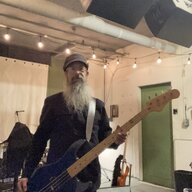
Playing bass cleanly takes time to master, then becomes easy!
BTW - watch me play banjo some time
BTW - watch me play banjo some time

An exercise that can help isolate the issue:
Take any scale, pattern, line, whatever it is you are working on, and play it very slowly one note at a time, but after each note, while still fretting the chosen note, individually pluck each other string, one by one. The goal is to have clean enough technique that every other string can ring freely if you want it to while the chosen note is still ringing as well. Then, the next step is to have every other string muted if you need that instead. But I find the first exercise more useful, because it will really narrow in on exactly which finger is out of position and where it is contacting the other string(s).
If you watch a guy like Michael Manring you see great examples of technique that is precise and clean, so the open strings are free to ring whenever they need to without a fretting-hand finger getting in the way.
Take any scale, pattern, line, whatever it is you are working on, and play it very slowly one note at a time, but after each note, while still fretting the chosen note, individually pluck each other string, one by one. The goal is to have clean enough technique that every other string can ring freely if you want it to while the chosen note is still ringing as well. Then, the next step is to have every other string muted if you need that instead. But I find the first exercise more useful, because it will really narrow in on exactly which finger is out of position and where it is contacting the other string(s).
If you watch a guy like Michael Manring you see great examples of technique that is precise and clean, so the open strings are free to ring whenever they need to without a fretting-hand finger getting in the way.


