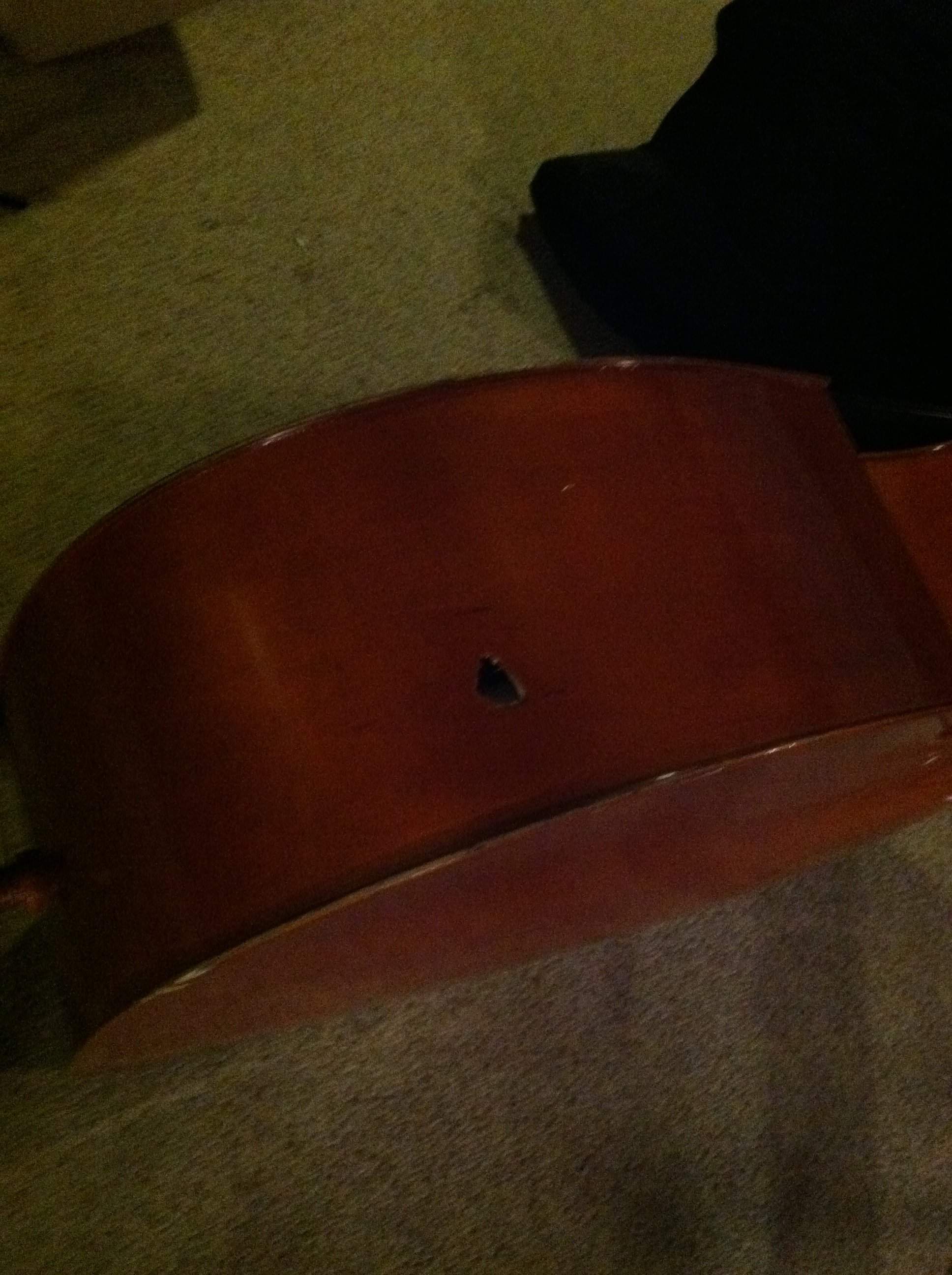
I have repaired such a hole without removing the top. Not sure how the hole happened, but it was a perfect oval, about 1" x 2".
I beveled the hole first, to about a 3:1 pitch. I then pulled a very thin patch from the inside, by threading a monofilament through the patch, running the line through an f-hole and out through the punched hole, then coating the patch with glue and pulling it tightly against the inside using the monofilament. When that was dry, I cut a plug of matching grained wood to fit the beveled hole from the outside, and bent it with heat to match the curvature of the rib at that point. I kept scraping the patch until it fit smooth and tight in the hole, with little or no gap, all the way around. I can't recall whether I chalk-fit it, but that would make sense.
When I forced it in place, using a home-made system of cauls and clamps, it fit tightly, so I slathered on the glue, put a plastic bag over it to keep it from adhering to the caul, and clamped it home. After the glue had completely dried, I filed the patch down absolutely flush, and began re-touching the finish. It turned out remarkably well, and, to me, the hardest part was matching that funky Chinese lacquer finish. I didn't know any better, so I was using oil varnish, and it was quite frustrating, trying to match that color... but I finally got it fairly unnoticeable, though certainly not invisible. I saw it again a few years later, and nearly failed to see the patch, but I had almost forgotten, so I wasn't looking for it.
Your results may vary, of course...but it can be done.