• TalkBass has been independent since 1998. Add your voice.
    Create a free account to reply to discussions, view embedded media, and browse with fewer display ads.
    Join freeLog in
    Want zero display ads or expanded classifieds tools? Compare plans.

Home built cabs...

I bought an EVM-15B sometime around 1980, and it came with those TL606 instructions. It was from a little mail-order place that I had never heard of before: "Musicians Friend." I had also gotten a book on speaker building from the public library, and built my own cab, that used the design parameters of the TL606, but without the internal frame. What happened rather quickly was the Great College Downsize, and I no longer needed a huge or loud cab. My speaker lived out its days in the college band rehearsal room for the most part.

Here's what I would say about it today. Of course it sounds like a TL606, and there's no reason to distrust the analysis in the plans.

But like anything designed long ago, it's fair to give a modern critique without diminishing its vaunted place in the bass pantheon. I've wondered: What was so special about the TL606? Here's my opinion: It was a well designed cab for a high quality driver, published at a time when bass speaker design was still a black art to most people, and there was very little trustworthy guidance. Personal computers were just becoming available. So the TL606 design was a generous gift from EV, many bassists built them, and they worked. I'm sure it also served a marketing purpose, of showing that their drivers were worth using in pro quality cabs.

But... when cast in a modern light, it's a basic ported speaker, for an old fashioned driver, that happens to be built like an utter tank. It might be possible to find plans for a speaker that achieves the sonic goals of the TL606, but with a lightweight driver and less rugged design. I don't think most of us need the ruggedness of an internal frame. The Greenboy and Bill Fitzmaurice Simplexx cabs are of that ilk, and pre-cut panels are available for both.
 
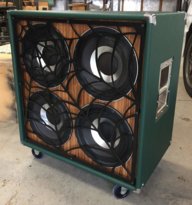
nice work for homebuilt, i like the different color wood going thru that.....Looking at 2nd hand or empty 15" cabs...would prefer a wedge type, but dont see any online..gonna be lazy and just go for a seismic audio cab and throw in a neodymium driver, save a few bucks.
View attachment 7222551
That is a “loosely” designed subwoofer: expectations should be pretty low for a bass guitar cab.
 
  • Sad
Reactions: HardNHeavy
I should also mention a bit about my own "technology." When I ordered the EVM-15B, I was prepared to measure the Thiele-Small parameters myself, based on instructions in the book from the library. For a sinewave generator, I had my brother's Korg analog synth. I had an ancient scope that my dad had trash picked at work, without even calibrated horizontal or vertical scales. I had learned to program in BASIC, and for calculation, I had gotten a Timex-Sinclair ZX81 computer when K-Mart was blowing them out for 25 bucks. Every math geek at my school heard about the bargain, and got one. There were no graphics, so I wrote down the numbers and graphed them by hand.

Miraculously the EVM-15B came with Thiele-Small specs, which simplified my effort. And of course I had no idea what I was doing, but fell in love with gear, electronics, etc., a passion that's still with me 45 years later.
 
I think a homemade bass cab is not necessarily going to be good or bad based solely upon the fact that it’s homemade.

If someone has the theoretical knowledge (or proven plans) required to build a well designed, well tuned cabinet and the craftsmanship required to assemble it, there’s no reason they couldn’t build a cabinet that stands up to commercially available cabs and there are plenty of home builders who have proven that. I think they’re in the minority, though.

Likewise, there’s no guarantee that a commercial cabinet will be a winner. There are plenty of mediocre bass cabinets with well-known brand names on them, although that’s becoming less common. Even lower priced commercial cabinets have gotten better in recent years.

I think Andy’s (@agedhorse) frequent efforts to dissuade people from building their own cabs, not that I can really speak for him, are based upon two big factors.
1) Professional cab designers don’t just have the theoretical knowledge to design a good cab; they also have the experience to know where design compromises make sense and where they don’t, which gives them much better odds of reaching a successful design right out of the gate. In most cases their mediocre designs are years behind them. Most modern commercial cabinets perform really well because they’re designed by people who really know what they’re doing.
2) You can’t compete with economy of scale. In an apples-to-apples comparison (buying a new commercial cab vs. buying all of your parts and materials new) there is no way one could ever match the performance of a commercial cabinet for the same price. It simply can’t be done. Once you factor in the used market it’s a slam dunk.

Andy’s right in both cases and he points these things out all the time - often only to be “corrected” by people who know a lot less than he does - in order to set home builders’ expectations accordingly. There’s more to it than just sticking a driver in a box and he’s better qualified to point that out than most people.

Do I believe nobody should build their own cabs? Heck no! Nobody would ever gain the know-how and experience without jumping in and doing it. But it also means learning all the theory behind it, which takes a long time and a lot of effort. Most people don’t have the patience for that and they’re unlikely to ever surpass building a merely passable cabinet. If they’re okay with that and they’re having fun…. rock on!!

As for those who really do have the skill set - the design chops and woodworking skills to build a truly excellent cabinet, hey, as long as you enjoy the process and don’t mind the expense, keep on building! You might be the next big innovator!

+1
As one who plays through home-built cabs, I agree with everything that's been said.

One other reason for going with commercial cabs when possible is that trial-and-error is a lot cheaper when you can try someone else's errors. If you live in a populated area, you can try a dozen different cabs in an afternoon. The ones that sound awful stay at the store.

This is harder when you live in a remote village like I do. It's hard when online retail has killed the brick-and-mortar shops. It's hard when you don't belong to the main target market for amps.

A subtle reason for choosing the DIY route is to explore a new technology before it becomes widespread in the market. I'd say it's happened twice in my lifetime for speakers: 1) Accurate-enough design software became widely available. 2) Neo drivers.
I too live in a remote village. The closest place for me to try an array of commercial cabs is at least 6 hours away. My DIY usually consists of buying used woofers at significantly reduced prices on the used market, then designing an enclosure to milk the last bit of performance from them while maintaining my tonal goals.

There are two other aspects of DIY I consider worthy of a mention.
1. Building something that is not commercially viable (horn loaded stuff, especially big cabinets; anything that is a niche). I have a 2x12 that’s will handle a genuine 1400w down to about 35hz. It’s loud and it’s low, but it’s also huge. Too big to ever be available commercially. It’s bigger than an Ampeg fridge. Space for me is not an issue, so I compromised on the size side of Hoffman’s iron law. Something most manufacturers have moved away from.
2. DIY for the sake of DIY itself. There is a good amount of people that just love to tinker, and loudspeaker enclosure design is a great area to do so (see diyaudio.com for a community infatuated with it). Sometimes the outcome is to have fun, learn and enjoy playing with something you designed and constructed, and not to build a better and cheaper mousetrap.

Provided the pitfalls involved are clear, what’s to lose in encouraging DIY?
 
DIY is great for learning. Some people don't care how a ported box works, what T/S parameters are, or how all of it correlates. To some of us it's fascinating.
In some ways it can "cheaper" or "better than" other offerings, but to me it's not about that.

I started out as most building stuff to save money. Shop class in highschool was great for a free source of plywood/partical board. I built so many subwoofers for car audio that the teacher asked me to start buying the wood...lol.

I also built a few home speakers which sparked that hobby for me as well. This lead to learning not only about boxes, but crossovers and acoustics. This is still a learning endeavor to this day.

So if it sparks a learning experience and intrigues you, by all means, do it. In this day and age there is an abundance of information out there.
 
+1

I too live in a remote village. The closest place for me to try an array of commercial cabs is at least 6 hours away. My DIY usually consists of buying used woofers at significantly reduced prices on the used market, then designing an enclosure to milk the last bit of performance from them while maintaining my tonal goals.

There are two other aspects of DIY I consider worthy of a mention.
1. Building something that is not commercially viable (horn loaded stuff, especially big cabinets; anything that is a niche). I have a 2x12 that’s will handle a genuine 1400w down to about 35hz. It’s loud and it’s low, but it’s also huge. Too big to ever be available commercially. It’s bigger than an Ampeg fridge. Space for me is not an issue, so I compromised on the size side of Hoffman’s iron law. Something most manufacturers have moved away from.
2. DIY for the sake of DIY itself. There is a good amount of people that just love to tinker, and loudspeaker enclosure design is a great area to do so (see diyaudio.com for a community infatuated with it). Sometimes the outcome is to have fun, learn and enjoy playing with something you designed and constructed, and not to build a better and cheaper mousetrap.

Provided the pitfalls involved are clear, what’s to lose in encouraging DIY?
For a 2x12 to handle areal 1400 watts at 36Hz, it would have to be about 8 - 10 times the size of an Ampeg 810. That’s just for the horn dimensions (length and mouth area) necessary, and that’s also assuming you could find a suitable driver (with a powerful enough motor) of that mechanical power handling for a horn loaded enclosure that could handle that kind of compression ratio and pressure without shredding the cone.

Something doesn’t sound right about your claim.
 
  • Like
Reactions: Hoochie Coochie Man
The main point, though, is that homebuilt, especially using new parts, is going to be more expensive and have more risk than your local secondhand market, and that's got to be the main takeaway for the typical impecunious young musician.

But if you want something unconventional, whether aesthetics, design, even weight then by all means go for it. But go for it with your eyes open.
 
For a 2x12 to handle areal 1400 watts at 36Hz, it would have to be about 8 - 10 times the size of an Ampeg 810. That’s just for the horn dimensions (length and mouth area) necessary, and that’s also assuming you could find a suitable driver (with a powerful enough motor) of that mechanical power handling for a horn loaded enclosure that could handle that kind of compression ratio and pressure without shredding the cone.

Something doesn’t sound right about your claim.
In your haste to poke holes in my post, you assumed the cab was horn loaded

1. Building something that is not commercially viable (horn loaded stuff, especially big cabinets; anything that is a niche). I have a 2x12 that’s will handle a genuine 1400w down to about 35hz…