
ah, the old Aviom. I am glad that we went to a digital mixer and we can just control via their app.I think these are the P&W standard
Aviom
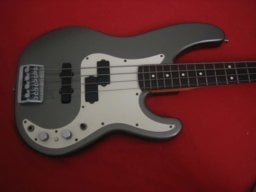
View attachment 7466245
Klang
View attachment 7466247
Behringer
View attachment 7466248

Enjoy the benefits of a premium membership!
Upgrade Account
-
TalkBass has been independent since 1998. Add your voice.
Create a free account to reply to discussions, view embedded media, and browse with fewer display ads.
Join free Log in
Want zero display ads or expanded classifieds tools? Compare plans.
You are using an out of date browser. It may not display this or other websites correctly.
You should upgrade or use an alternative browser.
You should upgrade or use an alternative browser.
How are IEM mixes done for a silent stage?
- Thread starter robert_stuart
- Start date
More options
Who Replied?

How are you powering your P2 then? ;-)
You’re right, those take a battery. But I can’t recall one dying on me during a show. Wireless mics and packs though…all the friggin time.


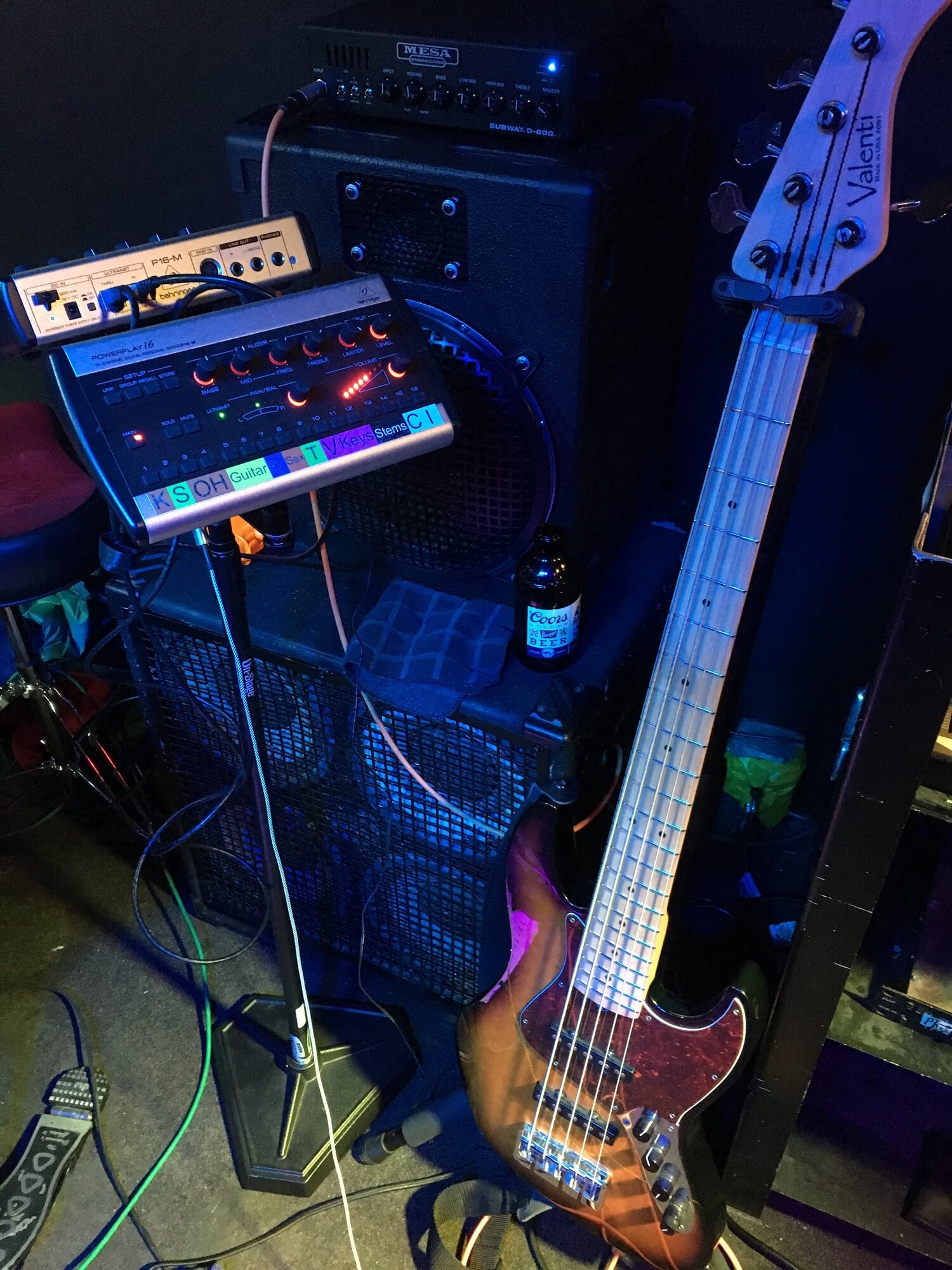
Typical look for me at a point. In this picture the 4x10 was backline I never used in that club. At this point I was still bringing one of my 1x12 cabinets “just in case.” I eventually left them at home and enjoyed the easy load out.
I put together our IEM system a few years back with the goal that it be independent of the FOH system. It is self-contained in its own small rack. The first component is a Behringer MS8000 XLR splitter. Every instrument and mic gets plugged into that. For each XLR input on the splitter, there are two XLR outputs: one goes to the IEM system, the other goes to the FOH mixer or FOH snake. The XLR patch cables for the IEM system next go to a Behringer ADA8200 8-channel preamp, where each channel has its own gain control. The ADA8200 is then connected via optical cable to a Behringer P16-I Personal Monitor Interface. That's all that's in the rack. From the P16-I I run Ultranet (Ethernet) cables out to the Behringer P16-M personal monitor mixers that each musician has. Each musician can set (and save) their own individual mix in their P16-M. Each musician then connects their IEMs (or headphones) into their P16-M. This can be done wirelessly via bluetooth or wired.
Initially the system could accomodate 8 channels, but I later successfully scaled it up to 16 channels simply by adding an additional MS8000 splitter, ADA8200 preamp, and P16-I Interface (each P16-M mixer already accomodates up to 16 channels). These days, we've downsized the band and so we're back to 8 channels. I guess some of this Behringer equipment is now considered "legacy" and has been updated to new equipment, but the concept should be the same.
This system was designed for the type of band we are (our configuration can vary from duo to quintet) and the type of venues we play at (typically smallish rooms). We rarely have our own sound tech. Sometimes we use our own PA system and sometimes we plug into the house system. Either way, our monitor mixes are always the same, but can also be individually tweaked by each musician. The personalized mix we each hear in our IEMs is exactly what each of us wants and is the same from gig to gig, regardless of who and how the FOH sound is being done. If we use a house system that includes wedge monitors, we simply ask that those be turned off. Other than that, the FOH sound tech has zero control of our monitor system.
One drawback to this setup is that there are no effects (such as reverb) built into the monitor system. One of our singers insists on having reverb on her voice in her monitors, so I got a reverb pedal (TC Helicon VoiceTone R1) and inserted it between her output from the XLR splitter and her input into the ADA8200 preamp. Easy peasy.
View attachment 7466250View attachment 7466251
View attachment 7466262
Nice diagram. Do you use this now? I used the P16m personal monitors mixers at a studio and quite liked them.
Most of the setups I've seen use the Xair series instead of the ADA8200/p16m- usually to some combo of wireless/wired IEM. I hadn't seen quite this xlr splitter -> preamp setup.
Sometimes lately, when we're just playing as a duo (me on guitar/bass/vocals, my wife on keys/vocals) in a very small room with low volumes, we just put a Bose L1 Pro16 behind us and use it as mains and monitor, with no IEMs. In a larger room (higher volumes) we'll use the IEM system, and then it's just a question of how many members/channels we need to accomodate.Do you use this now?
Last edited:

Been using “silent stage” for about 4 years now. Drummer has electronic drums and cymbals, so we are truly silent. No cabs at all on stage.
Rather than a hardware solution for each players mix choices we have a router in our rack that works with the X32 mixer and we all mix our own monitor feed ourselves. Using iPads, iPhones, Android pads, whatever.
So I have this infront of me on an iPad all night and I can adjust it on the fly.
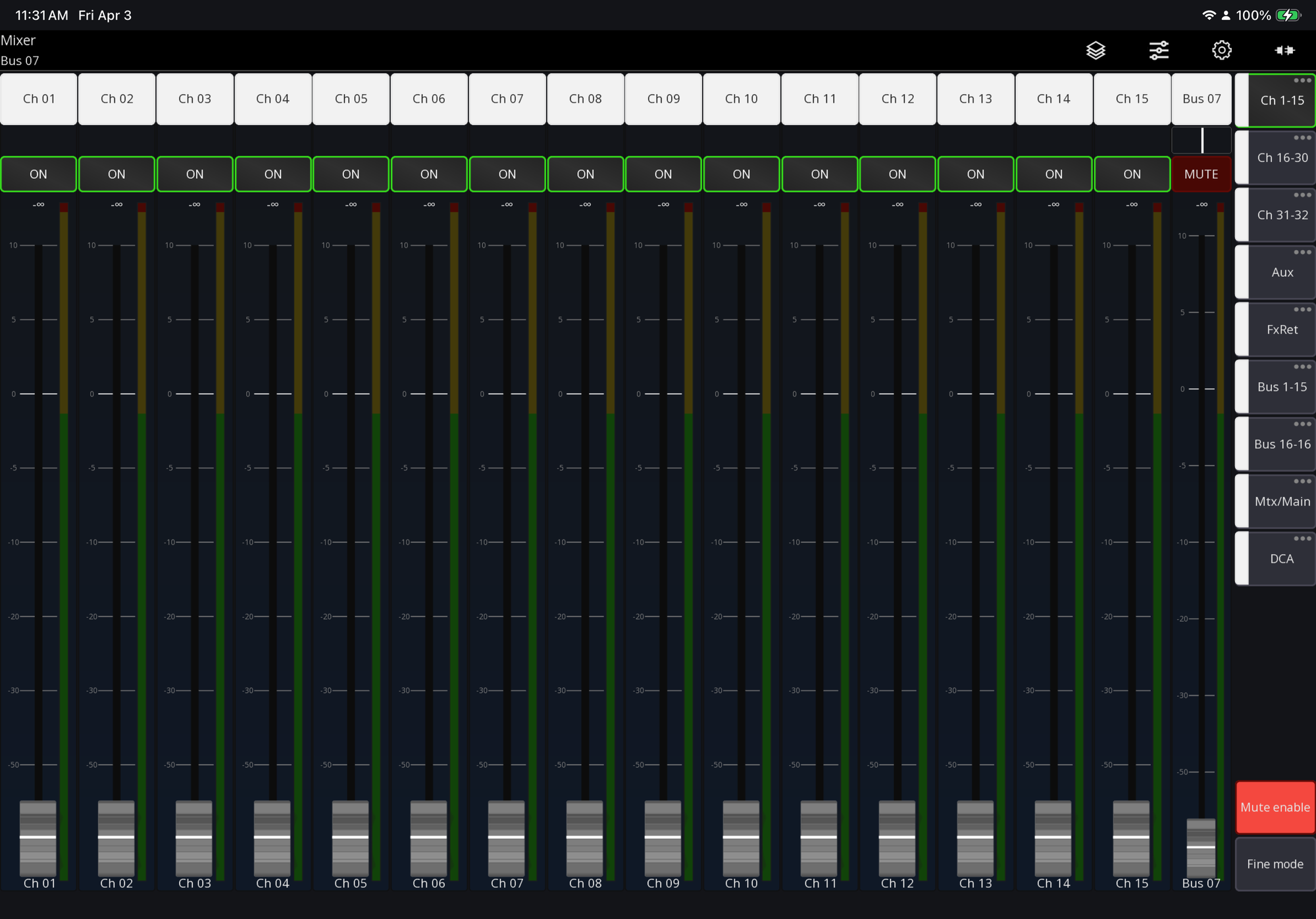
Gotta make sure inputs signals and gains arent too hot, or the distortion destroys the mix.But once sorted, you will hear your bass better than any amp. Another imperitive is the in ears you use. After 4 years Ive found Sennheiser CX400-II with sonic foam tips is fantastic at isolating your ear canal, and producing gratuitous amounts of BASS. And they’re under $49. Better than many higher cost IEM’s IMHO.
Rather than a hardware solution for each players mix choices we have a router in our rack that works with the X32 mixer and we all mix our own monitor feed ourselves. Using iPads, iPhones, Android pads, whatever.
So I have this infront of me on an iPad all night and I can adjust it on the fly.
Gotta make sure inputs signals and gains arent too hot, or the distortion destroys the mix.But once sorted, you will hear your bass better than any amp. Another imperitive is the in ears you use. After 4 years Ive found Sennheiser CX400-II with sonic foam tips is fantastic at isolating your ear canal, and producing gratuitous amounts of BASS. And they’re under $49. Better than many higher cost IEM’s IMHO.

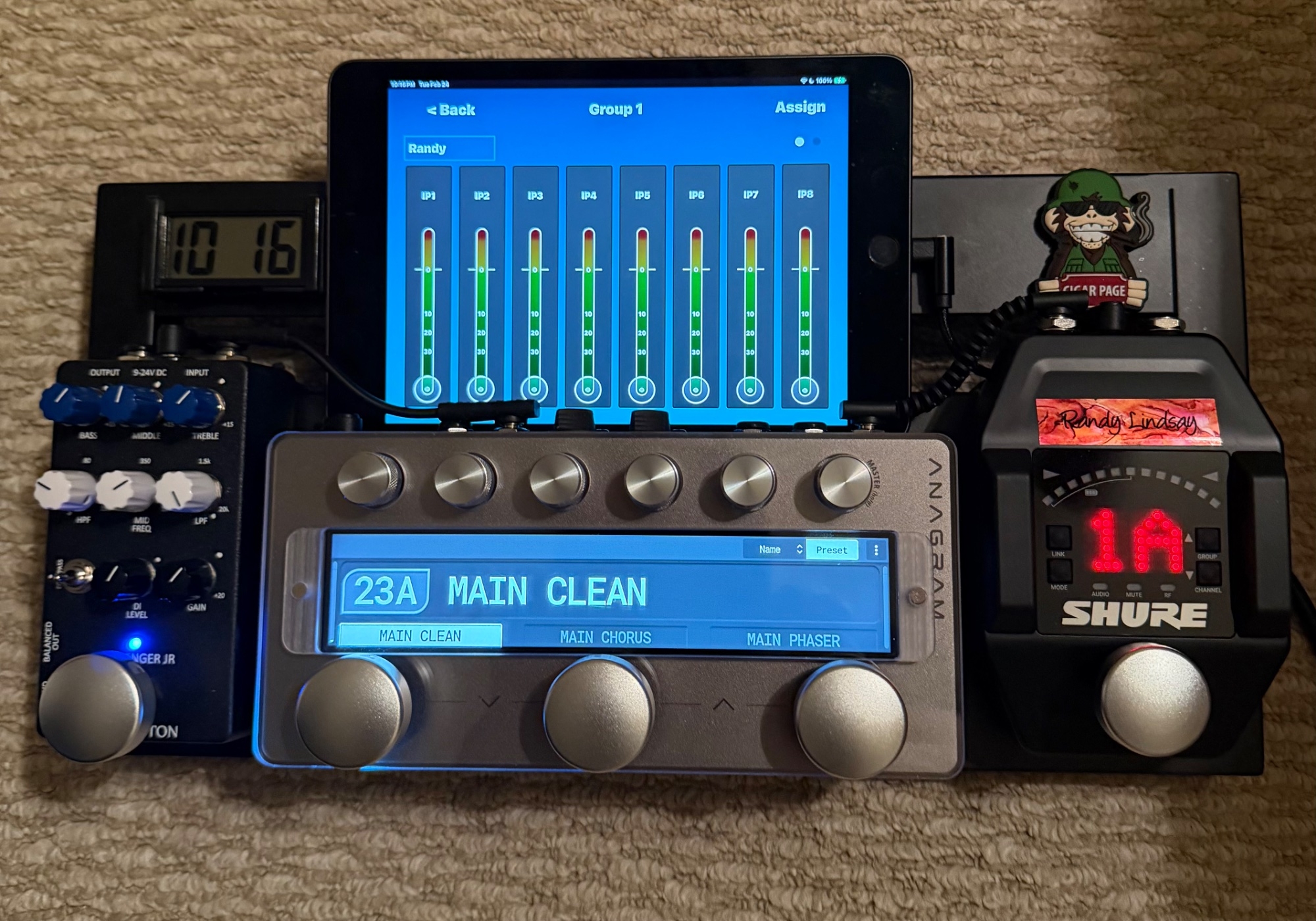
As others have mentioned, one of the soundboard’s AUX outs to my IEM transmitter (Shure PSM300), which relays to my belt pack and into my Ultimate Ears 11 Pro custom molds. On my pedalboard pictured is my iPad mini connected wirelessly to the board’s router. Shown is the Allen & Heath SQ4U mixing app. I also have Mixing Station and most other mixing apps loaded onto the iPad mini because I do a variety of shows with many different house systems as well as our own, so I just pick the appropriate app to the board being used and dial in my IEM mix which gives me a very consistent and satisfying mix in my ears.

It is amazing! It's also not very expensive, but it does take an investment in learning how it all works.This is amazing. Thanks!

I read people saying they like having their monitor mix exactly how they like it. But how is that possible? How does each musician have the ability to make their own special mix of all the other instruments?
The Aviom units are OK, but they break easily - the churches I played at where we had those, there were always a couple on stage that were flaky, and a pile somewhere of broken ones. The Behringer units have things going on signal wise that are not obvious - the user interface doesn't really reflect what's going on at times - they can be very frustrating to use.I think these are the P&W standard
Aviom
View attachment 7466245
Klang
View attachment 7466247
Behringer
View attachment 7466248
The Klangs, I haven't used.
The Livemix units are better - I play at a multi site church, and we have those in most of our locations. They are the standard at this point for good, reliable, usable personal mixers. At our largest location (it's a really big place) we have a monitor engineer on a really nice console.
The best in ear mix is one done by a competent monitor Engineer who knows what you like. Second best is mixing it yourself on LiveMix. The worst in ear mix you can get is from a monitor Engineer that isn't competent - that can be tough. Of course, if you don' t know much about mixing, that also applies to using a mix you made yourself.
I was one of the folks at Shure who worked on the first widely used gear for this - a bit over 30 years ago. The first thing we did was get together a small group of folks, and we tried playing with in ears. I was the bassist, in that ad hoc group., and the first person to rip his ears out - the gear was...manure before we released our stuff, it didn't do bass well, but modern in ears all do bass pretty well. At this point, I've done more than a decade with almost all ampless/in ear gigs (there was an occasional coffee house vibe kinda did I did for a while without in ears, but that's ended over 5 years ago. Once you are past the learning curve (yes, there is one), you probably won't want to go back. I certainly don't.
Last edited:

I did not know these existed. Super cool. Might have to pick some up for the band in the near future.I assume your entire group is using in-ears and have suffcient FOH support.
Also using this on your mics will eliminate a lot of stage bleed. It’s called a mic mute and that’s what it does but it’s actually a “proximity sensor”. They really clean-up the sound in your ears.
You use a digital mixer that connects to a wifi router. The mixers have tons of mix busses, each bus can be a monitor mix dedicated to one musician. All of the digital mixers have apps that let the musicians in the band connect and change the mixes sent to their bus, allowing them to mix their own monitors.

s0c9
Supporting Member
This is almost standard fare these days. even for not-fully-silent stages.You use a digital mixer that connects to a wifi router. The mixers have tons of mix busses, each bus can be a monitor mix dedicated to one musician. All of the digital mixers have apps that let the musicians in the band connect and change the mixes sent to their bus, allowing them to mix their own monitors.
I've been IEM for ~15 yrs now. OF the 6 bands I've played/subbed with over the last 2 yrs, ALL but 1 are fully digital and IEM.
I haven't used an amp in years. I DI to the stage mixer (x32 in current band) with one side of splitter stage box going to the mixer and one to the house. FOH love it because we mix ourselves via external router using the mixer app on tablet or phone.
Played Billy Bob's TX last weekend using a 16-ch splitter snake, split to X32 and House. They run FOH, we do our mixes!
Simple hookup, no fancy hand signals to FOH to adjust mixers.
Keep in mind those all need a front end unit to operate.I think these are the P&W standard
Aviom
View attachment 7466245
Klang
View attachment 7466247
Behringer
View attachment 7466248
The Aviom had a couple versions, one was a live level analog interface another was a mic level input interface complete with a built in splitter, I worked a few bands that carried an Aviom system with the mic level interface as their IEM rack before digital mixers became a rack mountable box.
Some digital mixers would interface directly to an Aviom system, the Allen Heath GLD series would and you couple Avion interface cards for Yamaha mixers.
If you want to go Aviom today there are plenty of used systems for sale on the cheap.
The P16 is a knock off of the Avioms and will interface to many Behringer digital mixers and interfaces, fairly inexpensive buy in.
The Klang takes it to another complete level with the ability to create 3D audio mixes in that you can place an audio input to appear like it is in front, behind, overhead more or less anywhere around you / in you head you want to hear it from.
The basic input interface is about $5000 and requires a Dante or MADI digital input source from yet another expensive piece of equipment or a dedicated mixer running the software, each pod is about $1400. I've read about the system but have not had a chance to give it a listen!


The "hows" have already been answered really well. I do have a question though that I've been dealing with lately:
How do you/us IEM folks deal with how you want to sound and play vs what the house actually hears if what you sound like and play is based on your own custom mix?
I know this isn't exactly a totally new problem. But I feel like I never felt that disconnected before when using wedges or none at all. With IEMs, I feel like the problem got bigger or more complicated. Partially because we now have our own individually customized mix we can change on the fly, more is being done at FOH now with digital mixers (for us peasants in low budget small venues that is lol), and IEM earbuds are super isolating so all we hear is our mix (i'm always taking off one ear to get a better "feel" of what's really going on).
How do you/us IEM folks deal with how you want to sound and play vs what the house actually hears if what you sound like and play is based on your own custom mix?
I know this isn't exactly a totally new problem. But I feel like I never felt that disconnected before when using wedges or none at all. With IEMs, I feel like the problem got bigger or more complicated. Partially because we now have our own individually customized mix we can change on the fly, more is being done at FOH now with digital mixers (for us peasants in low budget small venues that is lol), and IEM earbuds are super isolating so all we hear is our mix (i'm always taking off one ear to get a better "feel" of what's really going on).

^^ This is it.I'm not an expert, but I have worked with digital mixers over the past few years and they make it quite easy to get individual monitor mixes.
First, by having plenty of AUX outs, then by the use of some form of "My Mix" apps (an app on a tablet or smart phone connected to the digital mixer via WiFi) that allow individual players to set up their monitor mix elements on their assigned AUX channel ... and if the band is going IEM, then it goes to their in ears. I've done it myself and once you set up the inputs, it really can work great!
hopefully that begins to help answer your question
Our last church switched to silent stage. I used Beats cans with the bass channel audio feed (and mixer app on phone). Our current church recently switched me to going through the PA. I still bring a Rumble 100 (and kickback stand) aimed at my head, but I keep the volume very low. The FOH mix has almost enough bass for me (and plenty elsewhere).Been using “silent stage” for about 4 years now. Drummer has electronic drums and cymbals, so we are truly silent. No cabs at all on stage.
Rather than a hardware solution for each players mix choices we have a router in our rack that works with the X32 mixer and we all mix our own monitor feed ourselves. Using iPads, iPhones, Android pads, whatever.
So I have this infront of me on an iPad all night and I can adjust it on the fly.
View attachment 7466294
Gotta make sure inputs signals and gains arent too hot, or the distortion destroys the mix.But once sorted, you will hear your bass better than any amp. Another imperitive is the in ears you use. After 4 years Ive found Sennheiser CX400-II with sonic foam tips is fantastic at isolating your ear canal, and producing gratuitous amounts of BASS. And they’re under $49. Better than many higher cost IEM’s IMHO.
It comes down to trusting your soundperson.The "hows" have already been answered really well. I do have a question though that I've been dealing with lately:
How do you/us IEM folks deal with how you want to sound and play vs what the house actually hears if what you sound like and play is based on your own custom mix?
I know this isn't exactly a totally new problem. But I feel like I never felt that disconnected before when using wedges or none at all. With IEMs, I feel like the problem got bigger or more complicated. Partially because we now have our own individually customized mix we can change on the fly, more is being done at FOH now with digital mixers (for us peasants in low budget small venues that is lol), and IEM earbuds are super isolating so all we hear is our mix (i'm always taking off one ear to get a better "feel" of what's really going on).
I post this randomly on various IEM threads.......If you put together your own IEM splitter mixer rack system you need to know how the system works inside and out and how to trouble shoot it in a time crunch.......many do not.
Latest posts
-
-
 Greetings, and help me value my basses, please.
- Latest: MochaFiend
-
-

-
