• TalkBass has been independent since 1998. Add your voice.
    Create a free account to reply to discussions, view embedded media, and browse with fewer display ads.
    Join freeLog in
    Want zero display ads or expanded classifieds tools? Compare plans.

How Did Fender Cut Truss Rod Notch in Guards?

Hello--

Does anyone know Fender's method for notching out the truss rod slot on their 3-ply pickguards back in the 1960s? Would it have been done with a half-round bastard file?

Thanks...

Fender has always cut their pickguards with a Pin Router and a fixture. The blank has the holes drilled in one shot by a gang drill. Then it's slapped in the fixture and zipped around through the pin router to cut all the openings features and perimeter bevel.

These days, they might make them on a CNC Router. Or, they might not. A CNC machine is more expensive to own and operate per hour, and it isn't necessarily faster than a Dude with a Pin Router.
 
  • Like
Reactions: EveryMann and TomB
Fender's method for notching out the truss rod slot on their 3-ply pickguards back in the 1960s?
that "notch" is a trap!

it's just big enough to tempt somebody into trying to jam a screwdriver or something in there, but small enough that the tool won't fit and will chew up the pickguard in the process :mad:

look at the modern fender american standard basses to see a truss rod notch sized to actually be usable
 
that "notch" is a trap!

it's just big enough to tempt somebody into trying to jam a screwdriver or something in there, but small enough that the tool won't fit and will chew up the pickguard in the process :mad:

look at the modern fender american standard basses to see a truss rod notch sized to actually be usable

IMO what would be even more gooder is converting yourneck to take a spoke wheel truss rod nut.
s-l140.jpg
 
Fender did not notch out their bodies or their guards on '60's basses. If you see a notch on one it is an aftermarket modification. …and very common, often done with just a file.
I'll have to agree. I have a '78 Fender P-Bass - an all original '78 P-Bass - and, while it currently wears a replacement Fender cream/black/cream pickguard? I have the cracked, original black pickguard in safe storage; and, I guarantee you, it does NOT have a notch cut in it. And, neither does the 2-piece Ash body. And, for what it's worth, the replacement pickguard doesn't have a notch in it, either...:cool:
 
Fender did not notch out their bodies or their guards on '60's basses. If you see a notch on one it is an aftermarket modification. …and very common, often done with just a file.

Ummm. Yes they most certainly did! It isn't much of a notch, but it's definitely there. It's just a slight notch in the pickguard, and not the body. Many have been enlarged, or chewed up, but they have them. My 1968 Precision has one on the original guard.
 
  • Like
Reactions: EveryMann
To go a bit off topic, I have gotten several P pickup sets recently where the ears on the pickup cover are at about 70mm across. Seems like the "standard" is about 66mm. So, the pickups do not quite fit in a normal pickguard. I have been trying to figure out a way to NEATLY cut the extra 2mm circle extension on each side of the pickup cutout, but nothing I have managed so far is up to my standards. Closest I guess is using a file. Thinking about biting the bullet and buying a small drill press and some forstner bits. Don't really have room for that or for a router either. Seems like there should be a nice little 1/2 inch punch sold, but I haven't found such a thing.
 
To go a bit off topic, I have gotten several P pickup sets recently where the ears on the pickup cover are at about 70mm across. Seems like the "standard" is about 66mm. So, the pickups do not quite fit in a normal pickguard. I have been trying to figure out a way to NEATLY cut the extra 2mm circle extension on each side of the pickup cutout, but nothing I have managed so far is up to my standards. Closest I guess is using a file. Thinking about biting the bullet and buying a small drill press and some forstner bits. Don't really have room for that or for a router either. Seems like there should be a nice little 1/2 inch punch sold, but I haven't found such a thing.

I'm a pro with a big shop full of cool machines. But when I need to enlarge the ear notches in a pickguard, I would do it with a file. It would be faster and neater than a router or a drill press, or even a hand punch. Really. Pickguard vinyl is very soft and cuts easily.

One trick to make it easier is to find or make a hole in your workbench. Hold the pickguard flat on the table and the file vertical, going down through the hole. That way you can easily see what you are doing, and the pickguard is supported well by the table.

Here's my cool special custom pickguard filing sub-table, which clamps in the vise on my main woodworking bench. I made it just for doing trim filing of pickguards. You don't need something this fancy, but you get the idea.

IMG_6737B.jpg


IMG_6739B.jpg


IMG_6740B.jpg


Doing the filing with a 8" Round file. Here, I'm actually filing out some P-pickup openings. This was a one-off, and it wasn't worth the time to make up a template and cut it with a hand router or a pin router.

I traced the outlines of the covers on some masking tape, drilled a bunch of holes, and filed the openings to shape. Including the ears. No big deal, and only took maybe ten minutes.

IMG_6743B.jpg


I finished up the shape with square and flat files, then cleaned up the file marks on the edges with a small scraper.

Files are a Luthier's main tool.
 
Last edited:
I'm a pro with a big shop full of cool machines. But when I need to enlarge the ear notches in a pickguard, I would do it with a file. It would be faster and neater than a router or a drill press, or even a hand punch. Really. Pickguard vinyl is very soft and cuts easily.

One trick to make it easier is to find or make a hole in your workbench. Hold the pickguard flat on the table and the file vertical, going down through the hole. That way you can easily see what you are doing, and the pickguard is supported well by the table.

Here's my cool special custom pickguard filing sub-table, which clamps in the vise on my main woodworking bench. I made it just for doing trim filing of pickguards. You don't need something this fancy, but you get the idea.

View attachment 5333064

View attachment 5333065

View attachment 5333066

Doing the filing with a 8" Round file. Here, I'm actually filing out some P-pickup openings. This was a one-off, and it wasn't worth the time to make up a template and cut it with a hand router or a pin router.

I traced the outlines of the covers on some masking tape, drilled a bunch of holes, and filed the openings to shape. Including the ears. No big deal, and only took maybe ten minutes.

View attachment 5333069

I finished up the shape with square and flat files, then cleaned up the file marks on the edges with a small scraper.

Files are a Luthier's main tool.

Very much appreciate your response and knowledge. Thanks!
 
  • Like
Reactions: ReidK
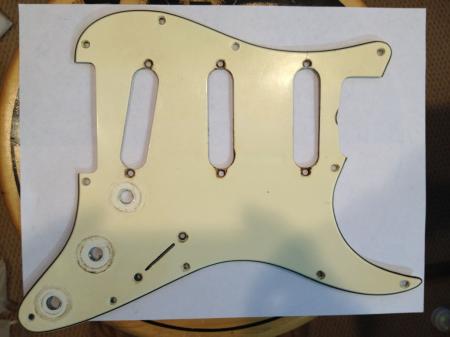
anyway to be clear, we're talking about a "notch" like this:

b490858286083dc3deddc032b1ae130e.jpg


barely more than a divot and not really useful

maybe back in the day it was done with some sort of conical router bit on the pin router, that way it would still be a matter of just sliding the guard on a flat table into the bit?

maybe the same bit used to bevel the outside edges?
 
Last edited: