• TalkBass has been independent since 1998. Add your voice.
    Create a free account to reply to discussions, view embedded media, and browse with fewer display ads.
    Join freeLog in
    Want zero display ads or expanded classifieds tools? Compare plans.

how do I fix this?

Feb 24, 2008
757
1,420
I was told to cross post here so here ya go.......


SL730105.jpg


I posted about this before. I thought it was a cracked neck but once I got the fretboard off I see it's a failed scarf joint.
Ignorant place to put a joint...but then again, I'm not a luthier, so....


Anyway, the Washburn B-10 had grover tuners and and active electronics w/ 3 band EQ which all work, so I figure it is worth the 25 bucks I paid.


Now back to the question.

How to fix it? I don't wanna just glue and clamp. It failed once, it'll fail again.

I was thinking of clamping and glueing, then drilling and glueing pegs through the joint from the fretboard side, just not all the way through.

Thoughts?
Suggestions?

Matt


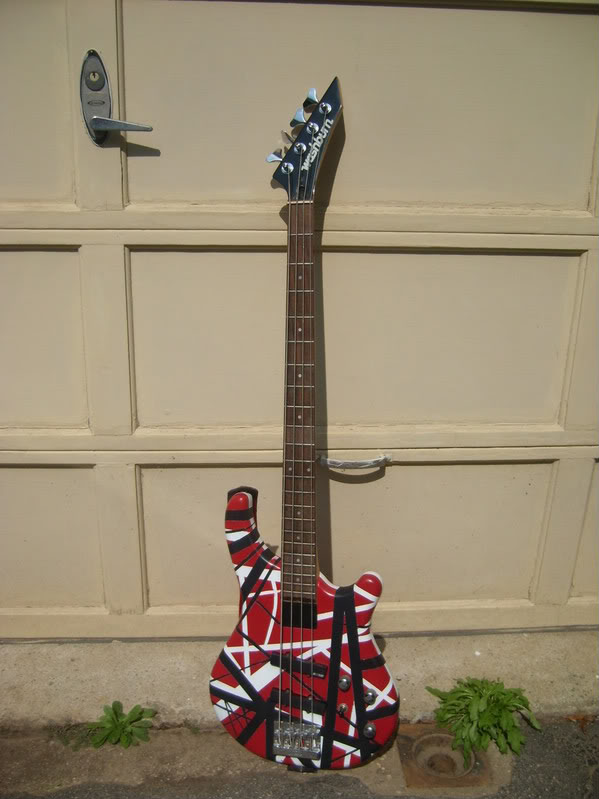
Fixed and painted....

SL730113.jpg
 
QUOTE: I don't wanna just glue and clamp. It failed once, it'll fail again.
I was thinking of clamping and glueing, then drilling and glueing pegs through the joint from the fretboard side, just not all the way through. END QUOTE

What, exactly, was done the first time the repair was attempted? For example: What was done to prepare the surfaces to be re-glued? What kind of adhesive was used? How was the clamping done? How many clamps? What kind of clamps? How were the clamps spaced? What kind of clamping cauls did you use?

You get the idea ;)
 
QUOTE: I don't wanna just glue and clamp. It failed once, it'll fail again.
I was thinking of clamping and glueing, then drilling and glueing pegs through the joint from the fretboard side, just not all the way through. END QUOTE

What, exactly, was done the first time the repair was attempted? For example: What was done to prepare the surfaces to be re-glued? What kind of adhesive was used? How was the clamping done? How many clamps? What kind of clamps? How were the clamps spaced? What kind of clamping cauls did you use?

You get the idea ;)

Agreed, can you elaborate on how the initial repiar was done. Simple clamping with improper glue will result in this repeating itself time and time again.
 
I don't mean the repair failed......the original scarf has failed.
AFAIK, it has not been repaired.
I want to make the repair stronger than the original scarf, if possible.
Or would it be sufficiently strong to just clean it up, glue and clamp?


Matt
 
I don't mean the repair failed......the original scarf has failed.
AFAIK, it has not been repaired.
I want to make the repair stronger than the original scarf, if possible.
Or would it be sufficiently strong to just clean it up, glue and clamp?


Matt

The repair isn't "difficult," but there are a few details to address if you want it to work.

As you may have inferred from the questions I asked in my previous response, there are several variables to consider. To begin with, the old glue has to be removed completely or new glue won't stick, and if you clamp it improperly, it's possible that you'll introduce a warp that wasn't there before. Were I to make that repair, it's unlikely that I'd reinforce the joint with dowels after the pieces had been glued-up - shouldn't need to if the rest of the job is done right.

If you have specific questions, please ask. Good luck!
 
Lizooki: I don't have a huge experience with repairs... but I'd act this way:

1) Removing all the glue on both sides of the joint;
2) Put something on the truss-rod to keep it free to move (masking tape);
3) Making of wooden "C shaped" pieces that follow the neck's shape and help you to clamp it correctly;
4) Epoxy glue! :D and lots of clamps.

Take your time and act without rush... I'm sure you can do it. Or, if you really don't feel able to do it, have it fixed by a pro.
 
Take your time and act without rush... I'm sure you can do it. Or, if you really don't feel able to do it, have it fixed by a pro.

Slow is OK...I'm not in a hurry...I have 4 other basses to play. :bassist:

But I have trouble paying to fix a $25.00 bass. :spit:

I'm guessing the scarf opened up by itself, but not enough to crack the fretboard, and then you separated the joint between the fretboard and the main neck shaft?


Yep, you got it. I removed the fretboard just to see how bad....plus I figured it would have to be removed to fix anyway.
There is a thin sliver of a crack in the fretboad right where the scarf opened, on one side of the trussrod. I figured I would work as much glue into the sliver as I could then let it go.


Suggestions?
 
Pretty much what Triad said, except that I would first remove the headstock from the fretboard, glue up the scarf joint (epoxy!), then rout channels in the neck for CF rods before gluing the fretboard back on. I'd want the rods as far toward the nut as possible without busting through to the headstock.

Using CF might be a little on the expensive side though for a $25 bass.
 
What does anyone think of the idea: After regluing the scarf, before regluing the FB, plane maybe 1/16" of neck surface off, and glue in a 1/16" veneer, then do the FB. This would put atleast some unbroken wood between the scarf line, and the crack in the FB.
 
You have an easy fix. Get some Franklin Hide Glue and and reglue the joint. Make sure that you have enough clamps on the fretboard and the joint.

That type of head joint is a quick and easy way to produce a back tilt from a 3/4" neck. The glue that is on there could be hide glue or yellow glue. Either way I would hide glue the entire neck back together to keep the angle perfect.
 
I'd clean the glue off and reglue/clamp. It failed before because it wasn't done correctly. a good woodglue joint is stronger than the wood. I've seen photos testing it, and the wood will actually rip off around the joint before the joint will separate.

Scarf joints actually make sense. they save wood, and don't leave your headstock with a cross grain to it. I'd trust a scarf more than a back tilted unscarfed neck.
 
I went ahead and completely separated the board and the neck pieces. Cleaned every thing up......I think I may have removed a bit too much wood in trying to clean off the old glue, but everything seems to have went back ok.
The finger board goes back today....we'll see then.
I'm still thinking I'm gonna go w/ light gauge strings for piece of mind. ( I'm not a luthier or wood worker)

Thanks for the replies guys!

Matt
 
By all accounts, liquid hide glue is the last thing you should use in luthiery. There are many accounts of having to throw away a neck after using it. One just recently.

I've been successfully using both hot hide glue and pre-mixed hide glue for more than 30 years. Hide glue has been used for centuries and remains in widespread use today by luthiers worldwide, particularly in the manufacture and repair of violins, violas, celli, and upright basses.

While hide glue is not the most appropriate adhesive for every glue-up, it remains remarkably useful in a wide variety of applications, even in the 21st century, and there are several modern adhesives that still cannot match hide glue's numerous strengths and versatility.
 
I've been successfully using both hot hide glue and pre-mixed hide glue for more than 30 years. Hide glue has been used for centuries and remains in widespread use today by luthiers worldwide, particularly in the manufacture and repair of violins, violas, celli, and upright basses.

While hide glue is not the most appropriate adhesive for every glue-up, it remains remarkably useful in a wide variety of applications, even in the 21st century, and there are several modern adhesives that still cannot match hide glue's numerous strengths and versatility.
Yes, I know that hot-pot hide glue is fantastic in many applications. It's also used throughout piano actions, in which strong physical demands are put on the joints.

Also that every glue has it's place.

So far, I've only heard negatives, warnings and failure stories about liquid hide glue. I definitely respect your woodworking experience, so, what would you consider appropriate applications for liquid hide glue in luthiery? From what I've gotten so far, it seems as though it might be good for non-stressed or ornamental joints, but not for anything structural. Is this right in your view? Or way off base?
 
Hide glue depends on protein bonds to do the actual work of sticking - protein bonds hold the glue together, and these bonds can last for centuries. Liquid hide glue contains urea, to keep the glue in liquid form and bypass the complicated process of preparing hot hide glue. Urea, however, eats away at the protein bonds in the glue and weakens it significantly. Over time, the urea continues to weaken the glue joint to the point of failure.