• TalkBass has been independent since 1998. Add your voice.
    Create a free account to reply to discussions, view embedded media, and browse with fewer display ads.
    Join freeLog in
    Want zero display ads or expanded classifieds tools? Compare plans.

How do I sand my fingerboard down without ruining the radius?

So, one of my pandemic projects last year was epoxying my fretless neck cause I was wanting them SS roundwound Jaco tonessss, plus I put a 12-16" compound radius into it. Turns out I like how it sounds with tapewounds. ‍♂️

Only thing is, I noticed there's some scuffmarks in the epoxy now, probably from where I guess I've gouged it a few times while putting on and taking the strings off. The obvious answer here is "resand it with low grit sandpaper and progressively work up to the polishing stage. Which, I agree. But how to I resand it without messing up the radius or the level playing surface I put into it? Should I get a precision straight edge, too? Also, I want to do a little bit of fall-away around the 16th fret onwards because despite the trussrod neck being just about completely flat with tension on it, and the neck being properly shimmed, it still lightly buzzes a bit in the upper fret area when I get to about the 10th fret, or so. Kind of a bit past the middle of the neck. Any ideas on how I sand this down a notch without messing things up?

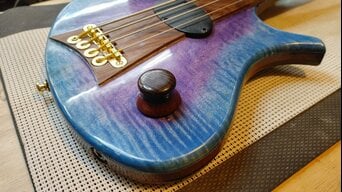
Also, last two pics are just for curiousity about the instrument. 20211018_214038.jpg 20211018_214117.jpg
 

Attachments

  • 20211018_214056.jpg
    20211018_214056.jpg
    701 KB · Views: 116
  • Like
Reactions: T_Bone_TL
We few, we happy few, we band of folks that like the sound of tapewounds... :thumbsup:

You have a compound radius, which you made, so you'd repeat that process to the extent needed to remove your scuffs?

Or there's a whole long thread on here about mostly paying attention to the straightness of the board under the string paths for fretless, (and not radius per se) with a huge amount of detail. Lemme see if I can find it. Here we go: Levelling Fretless Board
 
Last edited:
  • Like
Reactions: dwizum and bholder
Yes, you don't need a radiused block, just a fairly long (6-8" say) flat hard sanding block, and sand parallel with the string paths in long strokes. Assuming you are starting with something like 220 grit, you are not going to change the radius unless you tried very hard to do so; the marks are probably only a few thousandths deep. Radius blocks are good for establishing a radius initially, but once the radius is there they just add a lot of friction as the contact area is so much larger. This also makes the paper load up faster, which can lead to galling and marks in the finish. Just my opinion, others may vary.
 
  • Like
Reactions: bholder
I agree with using a straight block and sanding the board with it so that you can retain the straight string paths. I'd personally use a 24" block and remove the nut to be able to do long smooth strokes. If this were mine, because it's a finished board, I think I'd be doing this work wetsanding with 600 and if that was not gritty enough to take care of the problem, drop down to 400, but still wetsanding. Good luck! :)
 
  • Like
Reactions: TerribleTim68
I'm by no means experienced, but I was gonna say "start with a very fine grit". Like Beej said, if you start with something like 600 wetsanding, you probably stand way less of a chance of getting carried away changing the radius. I would probably even start out higher grit than that, because I'm way too nervous about things like that. But, fine grit, wet sand, flat long sanding board, take your time, check often. :thumbsup:
 
You have an overall problem here: If you sand the fingerboard surface enough to remove scratches, or to correct some uneven leveling, you are going to sand through the epoxy coating in some places. And if that happens, you pretty much have to do the whole epoxy process over. It's really hard to patch-fill the epoxy coating.

I think your only choice is to sand off all the epoxy, then fully true up the fingerboard surface with sanding blocks down the string paths. The standard process. Put on a new coat of epoxy. Then carefully true up that surface, and polish it up.

Also, you shouldn't add deliberate "fall away" at the end of the fingerboard. If you've got buzzing down there, it means you've got a high spot. For whatever reason. It may not have been fully trued when you epoxy coated it, or it may have pushed up a lump, or the neck may be starting a slight 12th fret kink (ski jump). However the high spot happened, it needs to be trimmed down to level. Don't go past level and make a "fall away".