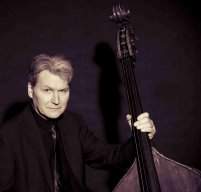
Okay, I'll take the bait here and say the obvious, that just because YOU don't understand something, doesn't make it bogus. That seems to me as being a small-minded and anti-social point of view. I recommend that next time @turf3 doesn't understand something, that they ask for an explanation before making a judgement because it will make the conversation more pleasant for everyone. I found @eerbrev 's explanation helpful in diagnosing the lack of comprehension and providing a useful analogy for understanding the "arm-weight thing" when standing holding the bass nearly vertically. Because of that issue, many of us lean our basses back towards us at an angle to the floor so that the weight of our arm does do more work for us. And bent endpins can help make that work better. But John Goldsby holds the bass nearly vertically and my observation is that @eerbrev 's explanation is spot on, that John pulls into the fingerboard with his fingers rather than squeezing. Watch John in action in any of the WDR Big Band videos and I think you'll see what I mean. In that stance, the weight of your arm is still a force vector, but it's no longer perpendicular to the ground, it's perpendicular to your body.
Well, if you want to redefine the word "weight" to mean "pulling back with your arm perpendicular to the fingerboard" rather than "the force of gravity" I suppose that's your prerogative, but don't expect all of us to go along with your ad hoc redefinition.
if you claim you're not redefining the word "weight" then explain, please, how a force acting nearly parallel to the fingerboard is going to help you push your fingers down perpendicular to the fingerboard (and let me clarify, I'm only talking about the standing position, normal bass, normal end pin, normal standard arm position).
In higher positions, there's little lever arm length between the place where the finger is and the place where the bass hits you in the belly, so it's easy simply to press down without using the thumb to react the force of the fingers. But in the low positions, pulling back against the neck causes the neck to wave all over the place. And dropping the elbow while using the thumb as a fulcrum helps you apply force on the index finger, but lifts the little finger away from the string. Are you claiming that I should drop my elbow for notes played with the index finger and raise it for those with the little finger? I don't think so.
So, please explain. Are you simply following the Humpty Dumpty rule of vocabulary ("When I use a word," Humpty Dumpty said, in rather a scornful tone, "it means just what I choose it to mean—neither more nor less." "The question is," said Alice, "whether you can make words mean so many different things." "The question is," said Humpty Dumpty, "which is to be master—that's all.") and redefining "weight" as a pull of the muscles of the arm and trunk, more or less parallel to the ground, or is there some other explanation here?
The few times I've experimented with sitting, it makes the whole "arm weight" thing meaningful, because you really CAN allow the weight of your arm (using the term correctly as the force exerted by the earth's gravitational field) to help pull, as well as having a third fixed point for the bass so the neck doesn't wave all over the place when you try to pull the strings down without clamping with the thumb.
If, on the other hand, you want to say "arm weight" is an analogy, that's fine, but then don't excoriate me for saying the analogy doesn't work for me.