

Enjoy the benefits of a premium membership!
Upgrade Account
-
TalkBass has been independent since 1998. Add your voice.
Create a free account to reply to discussions, view embedded media, and browse with fewer display ads.
Join free Log in
Want zero display ads or expanded classifieds tools? Compare plans.
You are using an out of date browser. It may not display this or other websites correctly.
You should upgrade or use an alternative browser.
You should upgrade or use an alternative browser.
How do you record your bass?
- Thread starter diverse379
- Start date
More options
Who Replied?

You're the first person I've known to actually make that comparison, and that's extremely reassuring. Thanks!
Well, regardless of what I may or may not think about Firewire, it's a legacy standard that's being phased out. So unless you're heavily vested in hardware with Firewire interfaces, now is probably a good time to start migrating to either Thunderbolt or the the newer USB standards,
If you're interested you can read the whole sad history of the Firewire standard here.
I've been fond of Ardour for years, so something even better is appealing indeed. Might just sign up to those lists, and keep an eye out. Thanks again!
Interestingly enough, the main thing that got me interested in Mixbus was the fact they had versions running natively on Windows, MacOS, and Linux. Such is the advantage of basing your product on well-supported Open Source software that is under very active development. That was something that was important to me (being an IT guy for a living) since it essentially makes Mixbus obsolescence proof as far as platform is concerned. And the license you purchase can be used on any of the three platforms.
But beyond that, once I started using it I began to appreciate the sound quality and the workflow. It's based on Harrision's hardware consoles and it feels very similar in use to using an actual console. I don't know if that makes it "better" so to speak. But I'm from the analog era and I have some experience using things like a Neve console so it feels like home to me. Someone who came up in the PC/digital recording era might be more comfortable with some of the newer interfaces and products that pack other functionalities like loop creation etc. under the hood. Mixbus is pretty flexible. But it has a pretty aggressive recording console paradigm it does't stray too far from. So if you approach recording more from a traditional "recording a live performance" perspective (like George Martin) rather than the newer solo loop and sample framework (like Moby or Björk) then Mixbus should feel very comfortable.
I guess you could say I like Mixbus half because it sounds great, and half because I'm too lazy to learn a totally different approach to recording. I don't record professionally so I don't need to keep up with the times. YMMV.


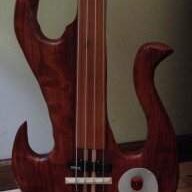
Pretty much all of the above over the years. Plus I sometimes close mike the strings on the fretless if I'm not using a cab at the same time. Just depends on the sound I'm after.
However, it has always gone to one tape track. I have yet to do much DAW recording. With low track count (up to 8) I have to make a decision and record what I want at the time.
Otto
However, it has always gone to one tape track. I have yet to do much DAW recording. With low track count (up to 8) I have to make a decision and record what I want at the time.
Otto

1. Bass - 1960 Ampeg B15 - Electrovoice RE20 - Focusrite ISA One - AD converter
2. Bass - Retrospect Juice box - AD converter.
3. Bass - Focusrite ISA One DI - AD converter.
2. Bass - Retrospect Juice box - AD converter.
3. Bass - Focusrite ISA One DI - AD converter.

I have 3 requirements for recording bass.
1) tube preamp
2) absolutely no noise
3) simple pc interface
My long time setup was the post pre DI out from a Mesa Boogie M2000 tube amp into an E-mu 1212m pc sound card. I record at 24 bit 48khz. The Mesa amp has a built in compressor and I usually apply a small amount of limiting while recording and maybe a bit of tone shaping with the onboard EQ.
Recently I got myself an A-designs REDDI and use that instead of the amp. The unit is a tube pre that was designed to sound as much as possible like a vintage Ampeg B-15. At $775, it isn't cheap, but it sounds absolutely amazing all by itself.
I've occasionally used a Tech21 SansAmp BDDI with marginally acceptable results, but it sounds a bit harsh to my ears. I suppose it really is more suited for live use.
1) tube preamp
2) absolutely no noise
3) simple pc interface
My long time setup was the post pre DI out from a Mesa Boogie M2000 tube amp into an E-mu 1212m pc sound card. I record at 24 bit 48khz. The Mesa amp has a built in compressor and I usually apply a small amount of limiting while recording and maybe a bit of tone shaping with the onboard EQ.
Recently I got myself an A-designs REDDI and use that instead of the amp. The unit is a tube pre that was designed to sound as much as possible like a vintage Ampeg B-15. At $775, it isn't cheap, but it sounds absolutely amazing all by itself.
I've occasionally used a Tech21 SansAmp BDDI with marginally acceptable results, but it sounds a bit harsh to my ears. I suppose it really is more suited for live use.
Last edited:
mark beem
Wait, how does this song start again??
From the last recording session with my band. Forgive the cheesy "Paint" diagram but it effectively conveys the idea..
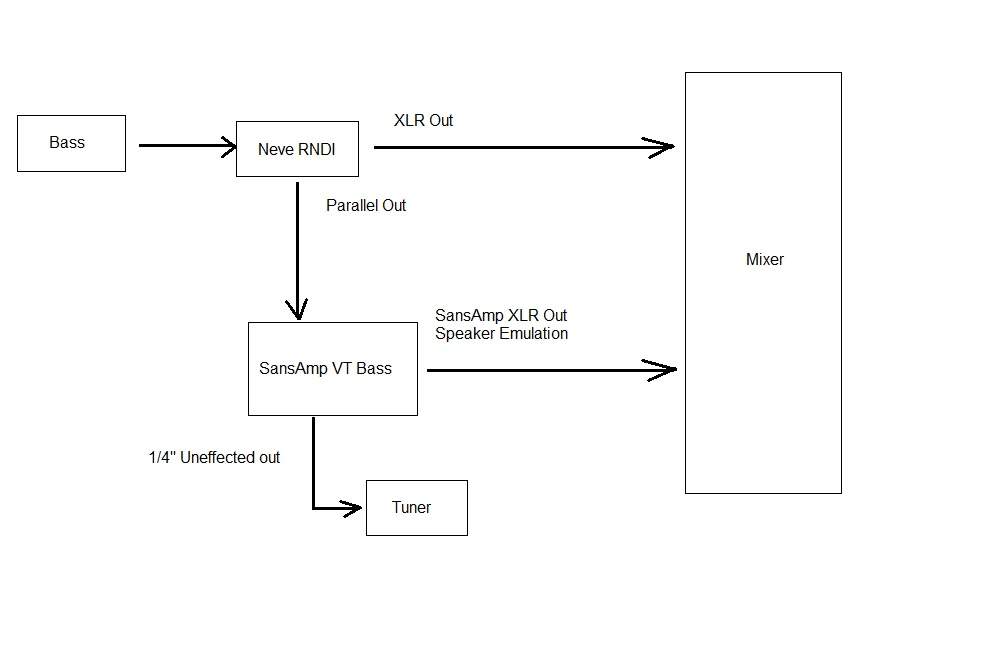

This is exactly how I do it as well.Bass -> interface -> DAW
Build amp in DAW, record, duplicate track, apply effects to duplicate, blend.

That’s because it’s the right way.This is exactly how I do it as well.


I try to get two channels. One goes through my line out, and the other is a miced cab. Engineer can blend to taste.
There's always discussion with the engineer about what he/she needs from my line out.
There's always discussion with the engineer about what he/she needs from my line out.
Bass-> HPF (MicroThumpinator) -> Transformer Out of Ampeg PF20T -> Focusrite 6i6 -> Reaper
Alternatively,
Bass->HPF->Focusrite 6i6->Reaper and apply Amplitube Amp Sims in DAW
Alternatively,
Bass->HPF->Focusrite 6i6->Reaper and apply Amplitube Amp Sims in DAW
*noodles for a few minutes * ooh better grab my pen and notepad! This could be something eventually  thought I posted this yesterday but I'm just being a smart allec. Still, this is how I record stuff so I don't forget it atm
thought I posted this yesterday but I'm just being a smart allec. Still, this is how I record stuff so I don't forget it atm
Thank you, sir! Very much appreciated.@2saddleslab Very cool song. Well done all around!

Ultradust
Commercial User
- May 19, 2007
- 227
- 1,052
- Disclosures
- General Manager, Moollon
We certainly all have our applications and needs.
I personally want full control once the signal has gone to tape/digital, and for me it's usually the most transparent dry signal as possible before going to digital. I use just a SPL Channel One -> UA Apollo Duo(or MOTU Ultralite Mk.III) -> MOTU DP9
If there are problematic frequency issues with the dry signal, then I can dial things in, but already having great bass tones without assistance means I almost never need to. And for that matter I'm not trying to get my ultimate *punchy/fat* bass mixed tone before going into digital (my studio certainly isn't a live stage), I just want the ultimate dry, workable signal that can be manipulated in digital space that leaves no regrets due to what I may have already done to the signal... Pre/cab sims seem to make so much more sense when a full mix/arrangement can define the context for my bass timbre's needs.
I've depended on a single preamp/compressor for nearly 20 years now for all my mic/line needs, and although I'd likely have done better with other units for certain applications, the Channel One us so easy to use and is excellent for dry bass tones that may or may not need just a little compression and/or EQ assistance.
Invalid Link Removed
I personally want full control once the signal has gone to tape/digital, and for me it's usually the most transparent dry signal as possible before going to digital. I use just a SPL Channel One -> UA Apollo Duo(or MOTU Ultralite Mk.III) -> MOTU DP9
If there are problematic frequency issues with the dry signal, then I can dial things in, but already having great bass tones without assistance means I almost never need to. And for that matter I'm not trying to get my ultimate *punchy/fat* bass mixed tone before going into digital (my studio certainly isn't a live stage), I just want the ultimate dry, workable signal that can be manipulated in digital space that leaves no regrets due to what I may have already done to the signal... Pre/cab sims seem to make so much more sense when a full mix/arrangement can define the context for my bass timbre's needs.
I've depended on a single preamp/compressor for nearly 20 years now for all my mic/line needs, and although I'd likely have done better with other units for certain applications, the Channel One us so easy to use and is excellent for dry bass tones that may or may not need just a little compression and/or EQ assistance.
Invalid Link Removed
Nice
I’ve never used one
But I like the fact that you have used it for so many years
You know exactly how to get your tone
Good stuff
I’ve never used one
But I like the fact that you have used it for so many years
You know exactly how to get your tone
Good stuff