
When possible, I use a pedal tuner that mutes. TC polytune mini. When that’s not available, the tuner app on my phone (guitar toolkit) gets the nod. I always tune up to the note.
Last edited:

TalkBass has been independent since 1998. Add your voice.
Create a free account to reply to discussions, view embedded media, and browse with fewer display ads.
Join free Log in
Want zero display ads or expanded classifieds tools? Compare plans.


I use a Sonic Research T-300. A little pricey, but the best I have ever found
Duke
View attachment 4690063
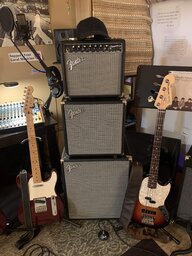
I think it’s interesting you have an alternate tuning. I’m gonna try that just for sh… and giggles and see what’s there. Thanks.One of my short scale hybrid bass+guitar is tuned up a minor third. E is G. I have one in 5ths tuning. CG D A but I digress
If there is no tuner but have a piano then tune the highest open string and tune the lower strings via harmonics.
In a gig specially bar. restaurant or outside gig. Korg tuner. Good enough for government work as they say. I still have a tuning fork though in A
I think it’s because you’ve trained your ear to hear that and hold it.I dont know why, but I can hear D's and G's in my head with near perfection....Its not a brag or boast because Im not sure why I can do that either lol....I use a tuner playing live but, if I absolutely had to (like often sitting on my couch), if I think of something in the Key of D, usually the intro guitar of Boston's "More Than A Feeling", I can grab that open D string, tune the rest of my bass, and Im ready to gig for standard tuned bands....Its a mystery to me why I can do that but at least its a good mystery lol
I’m battling tinnitus this past week. This sucks! This better go away…I tune it to the sound of my tinnitus.
Another person who starts at G. Interesting. More and more here mention that. I’m not alone. Cool.I use a pedal tuner if my pedal board is plugged in, otherwise a clip on. (I recommend the Turbo Tuner pedal and the TC Polytune Clip.)
I start with the G string and work my way down. On three of my basses I just tune with open strings because I know the intonation is adjusted well and further tweaking isn't usually required - my Stingray 5 in particular has excellent intonation all the way up the neck.
On my first bass, originally the nut slots were a bit high on 3/5 of the strings, which meant I couldn't tune using open string pitches on those strings or the notes in the first few frets would be sharp. At the time I didn't know the nut could be fixed - and this was pre world wide web so I couldn't just Google it - so I just compensated by tuning with the fifth fret pitches and that meant everything ended up pretty good as long as I didn't use open A, D, or G. Fortunately the E and B strings didn't have that problem so I could still hit open E no problem. An embarrassingly large number of years later I finally got the nut fixed, and now I tune that bass by starting with open string notes and just slightly tweaking based on pitch of a couple of fretted notes. ("Fixed" in this case means "significantly improved", not "perfect".)
I keep trying to spend money on a tuner but always end up back with the simple headstock tuner. (Just returned a Peterson strobe headstock tuner that cost some money but was driving me nuts) It’s such an important process it seems it should cost more to do it right but for most of us those headstock things are just fine.At blues gigs I'll ask the guitar player for an A and tune from there harmonically at 5th and 7th frets. At other jams and gigs and such, tuners are the way. I only recently got a headstock tuner a few months ago. Boy what a great tool and I can't believe it took me so long to get one. For 20 years I've been hauling around a Boss TU-12. Sheesh.
That’s great insight thank you.Decades ago, I'd ask the guitarist for open E, then tune my E string to that using a harmonic. After awhile I started asking for open A because I thought it was easier to hear.
Of course I'd use harmonics to tune my remaining strings relative to the E (or A). It would be via the usual "ping... ping", meaning a pause between the first string and the second. Then I saw a very good bassist hit the harmonics on both strings simultaneously. I realized it was perfectly valid, and less annoying sounding, so that's what I've done ever since when I'm not using a tuner, or doing a quick doublecheck after using one.
These days I'm all about clip-ons. The good ones are fabulous. Even the average ones are good... the typical problem is recognition of open low B, but when that happens the easy solution is to use the 12th fret harmonic.
Ya know, I just realized I'm the same as you: for years now I've been starting at high G and working my way down to low B (I'm a fiver guy, obviously). I don't know when or why I switched.
It seems many of us do start at G. Cool. Thanks.I always start tuning from the G string. I found the tension of the high strings affects neck bow and thus tuning of all other strings the most.
When you start from the lowest string, it can be out of tune again when you are done tuning the G string.

That’s a totally different thing. Tuning by ear is useful for ear training and for situations where your tuner may not work.Whats the point? Did you learn how to adjust your cars valves, even though you will never have to do it?


Ugh, that reminds me of when headstock tuners 1st came out and all the guitar players were tuning with their guitar still turned up



 ! sorry. Could not pass that one up


