
Enjoy the benefits of a premium membership!
Upgrade Account
-
TalkBass has been independent since 1998. Add your voice.
Create a free account to reply to discussions, view embedded media, and browse with fewer display ads.
Join free Log in
Want zero display ads or expanded classifieds tools? Compare plans.
You are using an out of date browser. It may not display this or other websites correctly.
You should upgrade or use an alternative browser.
You should upgrade or use an alternative browser.
How does hum control pot work on Ampeg V4B?
- Thread starter MichelD
- Start date
More options
Who Replied?
It should just turn with a screw driver. It’s possible your pot is stuck or damaged in some way.
It is a newly installed one, I looked quickly at it when I got it home from the shop but didn't see a screwdriver slot.
It is a newly installed one, I looked quickly at it when I got it home from the shop but didn't see a screwdriver slot.
If the pot was replaced with something non-standard that is different. Do you have a picture of the pot?

It is a newly installed one, I looked quickly at it when I got it home from the shop but didn't see a screwdriver slot.
I had to replace the hum balance pot on one of my SVTs a few years back. The original part was obsolete and the available part had a longer shaft that had to be cut off and notched for a flat head screw driver. I believe cutting the shaft was necessary on the SVT so it would fit behind the grill.
I used a Dremel with a disc like this:
It's possible whoever replaced the pot did not cut a notch. Since the pot is newly installed I suggest calling the tech and asking. If the shaft is long enough you can use pliers or vice grips.
I had to replace the hum balance pot on one of my SVTs a few years back. The original part was obsolete and the available part had a longer shaft that had to be cut off and notched for a flat head screw driver. I believe cutting the shaft was necessary on the SVT so it would fit behind the grill.
I used a Dremel with a disc like this:
View attachment 3831818
It's possible whoever replaced the pot did not cut a notch. Since the pot is newly installed I suggest calling the tech and asking. If the shaft is long enough you can use pliers or vice grips.
The same was done to my SVT at one point, but there are available replacement parts. The part number for a CTS wire wound 100 ohm 5 watt pot is in the portaflex wiki, these will fit the V4, B15, SVT, etc.
Technical - Amplifier | TalkBass.com
It sticks out a bit more than the original but not so far as to be a nuisance. had to install this one after a plate to heater short.
Last edited:


Putting the amp up against the wall is not a good idea. The amp runs very hot and requires air circulation around the back.
An image isneeded to see what is going on with the pot. If there isn’t a slot, the tech made a bad choice in what they installed. Ome pots have a locking nut to prevent the shaft from turning. With this type, the nut needs to be loosened for the shaft to rotate. Back to needing an image.
An image isneeded to see what is going on with the pot. If there isn’t a slot, the tech made a bad choice in what they installed. Ome pots have a locking nut to prevent the shaft from turning. With this type, the nut needs to be loosened for the shaft to rotate. Back to needing an image.
OP here.
The balance pot is recessed back about 6mm that's why I couldn't see it. And yes, it has a screwdriver slot.
I'm still getting some hum after a re-tubing and general overhaul so I was wondering if maybe my 2x15 B25B 4-ohm cabinet would be reacting differently to the amp than the tech's test speakers and if I should tweak the hum balance.
There is a hand-width of space between the head and the wall and I only play for a few minutes at a time in the basement anyway. My main practice amp is a little Samick right next to me here in my computer room. I do most of my playing with no-bass jazz jam track on Youtube.
The balance pot is recessed back about 6mm that's why I couldn't see it. And yes, it has a screwdriver slot.
I'm still getting some hum after a re-tubing and general overhaul so I was wondering if maybe my 2x15 B25B 4-ohm cabinet would be reacting differently to the amp than the tech's test speakers and if I should tweak the hum balance.
There is a hand-width of space between the head and the wall and I only play for a few minutes at a time in the basement anyway. My main practice amp is a little Samick right next to me here in my computer room. I do most of my playing with no-bass jazz jam track on Youtube.
The same was done to my SVT at one point, but there are available replacement parts. The part number for a CTS wire wound 100 ohm 5 watt pot is in the portaflex wiki, these will fit the V4, B15, SVT, etc.
Technical - Amplifier | TalkBass.com
It sticks out a bit more than the original but not so far as to be a nuisance. had to install this one after a plate to heater short.
View attachment 3832068
Maybe Fliptops needs to read the wiki
 . I searched several of my favorite parts suppliers, and went with Fliptops. I don't remember if this is the exact part, but it's the only hum balance pot I can currently find on Fliptops' website.
 Also the P/N 026T419S101A1A1-ND in the wiki no longer crosses to a Digikey P/N. 026T419S101A1A1 crosses to a Mouser P/N but the shaft appears to be solid and too long
Regardles of which one I used, the cut off shaft is a not beautiful, but it is functional.
I wonder if they’ve been discontinued.
I believe the fender style would work as well without having to cut down a pot. It’s recessed and lacks the panel mount pin, but 100 ohm linear and used in the same way in their amps. I have one of those in my parts bin, part number appears to be 028421, don’t have any of the ampeg style left. Would have to open up my V4 and check the part number.
Looks like the part number from the wiki is what I had, found an old picture of the burnt out pot on my V4. I think when I got this amp the original pot was stuck so I replaced it, and it burnt out with the tube short so I replaced it again.
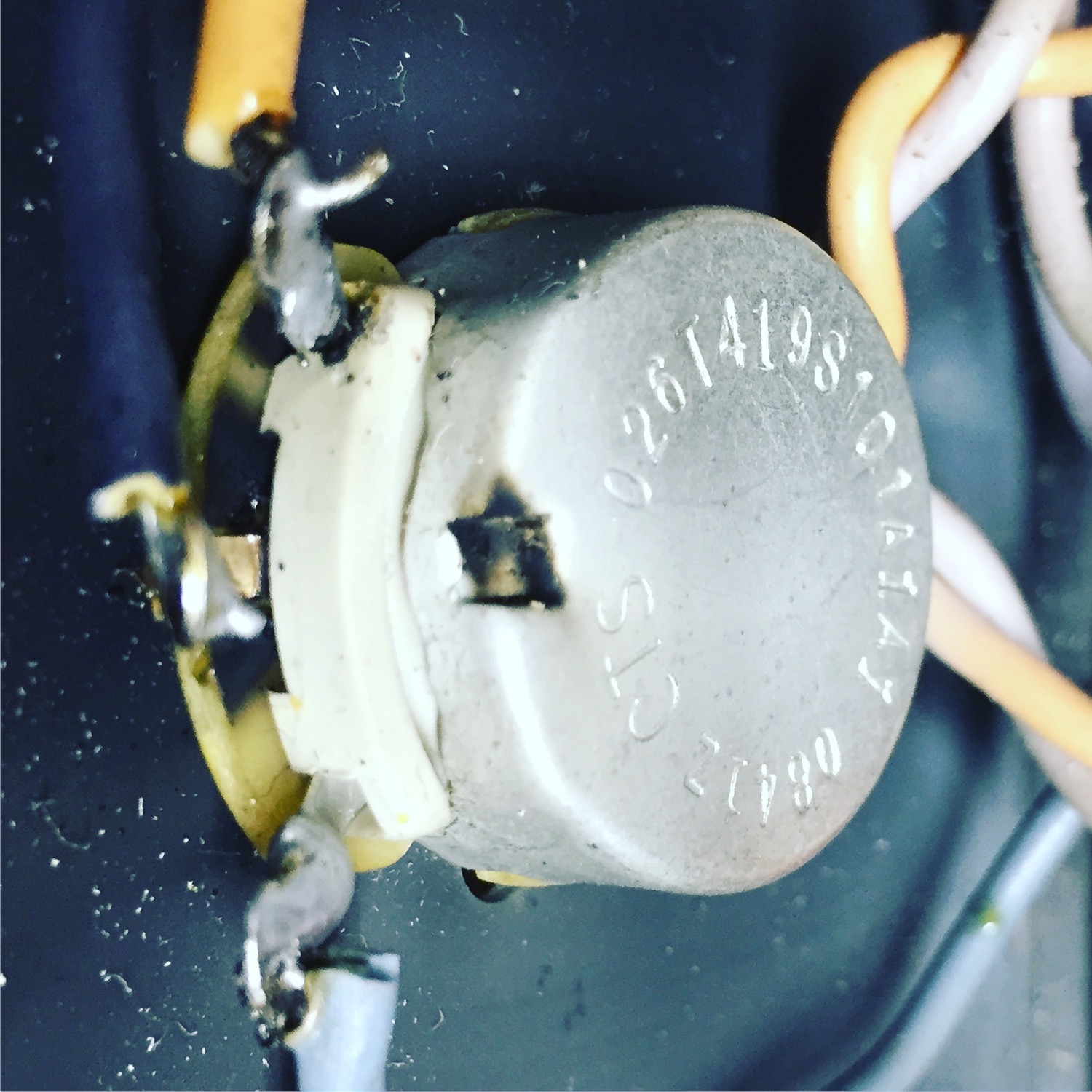
I believe the fender style would work as well without having to cut down a pot. It’s recessed and lacks the panel mount pin, but 100 ohm linear and used in the same way in their amps. I have one of those in my parts bin, part number appears to be 028421, don’t have any of the ampeg style left. Would have to open up my V4 and check the part number.
Looks like the part number from the wiki is what I had, found an old picture of the burnt out pot on my V4. I think when I got this amp the original pot was stuck so I replaced it, and it burnt out with the tube short so I replaced it again.
Last edited:
I wonder if they’ve been discontinued.
I believe the fender style would work as well without having to cut down a pot. It’s recessed and lacks the panel mount pin, but 100 ohm linear and used in the same way in their amps. I have one of those in my parts bin, part number appears to be 028421, don’t have any of the ampeg style left. Would have to open up my V4 and check the part number.
AFAIK you only need to be concerned with the resistance, power rating, and physical dimensions. I am pretty sure the Fender style would work fine and long as it will fit in the hole and threaded part is long enough for the nut to catch and hold. My guess is the OP has a Fender style in the V4.
If you do a Google search for 026T419S101A1A1 you will find images of the correct pot, but the sites I found use Cyrillic characters. I suspect it's an obsolete part.
I could not find any sources when I was working on my SVT, so I chose to cut down a pot to keep it more like the original.

I wouldn't use a dremel cutoff wheel unless there is no other option. A hacksaw generates far less heat and micro swarf compared to an abrasive cutoff wheel. Just clamp the shaft in a vise and lop it off; clean up with a file and slot it. Potentially, the internal plastic insulator that the shaft turns could melt from the heat generated from the cutoff wheel and
I wouldn't use a dremel cutoff wheel unless there is no other option. A hacksaw generates far less heat.
I don't own a decent hack saw or a vise. I do a own a Dremel, some cutoff wheels, a set of vise grips, and a pair of 3M Ear Muffs
. I was concerned about the heat, but it seems to have worked out okay. Guess I got lucky  .
.
The CTS pot in the wiki is what I use and it does look like they are no longer available. This was the part that many companies used for years, it figures that they would retire it.
The spec is 5W, wire wound, linear, slotted. Substitutes are be available although not necessarily to those exact specs. Note that the images on some parts suppliers are not always correct so you can’t go by that.
Here is the part number broken down: 026T419S101A1A1
026 is the CTS 5W wirewound series
T is solder lug
4 is the bushing length, the threaded part
19 is the metal shaft length
S slotted
101 100 ohms
A 10% tolerance
1 linerar taper
A no switch
1 locating tab, left side
https://www.mouser.com/datasheet/2/96/26-794192.pdf
The steel shafts are difficult to cut in comparison to aluminum, brass, or plastic.
Here is one source for a hum balance pot. It isn’t the same as the CTS pot. They supply the Fender part number below so you can find it elsewhere. It doesn’t have to be 5W, 2W is ok.
Darren Riley is my goto supplier for Fender parts.
Fender Control 100 OHM Hum Balance 0028421000
Here are two other sources for the Fender hum balance part:
Angela Instruments LLC
Fender Amp Parts - Fender Pots
This is another one that I use, it costs a bit more.
Invalid Link Removed
The spec is 5W, wire wound, linear, slotted. Substitutes are be available although not necessarily to those exact specs. Note that the images on some parts suppliers are not always correct so you can’t go by that.
Here is the part number broken down: 026T419S101A1A1
026 is the CTS 5W wirewound series
T is solder lug
4 is the bushing length, the threaded part
19 is the metal shaft length
S slotted
101 100 ohms
A 10% tolerance
1 linerar taper
A no switch
1 locating tab, left side
https://www.mouser.com/datasheet/2/96/26-794192.pdf
The steel shafts are difficult to cut in comparison to aluminum, brass, or plastic.
Here is one source for a hum balance pot. It isn’t the same as the CTS pot. They supply the Fender part number below so you can find it elsewhere. It doesn’t have to be 5W, 2W is ok.
Darren Riley is my goto supplier for Fender parts.
Fender Control 100 OHM Hum Balance 0028421000
Here are two other sources for the Fender hum balance part:
Angela Instruments LLC
Fender Amp Parts - Fender Pots
This is another one that I use, it costs a bit more.
Invalid Link Removed
Last edited:

Yes tweaking the hum balance is safe to do, just take note of where it’s set in case that’s good as it gets. It’ll probably improve, you may need to turn one way or the other.OP here.
The balance pot is recessed back about 6mm that's why I couldn't see it. And yes, it has a screwdriver slot.
I'm still getting some hum after a re-tubing and general overhaul so I was wondering if maybe my 2x15 B25B 4-ohm cabinet would be reacting differently to the amp than the tech's test speakers and if I should tweak the hum balance.
There is a hand-width of space between the head and the wall and I only play for a few minutes at a time in the basement anyway. My main practice amp is a little Samick right next to me here in my computer room. I do most of my playing with no-bass jazz jam track on Youtube.
Yes tweaking the hum balance is safe to do, just take note of where it’s set in case that’s good as it gets. It’ll probably improve, you may need to turn one way or the other.
Also you may find that the best position varies with the way you set the volume and tone controls. That was the case with my 69 SVT. I believe the reason is because each tube has a certain amount of hum and you adjust the control so the hum balances out. But if you adjust another control that modifies the relative gain between various circuits it throws the hum balance setting off.


