• TalkBass has been independent since 1998. Add your voice.
    Create a free account to reply to discussions, view embedded media, and browse with fewer display ads.
    Join freeLog in
    Want zero display ads or expanded classifieds tools? Compare plans.

How easily does this come off?

fretlessman71

Still beats havin' a job
Supporting Member
Aug 8, 2005
4,388
2,330
FoCo, NoCo
www.michaelolsononline.com
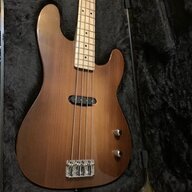
I have a Vega P bass that's about 40 years old, and worth nearly nothing (except to me) even though it sounds and plays wonderfully.

It has a solid mahogany body with a dark lacquer finish. The finish has seen better days (see pics), but the wood underneath seems pristine.

I am NOT a luthier, and would likely have someone do the work... but the chips out of the finish make me wonder how easy it would be to just try to "crack" it off a bit at a time. How are lacquer finishes like this usually removed?
PXL_20240302_003941766.jpg
PXL_20240302_004010866.jpg
PXL_20240302_004030311.jpg
 
I have a Vega P bass that's about 40 years old, and worth nearly nothing (except to me) even though it sounds and plays wonderfully.

It has a solid mahogany body with a dark lacquer finish. The finish has seen better days (see pics), but the wood underneath seems pristine.

I am NOT a luthier, and would likely have someone do the work... but the chips out of the finish make me wonder how easy it would be to just try to "crack" it off a bit at a time. How are lacquer finishes like this usually removed?View attachment 5370933 View attachment 5370935 View attachment 5370936

Finishes like that are normally removed by a combination of scraping and sanding. Not a big deal.
 
I would use a heat gun and a putty knife. I only mention it so someone who knows what they are doing can correct me if that is the wrong approach.

A heat gun is useful if you are trying to remove a tough polyester finish. Heat up areas to break the bond with the wood, and then use a scraper to peel it up. But that's overkill here. This is an old nitro lacquer finish that's actively trying to peel itself off the body. It just needs a little nudge with a scraper and it'll pop right off in one layer. Faster and with minimal damage to the wood.

The same is true with chemical strippers. That's for tough paint that's bonded down well. No need for the extra mess with old nitro.

Both heat guns and chemical strippers will soften the paint somewhat (that's what they are supposed to do), and that will usually push some of the residue down into the grain. Which means more sanding to clean up the wood.

When I strip finishes, my first choice is mechanical methods; paint scrapers, coarse files and coarse sandpaper. Use them to quickly peel the paint off, but don't let those tools dig into the wood. Don't go too far and make deep scratches in the wood. When you start seeing wood through the paint, switch to fine files and finer grit sandpaper.

Heat guns and chemical strippers are for emergency use on really stubborn finishes.
 
  • Like
Reactions: Auer and Markshan
Thanks for the replies folks. If I were to remove the lacquer, would this be fine with a really light oil finish? How can I treat the body wood so that it is protected but can still breathe? I live in a very arid climate (Northern Colorado).
I'm very fond of the Tung Oil finish I did on my Tele build, but make sure you get actual Tung Oil and you have to be extremely patient. I did a coat a week for two months.
 
I'm very fond of the Tung Oil finish I did on my Tele build, but make sure you get actual Tung Oil and you have to be extremely patient. I did a coat a week for two months.

I disagree with that. Use a Tung Oil Finish, not a Pure Tung Oil. If it has the word Finish in it, that means it's Tung Oil blended into a Boiled Linseed Oil or Polyurethane base. That base will sink into the pores and harden, fairly quickly, into a protective barrier. That's what you want.

A Pure or Genuine Oil will sink into the wood and never fully harden. It can take months to apply to get it to look nice, and it never really protects the wood very well. I don't recommend pure oil for musical instrument finishes.
 
Thanks for the replies folks. If I were to remove the lacquer, would this be fine with a really light oil finish? How can I treat the body wood so that it is protected but can still breathe? I live in a very arid climate (Northern Colorado).

Wood in an electric bass doesn't need to "breathe". That's old folklore from the world of acoustic guitars. An electric bass needs to be completely sealed up so it can't breathe. We don't the wood to absorb moisture and release it when the weather changes. That'll make it swell up and crack.

Scrape and sand off all the old lacquer, fine-sand it nice and smooth in straight lines along the grain, and wipe on a couple of coats of a hardening finish. Tru-Oil is a classic, very easy to use. Tung Oil Finish also works well. Plenty to choose from, with different shades of tinting.

If you want to go Water-Base, for speed and minimal fumes, I highly recommend MinWax's Oil-Enhanced Water-Base Polyurethane. Very easy to use, a nice oil-like amber tint, and it's fully hardened in a day or two. A tough protective coating. One or two wiped-on coats and it's done. You can scrub it to satin or buff it up to a shine.
 
  • Like
Reactions: Jazzdogg and Auer
I disagree with that. Use a Tung Oil Finish, not a Pure Tung Oil. If it has the word Finish in it, that means it's Tung Oil blended into a Boiled Linseed Oil or Polyurethane base. That base will sink into the pores and harden, fairly quickly, into a protective barrier. That's what you want.

A Pure or Genuine Oil will sink into the wood and never fully harden. It can take months to apply to get it to look nice, and it never really protects the wood very well. I don't recommend pure oil for musical instrument finishes.
I respect that opinion but he did say he wants something where the wood breathes. I think real Tung Oil does that in spades. Plus it feels amazing. Yes, in five years I'll probably have to do another application, but to me it's worth it.
 
I respect that opinion but he did say he wants something where the wood breathes. I think real Tung Oil does that in spades. Plus it feels amazing. Yes, in five years I'll probably have to do another application, but to me it's worth it.

Yeah, the "wood needs to breathe" thing is deeply set in some people's minds.
 
I am really conscious about weight (my bass's weight, not mine). I will, when I change things on a bass, weigh it on a very accurate scale, and I started noticing things....even without changing anything, my basses do get lighter over time, and are lighter in the winter than they are in the summer - even though they have polyurethane finishes on them, they actually do "breathe" some - it's unavoidable; no finish is actually completely impervious to water vapor. You don't have to worry about it - you bass will "breathe" some (although it'd probably be OK if it didn't).