• TalkBass has been independent since 1998. Add your voice.
    Create a free account to reply to discussions, view embedded media, and browse with fewer display ads.
    Join freeLog in
    Want zero display ads or expanded classifieds tools? Compare plans.

How effective are Bass traps for room accostics?

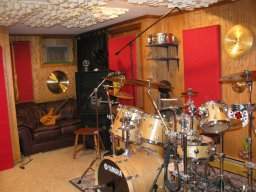
I have a 12 by 16 foot studio room with flat 9'-6" ceilings. I am just finishing up with updating the equipment plus I did new carpet and paint. When we rehearse or jam everyone's instrument is plugged direct into the board via pre-amps and effects. So when playing as a band, we are only hearing ourselves thru the JBL studio tower monitors. Located in the bottom of each tower is a self powered 1000 watt 12" JBL sub. The room sounds very good with the exception that the bottom end is a little boomy and the attack on the kick drum and lower notes on the bass guitar is not as sharp as it could be. Also, the decay on the bottom is a little slow which makes the bottom end somewhat muddy. So my next move will to be install some type of bass trap above each speaker. I have around 42" from top of speaker to ceiling. Just looking to hear from others how effective bass traps are. I have been looking at the foam types of bass traps on Amazon. Any constructive advice would be appreciated.

Studio Redo 2016.jpg
 
Last edited:
Bass traps are the single most important piece of acoustic treatment for ANY room. As far as I'm concerned you cannot have too much.

Remember that horizontal corners (wall/ceiling and wall/floor) are just as effective as vertical corners (wall/wall) when trapping. The floor isn't typically practical due to the loss of space for gear and bodies, but the ceiling corner is often overlooked, and if available a very functional location.

Corner traps are very effective and can be made with a number of different materials. Placement is critical as well, and will determine how low they effectively work. These typically work on a large bandwidth of frequencies. You can also use two panel traps in a 90-degree configuration to save floor space in the corner of required. You'd need the right type of rigid insulation and ideally an air gap behind the panel for this to be truly effective, but if you need to save every possible square inch it's a good route to consider.

Limp mass membrane absorbers and Helmholtz resonators are great if you have specific problem frequencies, but are harder to build and require more knowledge in terms of placement. I would measure the room and make decisions based on what you find.

It's hard to tell from your picture, but I would also look at rearranging your room a bit. Speakers placed in a corner will see increased low end performance, which is probably contributing to the boomy room problems you're describing. Obviously for functional reasons they need to be against a wall, but if you can shift them out of the corners you might see some acoustic benefit.
 
  • Like
Reactions: Stewie26
I would start by experimenting with the speaker placement

Putting a speaker in a wall/floor junction can boost low end by 3db
Putting a speaker in a wall/wall/floor junction can boost low end by 6db
Same Principal with Attenuation
I placed mine in the upper corner

Agreed that curtain doesn't help in the low end

Sound don't like randomness and loves square/flat/equal surfaces
My room is square , it helped to put wall attenuator @ random patterns
(don't see in the photo the rest of the room)
 

Attachments

  • DSCN1816.jpg
    DSCN1816.jpg
    814.6 KB · Views: 368
  • Like
Reactions: Stewie26
OP here. Thanks for all the reply's. I am thinking of out trying these. I have room, (42") to place three of these above each corner speaker giving a three foot high bass trap. The cost to do each corner is only $38.00. These were rate 4.5 out of five stars an Amazon. Has anyone had experience with similar foam block type traps?


51WqVAslcHL.jpg
 
Be careful with foam block type traps. Those are likely "packing" density foam which won't do much for low frequencies. Buy traps from a reputable manufacturer only. Look at what GIK has to offer for quality products at a reasonable price. If you want to spend bigger bucks you can look at RealTraps, but they might be overkill for your room.
 
  • Like
Reactions: Stewie26
\
I would start by experimenting with the speaker placement
Putting a speaker in a wall/floor junction can boost low end by 3db
Putting a speaker in a wall/wall/floor junction can boost low end by 6db
Same Principal with Attenuation
I placed mine in the upper corner

That looks like my situation. Wow, 6db is a lot! I can not re-position speakers as I need all the floor space I can get plus they are heavy and very difficult to move. There have been times when we have 7 persons in the room playing and singing at one time. So I definitely need to go down the path of taming the low end boom via room treatments.
 
It's been a while since I read up on traps but I remember that to be effective it was going to take some serious design skills and money.

The speaker placement thing is real. I was reading about sub placement for our sanctuary and everyone was all put 'put near a wall for a boost' and 'put it in a corner for a bigger boost' or 'put it in the center'. Well it sounded like crap near the walls and after experimenting with placement it worked best in a spot I never would have suspected. In a small room moving cabs just a few inches can change things drastically.

But, having said all that, your room reminds me of the practices space for a wedding band I was in. We practiced in the drummer's spare bedroom while his wife slept. He had jamhub. It was pretty cool. Everyone brought headphones and adjusted their own mix. It would 2 track record the rehearsals. I would forget we were on headphones until I took them off and the only sounds were the vocals and sticks hitting the vdrums.
 
I remember that to be effective it was going to take some serious design skills and money.
Pretty easy and cost effective actually. Get some Owens Corning 703 panels, double them up, skin them with a breathable fabric (Guilfords of Maine Anchorage on the expensive end, simple burlap on the cheap end), and straddle corners with them. Add a wedge of pink fluffy insulation behind the panel to increase performance. Cheap, easy, simple.
 
Some companies are using dense denim batting. I've used layers of dense ¼" wool felt, it is fairly lightweight. That can be expensive, but felt carpet underlay is more affordable. Efficiency will vary with the product used.

wool felt:

damping felt.jpg
 
Last edited:
That looks like my situation. Wow, 6db is a lot!

Came with this on a Google search:

[Invalid or Expired Link Removed]

"....Positioning the SB-2 at the junction of three boundaries (i.e. - at a floor/wall/wall or ceiling/wall/wall junction) yields maximum output sensitivity for use with high sensitivity satellites or for subwoofer-heavy applications. Placement at the junction of two boundaries (i.e. - floor/wall, ceiling/wall or wall/wall) reduces the subwoofer level by 3 dB. Placement in the middle of a single boundary (i.e. - wall, floor or ceiling) further reduces subwoofer output sensitivity by another 3 dB, to match ..... ."


And same principle applies for the positioning of a bass Monitor in a practice room. ;)
 
If you can't move the speakers (which would also be my first strategy), try putting a high-pass filter on every channel except the kick drum and bass. Just cleaning up unnecessary murk out of instrument channels and open mic signals can help a lot with the low end.

Also, +1 to building your own acoustic treatments. You'll find many good tutorials for building bass traps on line. Compared to buying pre-made, DIY will be far less expensive and will allow you to tailor the traps to your room.
 
Last edited:
  • Like
Reactions: Stewie26
Pretty easy and cost effective actually
What I recall is it wasn't as simple as putting sound absorbers in the corner. You can do that, and it will make a difference, but the size, material, placement, shape, room dimensions all factored in to which frequencies were going to be affected. Which is where the design skills came into play.

Kind of like building a speaker cabinet. It's not as simple as slapping a speaker in a box.

That's what I remember. I could be wrong.
 
It actually is quite simple.

Straddling a corner with a 703 product works well. Filling the void behind it with pink fluffy insulation works even better.

If you get into things like resonators, membrane traps, etc. it's more complicated, but for basic trapping in a room what I outlined above will get it done for most situations.
 

Latest posts