• TalkBass has been independent since 1998. Add your voice.
    Create a free account to reply to discussions, view embedded media, and browse with fewer display ads.
    Join freeLog in
    Want zero display ads or expanded classifieds tools? Compare plans.

How Fast should I be able to play 16th notes after 1 Year

Aug 26, 2024
23
21
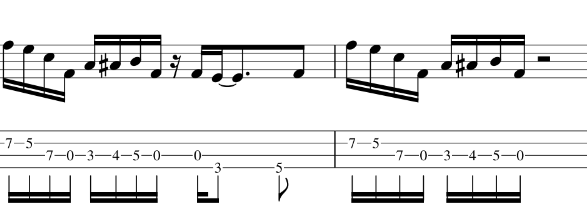
I have been playing bass for slightly under a year and I starting to learn more 16th note lines I am having issues with playing at speed with accuracy but I feel like I should be able to play faster and if I am slow what is the best way to increase my playing speed, here is some bechmarks of my speed and how much i practice to help give a sense of where i am at when it come to playing the bass gutiar (I understand the bass line effects your speed), I can play the chorus of Unfunky UFO by Parliament (photo below) at 100 and a short burst of ~4 16th at 110 bpm (It varies from day to day a bit), I regulary practice for an hour(sometime more) a day.

1724704315537.png


Thank you in Advance
 
  • Like
Reactions: 31HZ and icarus88
There is no absolute about how fast you should be able to play after some amount of practice. Everyone will be different. The best way to increase speed is to measure your playing with a metronome. To the Jeff Berlin fans, I am suggesting using the metronome simply as a measuring device.

Start at a tempo that you can handle, like 100BPM in your example, and play a repeating pattern that you don’t have to think about. NOT those two syncopated bars of Parliament :whistle: Open strings, a scale, a single bar riff, etc. Play only that for at least five minutes without making a mistake or slowing down. If you can't do that, notch the metronome down a bit and try to play for five minutes without making a mistake.

Keep a record of the fastest tempo where you can play something simple in 16th notes for five minutes. Every day, start at that tempo and make sure you can still play it that fast. If so, notch the metronome up a bit. If you cannot play that fast for five minutes, go back to the previous tempo the next day. If you feel any pain from playing fast, stop and take a 10-15 minute break.

Once you can play at the tempo of the song you are struggling with, try playing sections of it along with the metronome as above. Start well below the final tempo. If it’s 110, start at 90 maybe. Do the same thing….five minutes without a mistake before you notch up the tempo and keep track of the highest tempo every day. Ideally keep working at it until you can play it a notch faster than the recording.

Do this as just a part of your practice routine. If you're playing an hour a day, do this for 15-20 minutes nd give it a break until the next day.
 
Your fingers should be able to move fast enough so that your hand experiences time dilation in relation to the rest of your body. Thus the notes will arrive at your ears even as your fingers appear to slow down until they are motionless. I'm not sure why all bass players can't do this even after only a few weeks of learning to play. In fact, I can play so fast that nobody knows what notes I'm playing, especially me. ;)

Okay, seriously, @brianrost 's answer is spot on. Speed is worthless without accuracy and consistency. Nail those last two, and the first will come naturally. Be patient with yourself. Improving is a life-long process.

Welcome to Talkbass. :thumbsup:
 
There's no right or wrong answer, only constant improvement and finding new ways to challenge yourself. There are tons of factors that can make a fast line easier or harder, from fretboard position to fingering to context within a piece, it's not always as simple as "play X at Y tempo."

Remember to give yourself a variety of challenges beyond the technical and speed ones, too. Moving up and down the fretboard, identifying chords, charting songs efficiently by ear, and transcribing cool stuff like you are doing here.
 
  • Like
Reactions: Wasnex
I feel like I should be able to play faster and if I am slow what is the best way to increase my playing speed

You should be able to play as fast as you can play. Chances are, somebody will always be able play faster. So don't worry about it; just do the best you can.

If you keep practicing, you should get faster and faster, but progress is likely to be slower than you want.

Part of the problem is developing fine motor control and learning to play efficiently. Most people make progress on these aspects of playing over the course of many years. So it may be quite awhile before you can play as fast as you want.

How long it will take to develop the desired speed depends on your natural ability, how hard you work, and whether you practice the right way or the wrong way. Having a good teacher can be very helpful as they can provide useful guidance, knowledge, and demonstrations.

One way to develop speed is to start slow and play a line over and over. Part of playing fast is developing a good finger pattern that is efficient. Another part is playing with good technique. Another part is playing a line in; so it happens automatically, rather than having to think about all of the notes and details.

If you keep playing the same line over and over again, you may hit a wall and start to get frustrated. I believe this tends to cause us to develop mental blocks. A mental block can cause you to loose speed. So rather than pushing to the point of extreme frustration, I suggest rotating through several challenging passages. Start each passage at a tempo that is slow enough for you to play cleanly and correctly. Slowly work the passage up to a faster tempo. Just before you hit the wall, move on to another passage and start slow again.

Rotate through all of the passages you have selected for practice. Each time you come back to a passage, you will need to slow down a bit and work it back up. However, each time through the rotation you should be able to start and end a little faster than on the previous rotation.

If you develop a mental block, try removing the offending passage from your practice rotation. There have been pieces that I was not able to work up to tempo before performance. A few weeks after the tour, I sometimes found that I could play the passage. So it seems I had learned the passage and a mental block was preventing me from performing it at tempo. However after putting the piece down for awhile, the mental block was released.
 
I have been playing bass for slightly under a year and I starting to learn more 16th note lines I am having issues with playing at speed with accuracy but I feel like I should be able to play faster and if I am slow what is the best way to increase my playing speed,
...
Thank you in Advance

As others have said there is no right answer to how fast you should be able to play, but the answer is already in the question. To play at speed with accuracy you need to practice slowly with accuracy. It is easy, when playing slowly, to play sloppily and lazily. By that I don't mean out of time with bad musical results. I mean having flaws in your technique that are not apparent at slow tempo for one reason or another cause it to break down as the tempo increases. You need to take a forensic look at what happens when you reach those limits: Is one hand 'faster' than the other? Is one hand slightly 'ahead' of the other? Is the timing/rhythm of one hand less regular than the other? For descending lines on one string. are your fingers fully lifting off in time? Is there a problem crossing strings? Are your right hand fingers crashing into each other? Is there sufficient independence between your left and right hands? There could be a load more reasons. My point is they will be unique to you at this point so only you (perhaps with the help of an in-person teacher) can find them. Once you know what they are, you can modify your technique and/or devise exercises that target the specific areas of concern then practice slowly until the changes are embedded.

Incidentally, the engraving of the line is 'somewhat unconventional' (aka bad) because the separation of beats 3 and 4 is hidden inside that dotted quaver.
1724740170148.png

Better (aka 'correct') would be this:
1724739805706.png


Good luck!
 
Plenty of good advice here, but I haven't seen advice about the importance of relaxation. In order to play fast to need to be able to play relaxed. Common mistake for beginner is to try too hard and develop a lot of tension in your hands. It is counter productive since tension will limit your ability to speed up. And most importantly this is how you will injure yourself in the long run, you don't want to deal with life long tendinitis.
 
Learning to play fast is a matter of putting in the time and effort. Accept that it's going to take some time but it will pay off. Coordination comes first, speed comes later.

1. Learn to play fast by playing slowly. Don't play faster than you can play cleanly or you'll just be reinforcing bad habits. Focus on your accuracy and muting technique and when your technique starts to fall off then slow down to a point where you can play clean. This is important to develop coordination and to, train your nervous system and brain to naturally play correctly. What's the point of playing fast if you're sloppy and making unwanted noise? The is the brain part and the next is for developing your muscles.

2. Do finger exercises every day. There are too many for me try and explain from a keyboard. Do a search on YouTube for Bass Finger Exercises. Find three that are challenging and spend a few minutes everyday and to warm up before you play. They don't have to sound musical. This is important to develop all those little muscles in your fingers, hands, wrist, and forearm. It it's hard to do then do that one and don't go faster than you can play cleanly. Also, play efficiently and minimize energy.

3. Unless you're Rocco Prestia (Tower of Power) pluck with two fingers and not just one. Two fingers are much faster than one. If you use a pick then practice up and down strokes. You do this by rotating the pick in a circle with your fingers rather than moving your wrist or arm up and down. Play alternate strings and skipping strings while using up and down circular strokes. Plucking up and down is twice as fast as only plucking down strokes.

3. Play to a metronome or any drum rhythm pattern on a regular basis. The point is obviously to develop good timing skills. I can't overstate that timing and rhythm is as important as playing the right notes.

4. After you've worked on these and can play comfortably and cleanly then increase your tempo a little bit everyday or so.
 
Last edited:
Some great advice thus far.
Alongside the physical challenges of playing at speed, I have to address a mental block around timing.
I used to tense up, thinking I had to squeeze so many (extra) notes in - a sort of panic mode! This tension spread from my mind to my fingers & made the playing tougher and my timing suffer.....

Look for exercises to build playing 1/16ths keeping relaxed. It was a real Aha moment, when I discovered that I didn't have to rush/panic in my mind to 'get the notes down'.

Study where/how the notes land - varying emphasis on certain beats.

Build the bass lines gradually, perhaps utilising 1/8th notes here and there before full run of 1/16ths.

Don't be saying to yourself "I should". Try "I like to"
 
Even harder than playing it fast, try playing it super slowly!! Tap with your foot and don't worry about the metronome speed. Once you know something this way -- and I mean really slowly and clean in every way with the right hand and left hand -- then you can increase the speed (which will happen naturally), as long as you keep playing it just as well.

Once you're making mistakes because of trying to play fast, you gotta slow down again and work on it. For example, I am learning the bass line in Miss You (reading the notes), and I'm still working at 50% of the final speed. I CAN play some parts faster, but I still choke up in other parts. It just means that I'm not ready for speed yet! There is no such thing as learning too slowly.
 
  • Like
Reactions: SteveCS
There is no absolute about how fast you should be able to play after some amount of practice. Everyone will be different. The best way to increase speed is to measure your playing with a metronome. To the Jeff Berlin fans, I am suggesting using the metronome simply as a measuring device.

Start at a tempo that you can handle, like 100BPM in your example, and play a repeating pattern that you don’t have to think about. NOT those two syncopated bars of Parliament :whistle: Open strings, a scale, a single bar riff, etc. Play only that for at least five minutes without making a mistake or slowing down. If you can't do that, notch the metronome down a bit and try to play for five minutes without making a mistake.

Keep a record of the fastest tempo where you can play something simple in 16th notes for five minutes. Every day, start at that tempo and make sure you can still play it that fast. If so, notch the metronome up a bit. If you cannot play that fast for five minutes, go back to the previous tempo the next day. If you feel any pain from playing fast, stop and take a 10-15 minute break.

Once you can play at the tempo of the song you are struggling with, try playing sections of it along with the metronome as above. Start well below the final tempo. If it’s 110, start at 90 maybe. Do the same thing….five minutes without a mistake before you notch up the tempo and keep track of the highest tempo every day. Ideally keep working at it until you can play it a notch faster than the recording.

Do this as just a part of your practice routine. If you're playing an hour a day, do this for 15-20 minutes nd give it a break until the next day.
thanks for your advice, I will add this to my practice routine, I know not to use those syncopated lines I just used it as an example, but thanks still your advice is very helpful.
 
I have been playing bass for slightly under a year and I starting to learn more 16th note lines I am having issues with playing at speed with accuracy but I feel like I should be able to play faster and if I am slow what is the best way to increase my playing speed, here is some bechmarks of my speed and how much i practice to help give a sense of where i am at when it come to playing the bass gutiar (I understand the bass line effects your speed), I can play the chorus of Unfunky UFO by Parliament (photo below) at 100 and a short burst of ~4 16th at 110 bpm (It varies from day to day a bit), I regulary practice for an hour(sometime more) a day.

View attachment 7014272

Thank you in Advance

Frankly, I would not bother about it, plus it's a very difficult question to answer: it depends entirely on the person's natural ability and the amount of effort you put into it. Especially the latter.

In my opinion, you're better off focusing on accuracy and timing, and for that I'd start slowly. Make sure you play cleanly, your muting is good, that you can play in time and get the nuances of playing slightly ahead or behind the beat for different 'feels', and also the length of your notes, make sure you're consistent and can play different length notes cleanly and consistently...

If you do that, speed will come, don't worry. Don't try to go faster than you're able. Well, I mean, yes, push your comfort zone but be sensible about it and make sure that your feel is good. That will get you a lot further than speed. To me the ability to play fast comes as a consequence of becoming comfortable with the instrument and that is practice practice practice. If you want to get there sooner... practice more hours. But make sure you have a focused practice, noodling around is fun but as far as practice goes it's not the most effective way.
 
  • Like
Reactions: Wasnex
...
In my opinion, you're better off focusing on accuracy and timing, and for that I'd start slowly. Make sure you play cleanly, your muting is good, that you can play in time and get the nuances of playing slightly ahead or behind the beat for different 'feels', and also the length of your notes, make sure you're consistent and can play different length notes cleanly and consistently...

If you do that, speed will come,
...

^^^ Yep!
 

Latest posts