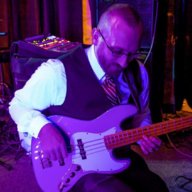
I just find it hilarious that in a world where some bassists are putting flats with foam on their basses to reduce sustain, other bassists are trying to convince us that heavier basses have such better tone that you need to be a weight lifting man (and I emphasize man) to be the best bass player that one can dream of being.
No, seriously. Spending time in the gym is a great idea, but why bother with weights? You're going to die because your heart fails, not because you're not strong enough. Do cardio. Do strength if you feel like it, but if it's for the sake of bass, just take that time to practice bass and get a lighter bass. You'll sound just fine.
Yah, I didn't mean to get involved in any debate on sustain and wood or anything like that. I have only my own anecdotal experience to go on there. Someone like Doug Parent has a much better idea of all the pros and cons. I just thought it was worth adding my two cents. For the most part, I avoid internet debates or even active participation. TalkBass is one of only two forums I participate in, and it's mostly passive.
For weights however, I am absolutely convinced of their value, in particular compound barbell lifts with medium grips and stances and maximal leverages, for men, women, and everyone in between or outside. But most of my artist, musician, and intellectual friends don't want to hear any of it, so I'm not about to try to convince strangers on the internet of my opinion. If you're interested, here's a good article to start with:
Invalid Link Removed. Like most people in the strength business, Rippetoe is a potty mouth and writes in a blunt, macho style, but if you can get past that, he has a lot of useful information to offer.
Indeed, the main problem with weights is their association with bodybuilders, action stars, and pro wrestlers, which is a big turn-off for a lot of people. But like it or not, a good part of your body is composed of muscle, bone, ligaments, and tendons, and keeping them fit is a huge quality of life issue. Healthy muscle and bone tissue also helps regulate things like your body's hormonal milieu, immune system, cognitive function, mood, sleep, appetite, and so on. You don't need a lot of weight or time, just get something in. If anyone wants me to give a fuller account of my approach, just PM me. Basically, I think there are three pillars in fitness: strength, conditioning, and mobility.
I broke my neck. ... So while I appreciate the point you are trying to make, and I know it was done with good intentions, you cannot simply assume that a "solution for you" is a "solution for everyone".

Yes, of course, the ability to lift weights will depend on your current health and biography. I'm sorry to hear of your situation, but it's great you've recovered as well as you have.
I had to give up running two years ago because I found out I have degenerative menisci. Two out of the three orthos I saw also told me to give up barbell squats and deadlifts. But one (who is also one of the Twin Cities top guys, operating on local sports stars) said no, one of the reasons I hadn't had trouble with my knees earlier is because the joint is otherwise pretty strong, thanks to squats and deadlifts. (On a separate occasion, a different ortho told me I have the shoulder health of a 25-year-old.)
Since finding out about the degenerative meniscus tissue issue, I've found I've been able to continue with squats and deadlifts, just have to monitor the situation and back off at the first sign of trouble, "live to fight another day" as it were. And I've been able to replace running with cycling, sled work, and other conditioning exercises, although nothing gives me quite the same exhilaration as a good run. Anyway, I didn't mean to "blame the victim" for whomever is simply not capable of lifting weights, although I've heard and read enough anecdotal evidence to think that in many, but by no means all, cases, some weight training, programmed smartly and with caution, could still be of some benefit.