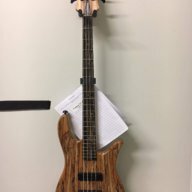
Turnaround
Commercial User
When? Every time I play "A Remark You Made". Even Jaco had to jump down an octave in part of his solo for the lack of 2 more frets.How often do you get anywhere NEAR the 20th fret, even when soloing?

TalkBass has been independent since 1998. Add your voice.
Create a free account to reply to discussions, view embedded media, and browse with fewer display ads.
Join free Log in
Want zero display ads or expanded classifieds tools? Compare plans.
When? Every time I play "A Remark You Made". Even Jaco had to jump down an octave in part of his solo for the lack of 2 more frets.How often do you get anywhere NEAR the 20th fret, even when soloing?


Like your post, but worried if this is your bass. There is something seriously wrong from the looks of that bridge. Either the neck needs a reset because the pitch is too low, or the wrong bridge is installed. And I'm a little concerned about the top sagging given the distortion at the f-holes.
Are you serious? Hahaha
View attachment 1036523
Don't the Precision and Jazz basses both have only 20 frets??
Hey, I get near the 20th fret!
... but only when I play the intro to For Whom the Bell Tolls (Metallica).
 The bass part in the middle goes on for a while and you're repetitively jumping from open A and E up to the 17th and 19th frets, which is actually a beautifully sounding rock part if I ever heard one. Try it! Great tune.
I raise this point because in practical terms because after doing some calulating with Stew Mac's fret spacing calculator, it would seem that most shifts in spacing occur at the pocket end of the fretboard, not the first 5 frets.
Ostensibly, even a longer scale fretboard could possibly benefit from having fewer frets because the pocket end of the fretboard would have wider spacing and thereby make playing in those upper registers easier than a bunch of cramped frets attempting to get a second octave.

Mind you, I'm thinking your typical Fender Jazz/Precision type bass here.
Is the number of frets a bass has inconsequential in most cases because most bassists don't play above the 12th fret?
Could anyone share their preferences for number of frets in relation to some standard scale lengths?
The Fender Mustang has 20 frets. Would it be silly to have that few frets on a longer scale bass? How many bassists actually utilize two octave scale fretboards?
While it's interesting to play in the upper registers at times, it seems most basses aren't even ergonomic enough to accommodate and facilitate that.
I don't care.
If the bass sounds good and plays well, these kinds of things are just details.
I would honestly like an extra fret on my jazz- just so i could complete a three octave e scale


Personally, 1/10 solos go this high. I prefer the mid-range pitches for soloing, so 5-12 is where I hang.How often do you get anywhere NEAR the 20th fret, even when soloing?
Like your post, but worried if this is your bass. There is something seriously wrong from the looks of that bridge. Either the neck needs a reset because the pitch is too low, or the wrong bridge is installed. And I'm a little concerned about the top sagging given the distortion at the f-holes.
It's not like you can only have one bass in your life. If you need to solo above the 20th fret, you grab your 24-fret bass ... or your 6'er (or high-C 5'er or whatever).Not quite. If one likes to solo and has ideas or material above the 20th fret, then these kinds of things become essential.
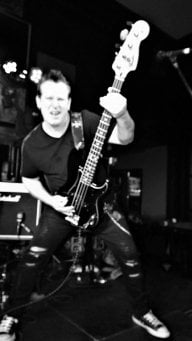

Annnnnd there in lies my general hate of some aspects of P and J style basses. I play and write originals, much of my melodics and arpegiations are done up above the octaves in conjunction with open strings. I have a fender zone PJ that has 22 frets. I would really like it to have a 35" scale with 26 frets ideally but still have the narrow jazz neck at the nut. But at least 22 is good enough for a jazz body, I love the bass btw. all the rest of my basses are 35" 24 fret necks. The why.....is simple the more frets and the longer the scale, the further down the neck the octave is and thus the further away from the cut-away the higher octave is, I can more easily use the higher notes that way. Last time I checked, our beloved instrument is a bass GUITAR. I use all the neck.Mind you, I'm thinking your typical Fender Jazz/Precision type bass here.
Is the number of frets a bass has inconsequential in most cases because most bassists don't play above the 12th fret?
Could anyone share their preferences for number of frets in relation to some standard scale lengths?
The Fender Mustang has 20 frets. Would it be silly to have that few frets on a longer scale bass? How many bassists actually utilize two octave scale fretboards?
While it's interesting to play in the upper registers at times, it seems most basses aren't even ergonomic enough to accommodate and facilitate that.