Apparently you only need 17. He never goes higher than the 17th fret.With 24 frets someone could probably play Eruption on their bass!
I selected 15.

Last edited:

TalkBass has been independent since 1998. Add your voice.
Create a free account to reply to discussions, view embedded media, and browse with fewer display ads.
Join free Log in
Want zero display ads or expanded classifieds tools? Compare plans.
Apparently you only need 17. He never goes higher than the 17th fret.With 24 frets someone could probably play Eruption on their bass!
I selected 15.
Four of my eleven basses have no frets at all...
When I got my first StingRay in '79 I figured the additional fret over the Precision would not be important. There was one song though where I started playing an A and E double stop on the intro that used that 21st fret. After a few months I took the P bas to a gig, that song came up and I started up there. Just before I hit that power chord I realized I didn't have the E. But having 20 or 24 or whatever has never been a factor in deciding whether to get a particular instrument.
 ...not so easy to disprove that one.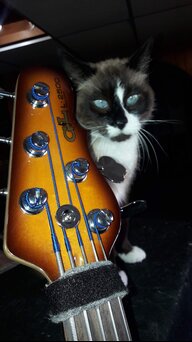

I saw Beck, Bogert and Appice. Beck broke a string. Bogert said, "well I'll take off one of mine then." He removed the low E. If it had been me, I would've taken off the G.Now I'm wondering what to go for if I ever get off my duff and try to build myself a 3-string... Maybe I'll just take the G off one of my 4's and see where that leads me.
Two of my more recent finds are 24 fret 4-strings and it's occurring to me how they change the equation up at the crossroads with the body (both are bolt-on's). Both basses have two pickups and the extra length on the fingerboard runs that end of the board up closer to the neck pickup than something like a traditional Jazz with maybe 20 frets.
What's caught my attention is that the extra fret board seems to create a fundamentally different tone from the string when I slap a little bit. I'm certainly not comparing two nearly identical basses with different numbers of frets here, but it seems that when I slap the string against a 24 fret neck, I'm knocking the string down against the frets at a different spot - effectively a little closer to the bridge - than on a 20 fret bass. Maybe a little less belly and a little more mid-range in that fundamental tone from a slapped string on a 24?
No biggie there, but it could be similar to how we can get different tones when plucking a string closer to the neck or the bridge. When I got these basses, it didn't even occur to me that they had "extra" frets. They were both really neat builds that would have come home with me even if they had only 12 or 15, but I guess I'll vote the 20-21 slot.

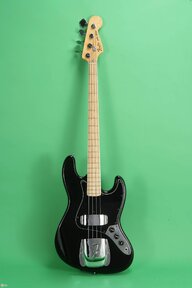
21 does for me. My two main four string basses - a Cort Rithimic and Peavey Palaedium, both Jeff Berlin signature models - fit this configuration. For me, that is more than enough to cover most of what I want to do with a four string. I say this because my main inspiration, Jeff Berlin, manages wonderfully with just 21 frets.
I do like having other basses with more frets or even more strings though I could happily play 21 fret four strings for the rest of my days and not feeling creatively or musically limited by that.

You left out 26...My bass has 24 frets, and this range is totally wasted on me. I wondering if I'm alone.


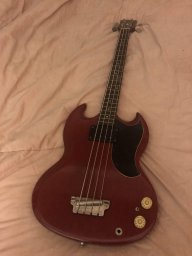
My bass has 24 frets, and this range is totally wasted on me. I wondering if I'm alone.

Actually Jaco only needed 20 fret lines.....Am I too late to post "Jaco only needed..."?

The only time I go beyond the 15 fret is for slides. I like slides.My bass has 24 frets, and this range is totally wasted on me. I wondering if I'm alone.


While I picked fretless carrots, I think 21 makes sense because when tuned to fourths (EADG or a similar pattern detuned), your lowest and highest notes are the same.
Question: why do the 21st frets on G&L fretboards not have the expected dots?I play mostly G&L basses, two of which (SB-2 and M-2500) have 21 frets.