• TalkBass has been independent since 1998. Add your voice.
    Create a free account to reply to discussions, view embedded media, and browse with fewer display ads.
    Join freeLog in
    Want zero display ads or expanded classifieds tools? Compare plans.

How many of you agree with this statement?

I think a lot of people here haven't listened to the clip very carefully.

Nowhere in that clip does Ned say that the wood composition of the body (i.e. the type of wood) is not important. He doesn't address the neck at all.

What he is saying essentially, is that you do not need a full size body to make a good sounding bass. In other words, while the body of an acoustic guitar is an absolutely essential part of creating the tone, a bass can be made with a very small body without it affecting tone all that much.

Now I would still argue that there are probably tonal differences between a bass with a full-sized body and an identical bass where much of the body mass has been cut off, but I think in general that he is right in that you don't absolutely have to have a full sized body in an electric instrument, whereas you cannot say the same about an acoustic one.

A bunch of folks here are putting words in his mouth. He never said the material the bass was made out of wasn't important. Indeed, the whole idea for the original Steinberger basses was to use a different material -- everything else like the headless design and the bridge resulted from his desire to use composites.

+1

 
I agree about Mr. Steinbergers statement, but the OP did use that statement as a jumping off point into the idea that the wood used on an electric instrument's body is inconsequential to the tone that you hear from your amp.

That's very true, but it's also not at all what Ned said in the clip. Many people are saying here that Ned said that the type of wood or other material used in a bass has no impact on the tone. He said no such thing in that clip.

What Ned was saying is that unlike an acoustic instrument which will not produce a tone without a full-size body, an electric instrument can be made with a tiny body, and still produce a useable tone. Other than aesthetics/ergonomics, there's no fundamental need (in terms of being able to produce a tone) to have a full-size body on an electric bass.

I think he's right on that. And I have an XL-2 to prove it.

Still an interesting discussion though. If you (gasp!) cut off the upper and lower bouts and horns on say a Ric (ouch!), how much would the tone change? My guess is that there would be a difference, though probably not a drastic one. While it would be a horrible thing to do, the bass would still function and produce sound (provided some place was found to put the controls). But please, don't try that at home. :D
 
That's very true, but it's also not at all what Ned said in the clip. Many people are saying here that Ned said that the type of wood or other material used in a bass has no impact on the tone. He said no such thing in that clip.

What Ned was saying is that unlike an acoustic instrument which will not produce a tone without a full-size body, an electric instrument can be made with a tiny body, and still produce a useable tone. Other than aesthetics/ergonomics, there's no fundamental need (in terms of being able to produce a tone) to have a full-size body on an electric bass.

I think he's right on that. And I have an XL-2 to prove it.

Still an interesting discussion though. If you (gasp!) cut off the upper and lower bouts and horns on say a Ric (ouch!), how much would the tone change? My guess is that there would be a difference, though probably not a drastic one. While it would be a horrible thing to do, the bass would still function and produce sound (provided some place was found to put the controls). But please, don't try that at home. :D


All true
 
I guess we could go all day while you talk about apples and me oranges......

I only continue to argue that I am a bass player that buys an instrument for performing it live or in a studio, most often live. What matters to ME is that when I'm on a gig or in a studio standing less then 5 feet from my bass amp or listening in cans I can easily tell the difference.

Being able to listen to an A/B test on my computer speakers, with headphones or using my studio monitors of either a solo'd bass track or a bass in the context of a group can be a fun experiment but really has no bearing on what I do as a bass player.

If things we're this simple all bass makers would simply post clips of their basses and we'd make our decision based on that. More to the point we'd just start making Headless/bodyless basses out of pressure treated lumber because who the heck can tell the difference when listening to the bass in a dense mix through a set of Ipod ear buds.


Makes sense to me. That's kind of what I was getting at in the last thing I said - that it's a got to be easier for someone to do this for their own gear than for someone else A/B'ing theirs.

Also, I really wasn't trying to argue for the sake of arguing, and I certainly wasn't trying to be a jerk about anything. Besides, I may be talking about apples and you oranges, but in the end they're still fruit (basses), right? And that's why we're here - we agree on the importance of fruit!

Cheers! :bassist:
 
This is an interesting discussion.
I think those little "fat finger" clamps and the brass headstock backplates to change the mass/density of the headstock are interesting.
I've only played around with being able to move a dead spot on a bass neck by adding weight to the headstock of the bass. (I used well padded vise grips)
I was able to move the dead spot by moving the location of the weight on the headstock.
Not sure how this fits into the discussion, but it seems that small changes in weight or density can have a huge impact if added or subtracted from the right area.
 
I think a bass has to have a certain mass to sound a certain way- I'm not sure a bass built with a small super-light wood body would sound anywhere near as good as a Steinie, all else being equal.

Funnily enough, the thing that kept me from keeping the 4 '80's Steinbergers I have owned was the lack of 'woodiness' to the tone, for want of a better way to describe it. Amazing sounding instruments but not my cup of tea in the end.
 
So we all agree that with all the right appointments Mr. Steinberger says (construction tolerances, pickup design, pickup placement, scale length, etc.) a 2X4 will sound the same as a $4000 boutique bass - right? :spit:

Again, that's not what he's saying in that clip. :rolleyes: He's just saying that a bass does not absolutely HAVE to have a full size body to produce a useable tone, unlike an acoustic instrument.

BTW, interesting point, Kirkowitz.
 
I think a bass has to have a certain mass to sound a certain way- I'm not sure a bass built with a small super-light wood body would sound anywhere near as good as a Steinie, all else being equal.

Interestingly enough, I think he believed that as well. I've seen another interview with him in which he stated that one of the reasons for the dense composite they used was to distribute the mass along the length of the bass so that there would be more sustain. He was looking at the instrument from a physics standpoint -- trying to make it a better (more perfect) platform for a vibrating string.

On the one hand, the original Steinys have tremendous sustain and a ringing tone. OTOH, they sure don't have that classic Fender tone. Sometimes what's best in theory doesn't turn out to be the best in practice. There may be some imperfections in the tone of a large wood body from a physics standpoint that turn out to be desirable for musicians.
 
Alvaro Martín Gómez A.;8028328 said:
I respect your opinion on basswood, but I must say that the EBMM Bongo is a terrific-sounding basswood-made bass (for my taste, of course). Perhaps its electronics counteract such flaws you are mentioning?

I would trust Music Man basses would do that. Particularly at the price point.:D

To add:

Not all conventions are good, I agree. But sometimes those conventions have held so well over time because they were right. I stand by me assertion that the body of a guitar or bass is a good thing. While I would agree that it isn't necessary, per se, to get tones out of the instrument. I do think that having a body satisfies tonal and other concerns.
 
Interestingly enough, I think he believed that as well. I've seen another interview with him in which he stated that one of the reasons for the dense composite they used was to distribute the mass along the length of the bass so that there would be more sustain. He was looking at the instrument from a physics standpoint -- trying to make it a better (more perfect) platform for a vibrating string.

On the one hand, the original Steinys have tremendous sustain and a ringing tone. OTOH, they sure don't have that classic Fender tone. Sometimes what's best in theory doesn't turn out to be the best in practice. There may be some imperfections in the tone of a large wood body from a physics standpoint that turn out to be desirable for musicians.

I think that Yamaha got this right with the A.I.R. basses. Though I believe that the body on those is actually some kind of wood/composite ply. They sound REALLY nice. I think better than Ned's stuff. This is, of course, an opinion. I haven't had the chance to test that to see, but I could have sworn that the Yamaha was all wood from the sound.

So I ask then, what is the ideal platform for a vibrating string? (Or should this be another thread?)
 
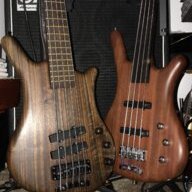
If it truly doesn't matter, you'd think Ned could have at least made the body look cool!? :rolleyes:
You mean like this?
230169634084-1.jpg
 
the difference between having a body or not, is perceptible probably only to the subconscious, but perceptible none the less. (is this a sci-fi post?)

much like the difference between 320kbps mp3s and lossless music. You can't tell the diff by listening to a song, but if you listen for hours and hours the 320kbps is more tiring on your ear as your mind keeps adding the missing parts. same with an instrument - if your mind doesn't have to keep intuiting and adding the small bits that would make the instrument tonally pure (an amplified instrument is the amplification of the entire instrument, not just the pick-ups... regardless of how small an impact the rest of the instrument has on the picked up sound).

the real question is: is your mind trying to intuit a natural instrument when listening to an amplified one? and the answer may just be yes, but no one is really going to answer that.