
Enjoy the benefits of a premium membership!
Upgrade Account
-
TalkBass has been independent since 1998. Add your voice.
Create a free account to reply to discussions, view embedded media, and browse with fewer display ads.
Join free Log in
Want zero display ads or expanded classifieds tools? Compare plans.
You are using an out of date browser. It may not display this or other websites correctly.
You should upgrade or use an alternative browser.
You should upgrade or use an alternative browser.
How should a beginner go about practicing a 6 string bass?
- Thread starter Neal Brakey
- Start date
-
- Tags
- 6 string 6 string bass
More options
Who Replied?

Im confused, you have a six string bass or you want to use a six string guitar to practice six string bass? If your using a guitar why not invest in a baritone? I think Dan Electro has one under $500. I'm first to admit I'm stuck in the past a bit...kicker Harleys and 4 string basses. Perhaps you pick up a 4 string like from Rondo or GFS and become proficient on that first, assuming your saying you have been playing guitars since 95. You should have enough basics to get started. Hell most guys I know ended up playing bass because the garage band they were in talked them into it . I started playing bass on a Harmony H48 using the bass circut they had. Getting a real bass made all the difference. I also agree with the poster who said to get playing and with others. Home recording is a real trap if you use it to replace playing with others. Good luck on your intentions . 

OK, I'm game: I only have 12 chromatic notes in most of my octaves; what are the other three major scales I have been missing?
- Learn to read, write, and play the 15 major keys. Practice the 15 major scales on every string, over the full range of the instrument. If you learn 1 a day, this will take half a month.
The op might not miss the low notes,Personally I would take the top and bottom strings off.
I realize that doesn't help at all.
Sorry
Kind of
But would likely miss not having the upper register for solo work.
IMO, Jaco would have dove into this if given more time and a clear head.

anyone can learn 12 keys of scales, it takes real diligence to complete 15. That would send me right to learning Black Sabbath Paranoid bass lines as my Jack & Jill first reader.OK, I'm game: I only have 12 chromatic notes in most of my octaves; what are the other three major scales I have been missing?
OK, I'm game: I only have 12 chromatic notes in most of my octaves; what are the other three major scales I have been missing?
The "enharmonic" keys (that sound the same pitch, but are written differently):
F#/Gb
C#/Db
B/Cb

For the time being. (Not suggesting do not do it) but learning a five is a lot more straight forward BEADGCF, 5 sharps, BEADGCF, 5 sharps, BEADGCF, 5 sharps, etc etc etc. Yeah same pattern continues on a five string. Six string at a later date.
Laurence
Laurence

Ric5
Inactive
- Jan 29, 2008
- 29,772
- 30,452
- Disclosures
- I like 5, 8, 10, and 12 string basses
How should a beginner go about practicing a 6 string bass?
learn some songs and play them
learn some songs and play them
How should a beginner go about practicing a 6 string bass?
I find this really very useful
[Invalid or Expired Link Removed]
Choose your starting position/note and type of scale, away you go - start to master the majors first (maybe).
You asked what the difference between major and minor is, my rough description would be major sounds "happier", minor "sad"... but that's a rough description.
Very best of luck, welcome to the club.
I find this really very useful
[Invalid or Expired Link Removed]
Choose your starting position/note and type of scale, away you go - start to master the majors first (maybe).
You asked what the difference between major and minor is, my rough description would be major sounds "happier", minor "sad"... but that's a rough description.
Very best of luck, welcome to the club.
OK, I'm game: I only have 12 chromatic notes in most of my octaves; what are the other three major scales I have been missing?
Don't feel bad. Victor Wooten didn't get it either:

Bryan R. Tyler
TalkBass: Usurping My Practice Time Since 2002
Staff member
Administrator
Gold Supporting Member
Supporting Member
- May 3, 2002
- 28,948
- 20,932
- Disclosures
- Reviewer: Bass Player Magazine
Just treat it as if it were the same as any other bass. Because it is. There’s a couple extra high/low notes, the ones on the C string being ones you’ll barely ever use, and the rest of it is just note tones- the same as you would find on any 4-string bass.
if you have to ask then youre far from ready , there is zero shame in playing a 4 string.. learn on that first then move to a 5 then a 6,As a beginner myself, and having no interest in joining a band in the near future I plan on playing a 6 string to solo and record my own sounds/ experiment.
What I am wondering is what is the best way to learn on the 6 string compared to a 4 for a complete beginner?
Most practice material online I see is for a 4, and I want to make use of all 6 strings.
So, if I could get some suggestions, or ideas on what some good practices would be to learn the 6 string, or maybe a place to learn on it, or something I can read up on I would greatly appreciate it.
It is what I see myself ending up playing.
Bryan R. Tyler
TalkBass: Usurping My Practice Time Since 2002
Staff member
Administrator
Gold Supporting Member
Supporting Member
- May 3, 2002
- 28,948
- 20,932
- Disclosures
- Reviewer: Bass Player Magazine
if you have to ask then youre far from ready , there is zero shame in playing a 4 string.. learn on that first then move to a 5 then a 6,
Bad idea if you know you want to end up on a 6. To a beginner a 6 is really no harder than a 4, but once you are accustomed to a 4 it will feel like moving to a different instrument when you do go to a 6. And you’ll only adding to the difficulty you will have in transitioning to a 6 the more you use the 4.

Lot of info already provided in the previous posts.
I have been a 4-string player for some time (~20 years) and recently (~5 years) moved to 6 strings.
The most important thing to remember: you don't NEED to use the extra notes!
Start with the normal 4 strings exercises that you can find everywhere.
Pay a lot of attention to your hand/body position: a 6 string bass will make any mistake here even more noticeable than a 4.
As previously stated, the technique involved to play proficiently a 6-string bass is basically the same as any other bass... if we don't consider string muting: this is where things get nasty.
There are different approaches to mute an extended range bass and AFAIK there is no right or wrong: you need to find your own "right one".
IMO, if you are a beginner including notes from the bottom B to the high C in one scale is going to give you some problems.
I know of few players which keep their thumb anchored to the same position to reach all strings: for most people this does not work. It's up to you (and your music teacher) to find out what works for you.
I wish you a lot of fun playing what is universally known as THE BEST INSTRUMENT IN THE WORLD: the BASS.
Always the best, regardless the number of strings it has.
Ciao, Domenico
I have been a 4-string player for some time (~20 years) and recently (~5 years) moved to 6 strings.
The most important thing to remember: you don't NEED to use the extra notes!
Start with the normal 4 strings exercises that you can find everywhere.
Pay a lot of attention to your hand/body position: a 6 string bass will make any mistake here even more noticeable than a 4.
As previously stated, the technique involved to play proficiently a 6-string bass is basically the same as any other bass... if we don't consider string muting: this is where things get nasty.
There are different approaches to mute an extended range bass and AFAIK there is no right or wrong: you need to find your own "right one".
IMO, if you are a beginner including notes from the bottom B to the high C in one scale is going to give you some problems.
I know of few players which keep their thumb anchored to the same position to reach all strings: for most people this does not work. It's up to you (and your music teacher) to find out what works for you.
I wish you a lot of fun playing what is universally known as THE BEST INSTRUMENT IN THE WORLD: the BASS.
Always the best, regardless the number of strings it has.
Ciao, Domenico


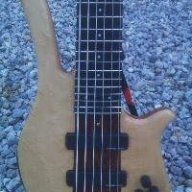
I think that you are over thinking this. The only real difference between a 6 and a 4 string is additional octaves, both lower and higher. When I switched from 4 string to a 6, I learned to change the way I looked at the neck. If you were to play a C major scale on a 4 string and started on the 3rd fret of the A string, you can now do an octave lower by playing from the first fret of the low B. Same fingering (more or less). By doing scales from the low B to the high C will help you learn the neck. IMHO
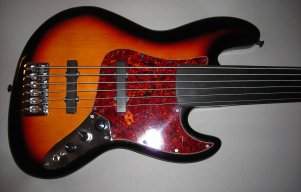

IMHO...
Learn theory... Especially chords... I personally recommend the Berklee chord studies book for bass.
Trombone literature, recordings, and gigging...
Play the six as much as possible...
And you are going to have to deal with sympathetic ringing. It comes with the instrument...
Be a musician first and a bassist second... Correction, be a nice person first... It opens doors.
Learn theory... Especially chords... I personally recommend the Berklee chord studies book for bass.
Trombone literature, recordings, and gigging...
Play the six as much as possible...
And you are going to have to deal with sympathetic ringing. It comes with the instrument...
Be a musician first and a bassist second... Correction, be a nice person first... It opens doors.

Wow that a super lot of info, and I appreciate every bit of it. I will try to incorporate that in some way. I want to learn what scales are for what and what notes sound good on what scales, but that is all music theory. Right now I couldn't tell you anything about a major or minor scale, but in due time I plan on learning it. Like I said I am not crunched for time, but I really really appreciate you doing all this for me. It really helps, and I will go about putting it into a technique of some sort.
Thank you so much for the help so far!
This is very basic mechanical stuff. Many people who try to teach themself to play bass use only one finger on each hand. The ideas I wrote out are just intended to get you started down a path where you can use your fingers efficiently.
In regards to theory, I wanted to mention that piano or keyboard is pretty much the ideal instrument for studying theory as you can play chords and melodies simultaneously. As a music major, all students at my school were required to take class piano. I spent more time studying theory, working assignments out on piano, and also doing Solfege voice training than I did practicing bass, but I was happy to do it because I knew it would make me a better player. I would learn theory in the class room, study on piano, and then later apply it on bass. The one area of music study where my interest is probably weakest is music history. History exposes you to a lot of music you would not hear otherwise and is especially useful if you will be playing older styles. A well rounded bass player will want to study all of these areas and more.


