• TalkBass has been independent since 1998. Add your voice.
    Create a free account to reply to discussions, view embedded media, and browse with fewer display ads.
    Join freeLog in
    Want zero display ads or expanded classifieds tools? Compare plans.

Double Bass How should this be bowed? (Mendelssohn Scherzo bit)

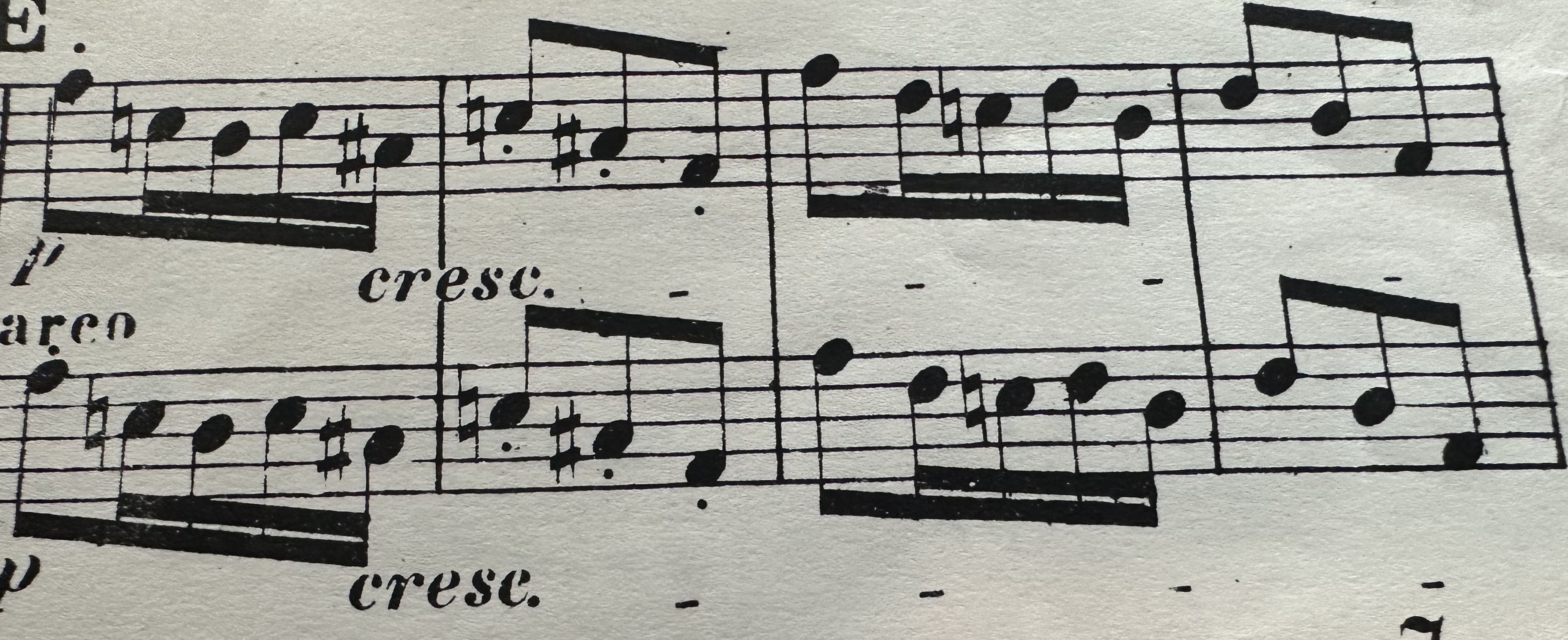
The community symphony I play with is doing the Scherzo movement from Mendelssohn’s Midsummer Night’s Dream in December and I’m wondering what the proper bowing is for this phrase (I am a bowing and classical neophyte). Should I alternate down and up bows as they come, which leads to starting the second and fourth measures with an up bow, or figure out a way to begin all four measures with a down bow? My section leader is not much help on bowings, and my teacher says she hasn’t played this piece but will ask her contacts. Thoughts from the collective? (This is a combined cello and bass part).
482723A8-7EEA-4D07-B276-ED805B4A15FD.jpeg
 
Yes, or I'd just bow in sequence, starting the staccato A on a down bow, and you[ll be there again with the next staccato A with the down. The second A is not staccato so an upbow will suffice and help remind you of the difference.
 
  • Like
Reactions: AGCurry and oren
I'd be curious to know if the other section have at some point a similar rhythm then check how they play it. Cello, Alto or even Violin. The concert master could also give you some nice pointer if the person's is willing to...
If not then I would be curious to know what the conductor says. Then according to what s/he is looking for I'd adjust.

Of course you could alternate everything or the opposite also.
You could try many different things. I like to go Down-Up-Up on triplet, so that could also give you some option. Than that would imply doing Down, Down-Up-Down-Up on the eight double double.
 
  • Like
Reactions: oren
What are the cellos doing?


To fast to do a lift IMHO.

Using strict alternation and starting with an upbow seems most intuitive to me...but I don't have a bass and bow in my hands.
 
  • Like
Reactions: oren
Start down bow and play it as it comes. It's fast, soft and light, and will be too fast for a retake between the first and second notes of the first and third measures. If your section leader and teacher don't have an opinion, it's up to you. If a cellist or violinist recommends a fancy bowing, just remember that the upper strings have a much different ratio of bow length/weight to instrument size, and what works for them doesn't necessarily transfer to bass. My teacher is adamant that basses go their own way even when in unison with the upper strings if simple practicality demands it.
 
The goal is to be light and facile, so I would think taking it as it comes is a fine idea. I personally love retakes, but maybe not here, just to keep everything even and airy. Till it's not, of course. Starting up or down bow, I would probably follow the other sections unless I had a good reason not to.
 
  • Like
Reactions: Wasnex
The concertmaster of my community orchestra insists on marking bowings for the whole string section. I frequently change these since we are not violins. I always go for clarity from the bass section which is also what the conductor wants from us. With that in mind given the capability of my section I would go with as it comes in this case.
 
I like bowings that accentuate the natural metric hierarchy, so I would probably hook the first 1/16 note into the first 1/8 note in the first bar (way too fast for a retake IMO) and then do double up-bows in the second bar. Plus, you can start this out in the middle of the bow and then use the double ups to get gradually closer to the frog to facilitate the crescendo. Also in trying this out, I'm finding that if I do it as it comes the string crossing from C# to E from the first to second measure is a bit harder to manage at tempo if I play them down up as opposed to up down.

EDIT: I should add that when I say "accentuate the metric hierarchy" I mean giving the line direction where the first beat is the arrival point and beats 2 and 3 go to the next downbeat. It's less accenting the first beat of every measure and more playing the second beat a little softer and the third beat somewhere in between beats 1 and 2 to give the measure direction.
 
Last edited:
  • Like
Reactions: Wasnex

Latest posts