
Hi everyone, I've got a myriad of questions for building my neck, so this may end up being quite a long post. I'll list the questions with numbers, so feel free to answer some or all of them at your leisure, so here we go...
1. I've got a neck blank glued up that measures 1" x 2-7/8" by 40". I plan on jointing/planing it down to 3/4" thickness. Is this a good thickness considering I'm doing a fender-style non-angled headstock with a 5/8" neck pocket, or should I go thicker to 7/8" and make the neck pocket slightly deeper? (The body thickness is planned to be 1-5/8").
2. Should I then cut/rout the neck to my template shape before or after routing the heel-adjusted truss rod channel? I'm thinking that I'll make a template so I can use a bushing with the 1/4" bit, but I'm also thinking of using an edge guide if I can cut the channel when the neck blank is still square.
3. My truss rod is has a 4mm hex head adjustment nut. Would it make more sense to cut the slot straight through the heel, or could I drill a hole in the heel that connects to the slot and slip the trussrod in at an angle? I wonder this, because I watched a video where they attempted to do this, but the hole was too tight to be able to slide the truss rod in that way.
4. Relating somewhat to question #2, I bought a pre-radiused fretboard from Stewmac, so it won't be so easy to trim with a bearing router bit that rests on the fretboard. Should I glue the fretboard on first, trim it with a bandsaw, then rout it flush to the neck, or should I do most of that work before I glue it on. One reason I worry about this, is that where the fretboard meets the headstock, I plan to taper it with a spindle sander to meet the wood of the headstock. However, seeing as the fretboard comes with an extra 5/8" beyond the nut slot, as the headstock flairs out, I'm worried that if I haven't trimmed the neck to my template, it may be hard to trim this flair without chipping the ebony. Sorry if this is hard to understand, it mostly relates to whether or not I trim my neck to my template first or whether I glue the fretboard on before trim the neck to the template (which would be hard with the radius on the fretboard getting in the way of the template being placed on top).
5. Should I try to angle the actual heel of the neck, or would it be better to leave it flat and add a full-pocket neck shim afterwards to create desired neck angle. I fear adding a shim may increase the height at the end of my 3/4" thick neck in the 5/8" than my bridge can really handle (with the a shim I can see the height of the fretboard being up to a 1/2" above the height of the body. See picture below)
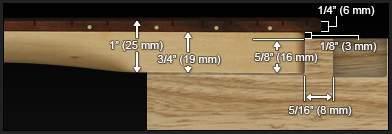
Here's a picture of how I'm envisioning the neck pocket going. It's from Warmoth, describing a Strat pocket, but would the measurements work for a bass?
Thanks for reading through this mini-novel of questions, I keeping fretting over simple questions as I'd rather not mess anything up. Thanks for your replies, and if you have any other tips and tricks you're willing to share, please let me know!
1. I've got a neck blank glued up that measures 1" x 2-7/8" by 40". I plan on jointing/planing it down to 3/4" thickness. Is this a good thickness considering I'm doing a fender-style non-angled headstock with a 5/8" neck pocket, or should I go thicker to 7/8" and make the neck pocket slightly deeper? (The body thickness is planned to be 1-5/8").
2. Should I then cut/rout the neck to my template shape before or after routing the heel-adjusted truss rod channel? I'm thinking that I'll make a template so I can use a bushing with the 1/4" bit, but I'm also thinking of using an edge guide if I can cut the channel when the neck blank is still square.
3. My truss rod is has a 4mm hex head adjustment nut. Would it make more sense to cut the slot straight through the heel, or could I drill a hole in the heel that connects to the slot and slip the trussrod in at an angle? I wonder this, because I watched a video where they attempted to do this, but the hole was too tight to be able to slide the truss rod in that way.
4. Relating somewhat to question #2, I bought a pre-radiused fretboard from Stewmac, so it won't be so easy to trim with a bearing router bit that rests on the fretboard. Should I glue the fretboard on first, trim it with a bandsaw, then rout it flush to the neck, or should I do most of that work before I glue it on. One reason I worry about this, is that where the fretboard meets the headstock, I plan to taper it with a spindle sander to meet the wood of the headstock. However, seeing as the fretboard comes with an extra 5/8" beyond the nut slot, as the headstock flairs out, I'm worried that if I haven't trimmed the neck to my template, it may be hard to trim this flair without chipping the ebony. Sorry if this is hard to understand, it mostly relates to whether or not I trim my neck to my template first or whether I glue the fretboard on before trim the neck to the template (which would be hard with the radius on the fretboard getting in the way of the template being placed on top).
5. Should I try to angle the actual heel of the neck, or would it be better to leave it flat and add a full-pocket neck shim afterwards to create desired neck angle. I fear adding a shim may increase the height at the end of my 3/4" thick neck in the 5/8" than my bridge can really handle (with the a shim I can see the height of the fretboard being up to a 1/2" above the height of the body. See picture below)
Here's a picture of how I'm envisioning the neck pocket going. It's from Warmoth, describing a Strat pocket, but would the measurements work for a bass?
Thanks for reading through this mini-novel of questions, I keeping fretting over simple questions as I'd rather not mess anything up. Thanks for your replies, and if you have any other tips and tricks you're willing to share, please let me know!


