
@HaphAsSard would you look at that!

TalkBass has been independent since 1998. Add your voice.
Create a free account to reply to discussions, view embedded media, and browse with fewer display ads.
Join free Log in
Want zero display ads or expanded classifieds tools? Compare plans.
@HaphAsSard would you look at that!

[Shhhh... That's more or less what I do with my Epi EB-3.@HaphAsSard would you look at that!

You simply aren't going to be playing your best if you're having to support the neck while you're playing, even a little bit. I will always choose a heavier bass if that's what it takes to avoid any neck dive, for my main players at least. If it's a bass I'll only use once in a while in the studio or whatever, then anything goes.This is the best move. Fighting with an instrument isn't fun, and isn't that why most of us play music?

That's okay, as far as dealing with the neck dive, but I've found that it introduces another problem. Any tension on the bass, causes the neck to flex, putting the bass out of tune.This is how I fixed it. I simply ordered a strap that is suitable for a solid body electric or an acoustic guitar. The strap came with a loop with a strap button on it. The loop goes around the nut end of the headstock, under the strings, and after the nut. This is normally used on acoustic guitars, in my experience.
I simply attached the loop to the Talman bass as if it was an acoustic guitar -- looping it just beyond the nut under the strings.
This allowed me to balance the bass at the right point on my shoulder to get rid of the neck dive.
Thought I would share as neck dive is often a problem with certain instruments and a gripe that many bass players have when reviewing specific models.
I did the same with my EB-0, but used a shoelace string that came with another strap (for acoustic guitars), to attach the strap to the bridge screw. That, combined with a 3.5" wide leather strap, held the neck up.This is my unusual solution that I performed on a short-scale Epiphone EB3.
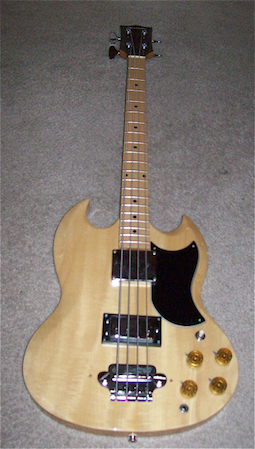

The offset design of the body entails that keeping the rear strap button at the body edge but moving it aways up (I would say well into the arm cut, almost where the now-thinned edge meets the imaginary line of the back of the bridge) might give a further, significant help.View attachment 7258254
I installed Hipshot Ultralites which helped. I also swapped the rest of the hardware to black. That didn't help the neck dive, but made the bass look cooler...

Brother from another mother....I hate neck dive, so I have tried different options to get rid of it. The most effective one for me has been to add a short extension to the strap button. I replace the screw with a longer one and put some sort of sleeve on it before tightening down. I built the bass below and it had mild neck dive, so I added an extension. The sleeve is from a black ink pen. Problem solved.
View attachment 7257610
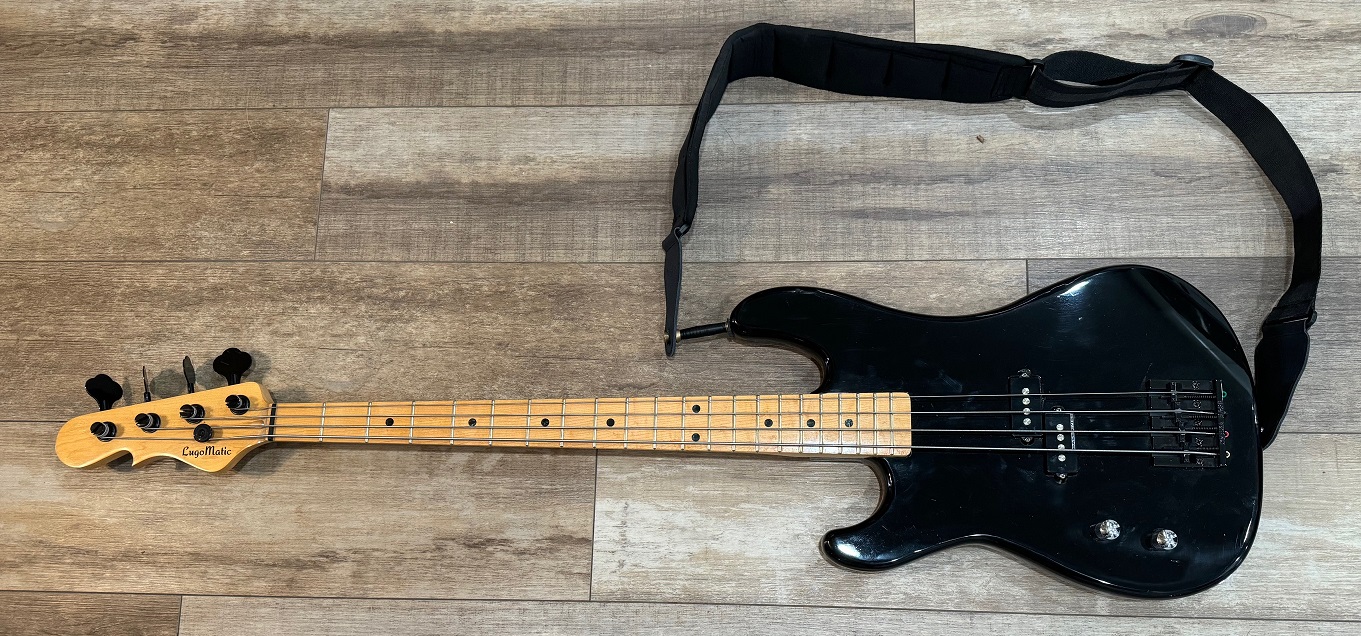


Guess we're triplets.Brother from another mother....
Of course I used electrical tape, it was handy.