
Enjoy the benefits of a premium membership!
Upgrade Account
-
TalkBass has been independent since 1998. Add your voice.
Create a free account to reply to discussions, view embedded media, and browse with fewer display ads.
Join free Log in
Want zero display ads or expanded classifieds tools? Compare plans.
You are using an out of date browser. It may not display this or other websites correctly.
You should upgrade or use an alternative browser.
You should upgrade or use an alternative browser.
How to get same articulation from bass at a high volume?
- Thread starter 30hzilla
- Start date
More options
Who Replied?
27550755[/URL], member: 81861"]the higher the volume levels, the slower the sound waves move. Try cutting some lows the louder you play.
You live in a different universe than I do.
What you say violates the Physics of my universe.
Less articulation at high volumes is a non-linearity problem. Either your amp or your ears are being overloaded. Perhaps both. The solution is to turn down or get a more capable rig.


Wasn't sure where to post this, so I apologize if this is not exactly the correct spot.
I have always been so focused on practicing and playing, as opposed to how my gear works, that I can miss things that might seem obvious to others! Here's my issue: When playing at lower volumes, my playing has the articulation I desire. Notes are "crisp" and I'm generally able to express what my "brain wants to do." But when I play at high volumes, things get "flabbier" and don't sound as precise as when I'm playing at practice session levels.
What is the reason for this? Is there an approach to setting the controls on my amp so that even when playing at a club gigging volume I can get the same "precise" response from my rig? The gain dial on my amp is already extremely low. Would turning down the volume knob on the bass help?
Hopefully someone will understand what I mean here and offer a solution. Thanks!
I just wanted to congratulate you for focussing on your playing more than your gear!

It's often the other way around here.


I’d like to see a vid on this. Go.Another approach: my rackmount has a single mid PEQ. I crank it up to gig volume, attenuate by 5+ dB, then do a "sweep" to find the sweet-spot.
Riis
2K is my go-to favorite to make the bass "pop" out more with a fairly wide bell.... Im still a fan of fresh new strings, thoAnother approach: my rackmount has a single mid PEQ. I crank it up to gig volume, attenuate by 5+ dB, then do a "sweep" to find the sweet-spot.
Riis

I’d like to see a vid on this. Go.
Didn't even view it but here ya go. The more standard approach is to "boost & sweep" to find the more glaringly obnoxious frequencies requiring attenuation. My BBE preamp has a single band but any number of amps and peripherals have 3-5 bands.
Riis

Speaker cabs "break up" at higher volumes. Sometimes the breakup is objects vibrating in the room. If you're loud enough, the walls and ceiling vibrate. All in all, everything eventually resonates.
Didn't even view it but here ya go. The more standard approach is to "boost & sweep" to find the more glaringly obnoxious frequencies requiring attenuation. My BBE preamp has a single band but any number of amps and peripherals have 3-5 bands.
Riis
thanks man… this couldn’t have come along at a better time for me.

It's a whole other instrument at high volume. You really need to control your strings. Muting the strings you are not playing is really important and you kind of have to play the bass and the room. A note will light up different resonances in the room so you need to control when you stop a note. Its as important as when you start a note. And even if you stop a note where you want it to stop it could keep ringing in the room for a while. Listen for that and adjust your playing to compensate. Your instrument now includes the PA and the sound of the room. The only way to practice that is to gig alot. Oh yeah and every room is different but eventually you will start to hear the bigger picture. When the whole band is doing that magic happens.

You're simply hearing your amp and speaker(s) pushed far closer to their limit, and the tone often changes and gets indistinct as you're pushing every thing into distortion that isn't happening at bedroom volumes.
More budget friendly amps are more prone to this, and why a Demeter amp on top of Bag Ends or Acmes costs a lot more than a Rumble stack.
However at any price range, bigger amps and more cabinets can reign this in generally.
More budget friendly amps are more prone to this, and why a Demeter amp on top of Bag Ends or Acmes costs a lot more than a Rumble stack.
However at any price range, bigger amps and more cabinets can reign this in generally.
the higher the volume levels, the slower the sound waves move.
You are kidding, right?

There is already good advice for improving articulation at high volume...and some goofy "stuff." My personal experience? Reduce stage volume and let the PA do the heavy lifting.

It's that blasted Herman Munster curve(as our road crew used to tell us in the 70's!)!Basically the ear does different things across the frequency spectrum at different SPL:
Equal-loudness contour - Wikipedia
This results in: things that sound good at low volume often sound awful at high volume. Especially bass tones.
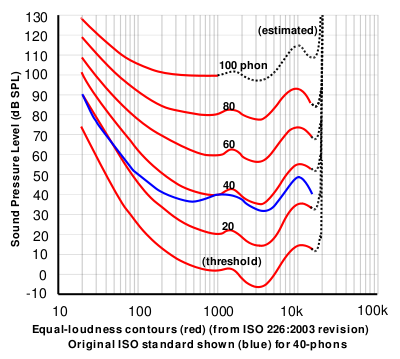
Look at the differences at 100Hz vs. 1000hz in terms of how much SPL you need to hear it as "roughly equal".
Bascially that 500-2k range the ear is pretty good. But outside of that, it gets strange.
Also why some guitar amps sound like "icepicks in your ear" when turned up.
Articulation is probably a perception thing between your fingers, ears and expected results. And these don't line up.
I do agree that really great hearing protection helps (plug for the etymotic and similar if you all play with amps and live drummer) or really good monitoring in IEMs.
As for "ice picks in the ear", we had a mixed gig once with a bluegrass/country band. One not-group-friendly player had a Fishman amp at ear level that was ice-picking everyone on stage. Things got strange more than a few times at that gig. We won't do a gig with that guy ever again.
Geddy Lee and Chris Squire eq curves and a touch of dirt worked.
Others get it by using basses that do that by virtue of their build, pickup location, EQ on-board(Musicman, Alembic, etc).

Well, technically soundwaves vary velocity based on medium of propagation, right? Sso... if your neighbor down the block is performing your soundcheck from her bathtub... the waves observed will behave like particles? I get so mixed up sometimesYeah, no

And HPF FTW as advised earlier.
thanks man… this couldn’t have come along at a better time for me.
Ongoing problem? What do you have available on-hand for remediation? Speaking from experience, my favorite solution is the Tech21 Q Strip which has a HPF and 4 EQ bands including 2 adjustable mid-centric PEQ bands. It's effective, intuitive, and won't give you a brain-cramp.
Riis
Jazzdogg
Less barking, more wagging!
Wasn't sure where to post this, so I apologize if this is not exactly the correct spot.
I have always been so focused on practicing and playing, as opposed to how my gear works, that I can miss things that might seem obvious to others! Here's my issue: When playing at lower volumes, my playing has the articulation I desire. Notes are "crisp" and I'm generally able to express what my "brain wants to do." But when I play at high volumes, things get "flabbier" and don't sound as precise as when I'm playing at practice session levels.
What is the reason for this? Is there an approach to setting the controls on my amp so that even when playing at a club gigging volume I can get the same "precise" response from my rig? The gain dial on my amp is already extremely low. Would turning down the volume knob on the bass help?
Hopefully someone will understand what I mean here and offer a solution. Thanks!
The way human ears work is a subject worthy of study for all bassists.
Another subject worthy of study is the way bass cabinets interact with the physical environment in which they are being used.
Plucking the strings is just first step.
Good luck in your quest - I've been at it for more than 55 years, and I'm still learning.



Thanks. It’s been good for my chops/theory over the years but I can come off as clueless compared to lots of folks. Often because I am! I guess everyone has their own priorities on how to spend their time.I just wanted to congratulate you for focussing on your playing more than your gear!
It's often the other way around here.

I’ve been experimenting a bit here, and the conventional wisdom (bass neutral or cut, minds and treble up) seems to work quite well.
I’m not a big fan to the crispy treble of my stingray (no please keep the flatwounds for yourself) but I’ve been turning it up more than usual and it makes the entire bass signal more readable. It still sounds good in the band, not too trebly.
I usually play R&B type stuff, but the particular situation is with two loud guitarists and a loud drummer.
I’m not a big fan to the crispy treble of my stingray (no please keep the flatwounds for yourself) but I’ve been turning it up more than usual and it makes the entire bass signal more readable. It still sounds good in the band, not too trebly.
I usually play R&B type stuff, but the particular situation is with two loud guitarists and a loud drummer.


