• TalkBass has been independent since 1998. Add your voice.
    Create a free account to reply to discussions, view embedded media, and browse with fewer display ads.
    Join freeLog in
    Want zero display ads or expanded classifieds tools? Compare plans.

How to get same articulation from bass at a high volume?

30hzilla

Inactive
Jun 10, 2023
2
2
Wasn't sure where to post this, so I apologize if this is not exactly the correct spot.

I have always been so focused on practicing and playing, as opposed to how my gear works, that I can miss things that might seem obvious to others! Here's my issue: When playing at lower volumes, my playing has the articulation I desire. Notes are "crisp" and I'm generally able to express what my "brain wants to do." But when I play at high volumes, things get "flabbier" and don't sound as precise as when I'm playing at practice session levels.

What is the reason for this? Is there an approach to setting the controls on my amp so that even when playing at a club gigging volume I can get the same "precise" response from my rig? The gain dial on my amp is already extremely low. Would turning down the volume knob on the bass help?

Hopefully someone will understand what I mean here and offer a solution. Thanks!
 
  • Like
Reactions: ahbradot
- Average quality amps and cabs often sound muddy at high volume, you need high quality gear to get an articulate and clear sound at high level
- Depending on the room's accoustics, low frequency often sound muddy at high volume, so using a HPF or cutting the lows may help
- Scooping the mids often sounds nice at home, but you shouldn't do it at loud levels. Start with a flat EQ, then adjust carefully (and again, don't scoop the mids)
- The gain should generally be set to the highest level before saturation, then the volume knob set to desired output level
 
Less low frequencies, more upper mids.

When you say your amp gain is low, so you mean your amp has both an input gain control, and an output volume control?

One approach is to set your output volume at maximum, and use the input gain as the level control.

This way you can set the amp loud, but clean - and you learn to play with a lighter touch, so that your dynamics are preserved when you need to dig in.

If you're using a compressor of any kind (on the amp, or in pedal form), bypass it for the time being, until you've got a handle on getting the desired result from your amp.

Perhaps you have reached a point in the volume war (with too much low frequency content) that you're digging in pretty hard, and basically have nowhere left to go in terms of dynamics.
 
The best education for me was when I was actively gigging with salsa and latin bands was I had to use a lot of backline or house bass amps and back then it was some form of SWR/Trace/Eden, Ampeg SVT variants and Gallien Krueger or Peavey. Back then there were no fancy all in one preamps. Upright guys may have a Fishman which was required for the BP100 pickup. With the amp turned up loud, what happens is that you feel this fluid but almost unconnected feeling while playing (in your words flabbier) because the sound waves of the amplifiers, the drummer/s and FOH do vibrate the bass guitar/DB as well. So you EQ at gig volume is different and the feel will also change. You just need to play out more and you'll get it. Once you learn it and specially if you have to use other amps, you will find what works for you. I think even with IEMs you can't get away from this because the PA will still produce SPL that will come back to you on stage. Some folks live for that "flabby" feeling.

I actually struggle to go from gig to studio tracking back then.
I still have a small PA with Subs and sometimes I just play drum tracks with maybe a pre-recorded guitar or keyboard and crank my bass rig to spot problems and figure out what EQ would sound like and the first thing I notice is the flabby feeling and the need to play lighter. and EQ differently (less smiley EQ -- more mids) You cannot get this from headphones or low volume.
 
Playing at high volume or in big spaces with PA support takes much more precise technique to make each note speak, this is also true of recording. Keep in mind that at high volume your sound is magnified so much more than at practice room volume levels.

I found that practicing with headphones really helped me focus on that crucial skill.
 
the higher the volume levels, the slower the sound waves move. Try cutting some lows the louder you play.
WOW! Never heard that one before. Sound speed is affected by neither loudness nor frequency.

It took me a long time to internalize this and use it, even though I "knew" it. You need less bass volume when playing louder that quieter. It's a matter of how the human ear hears lower frequencies. So as other have said, lower the bass control at louder volumes.

Articulation also suffers at louder volumes. I have found that playing with a light touch and not digging in helps to preserve the distinct articulation note-to-note. And a bit of upper mid boost helps. For punchiness and staccato, pluck closer to the bridge.
 
Last edited:
WOW! Never heard that one before. Sound speed is affected by neither loudness nor frequency.

It took me a long time to internalize this and use it, even though I "knew" it. You need less bass volume when playing louder that quieter. It's a matter of how the human ear hears lower frequencies. So as other have said, lower the bass control at louder volumes.

Articulation also suffers at louder volumes. I have found that playing with a light touch and not digging in helps to preserve the distinct articulation note-to-note. And a bit of upper mid boost helps. For punchiness and staccato, pluck closer to the bridge.
:) follow me for more great info!
 
IMHO it's something you have to learn to deal with.

Part of the problem has already been identified. The response contour of your hearing changes with volume. So powerful and precise EQ could help. Most amps don't have such a powerful and precise EQ. However, you may find an amp with the voicing and EQ characteristics that can dial in a good sound at higher volume.

Another part of the puzzles is masking. Essentially when you hear two sound sources playing the same frequency, you only hear the louder sound source. So when playing with other people the sound of their instruments will mask part of your sound. A common recommendation is to turn up the mids, so you cut through better.

Your own sound is also a source of masking. The sound comes out of the speaker and then hits the walls, floor, and ceiling and bounces around. Eventually the sound makes it's way back to your ears. But what you hear has significant propagation delay it can no longer integrate perfectly with your direct sound.

In order to hear more of the direct sound, my approach is to elevate my speaker and aim it at my ears. If you don't at least aim your speaker at your ears, you will not hear the mids and highs before they have bounced around the room.

One potential solution would be to use IEMs rather than an amp. Quality IEMs can provide isolation from the sound on stage, so you won't have to play louder. the idea here is IEMs eliminate the acoustic problems and allow you to monitor at a consistent volume. Of course, IEMs are not a panacea as they bring a different set of problems to bear on the situation.

So you are back to learning how to deal with the problems rather than a solution to completely eliminate them.

Good Luck!
 
the higher the volume levels, the slower the sound waves move.
Well this is one I haven’t heard before! Not true, though it makes for a great internet story ;)

This is an ideal application for a high pass filter. As the volume increases, two things begin to happen:

1. the ear becomes more sensitive as LF volume increases

2. The speaker’s power handling decreases and distortion increases with extended LF content.

The HPF set at the -3dB response point of the speaker’s LF rolloff will go a long way to reduce the “mud”.
 
Ears do have a protection mechanism for unexpected loud noises but it's slow to respond, and can't last over long periods, and doesn't work as well for older people.
The Ear's Protective Mechanisms
You can actually hear this muscle/tendon when you yawn. It's a low rumble. Your hearing drops when you yawn.

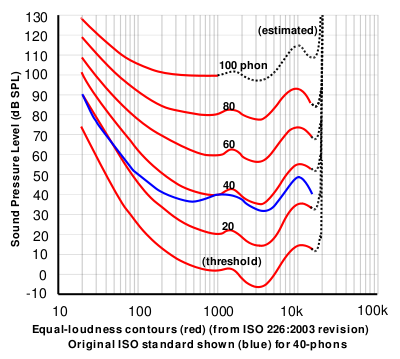
But the Equal Loudness Contours come in for sustained volumes. At overall low volume your ears aren't as sensitive to lows and highs as they are to mids. So people turn the lows and highs up to hear them better. This actually may be baked into the head's own EQ as a signature sound. It makes the head sound good at lower store volume levels.

Articulation is mainly in the mids.

At high overall volume, your low hearing is more on equal with mids, and the bass setting you used for low volume are way too high to be equal with the mids. Mids get masked. Turn the bass EQ down when you turn up the volume.
 
  • Like
Reactions: Wasnex
Basically the ear does different things across the frequency spectrum at different SPL:

Equal-loudness contour - Wikipedia

This results in: things that sound good at low volume often sound awful at high volume. Especially bass tones.
400px-Lindos1.svg.png


Look at the differences at 100Hz vs. 1000hz in terms of how much SPL you need to hear it as "roughly equal".

Bascially that 500-2k range the ear is pretty good. But outside of that, it gets strange.

Also why some guitar amps sound like "icepicks in your ear" when turned up.

Articulation is probably a perception thing between your fingers, ears and expected results. And these don't line up.

I do agree that really great hearing protection helps (plug for the etymotic and similar if you all play with amps and live drummer) or really good monitoring in IEMs.
 
Less low frequencies, more upper mids.

When you say your amp gain is low, so you mean your amp has both an input gain control, and an output volume control?

One approach is to set your output volume at maximum, and use the input gain as the level control.

This way you can set the amp loud, but clean - and you learn to play with a lighter touch, so that your dynamics are preserved when you need to dig in.

If you're using a compressor of any kind (on the amp, or in pedal form), bypass it for the time being, until you've got a handle on getting the desired result from your amp.

Perhaps you have reached a point in the volume war (with too much low frequency content) that you're digging in pretty hard, and basically have nowhere left to go in terms of dynamics.
With the amps and cabs I've had, that "max the master and adjust with the gain" doesn't work at all. It is a common setting with guitarists though. There are some amps that are designed to run that way, just not the ones I use. The amps I have all have a "gain set light". The object with the gain setting is to get that gain-set (sometimes called "gain-clip" light) to dance on your lowest, loudest notes. That gives you the hottest clean sound with the lowest noise to feed to the power section.

If you turn the gain up so it always stays one, you lose some of the articulation and the clean sound it normally generates. With SS amps, distorting the preamp by running the gain too hot, pretty much never sounds good. It typically has to be designed into the preamp with either a tube in the gain for overdrive/distortion, or a tube emulating chip to dial that in. Just overdriving the gain if it's not designed for that, sounds like crap.

But that's not what you're suggesting. You're talking about running the power section all the way up all the time. And, we're not talking a 100-watt amp, which is typically the highest powered amp a guitarist uses, we're more commonly talking 500-watt to 800-watt rms amps. Running those at full level is hard on the amp and if you add a low setting on the gain, it's a noisy signal to boot because you are not sending it a strong clear signal to the power section for it to amplify.

Running a low signal into a maxed out power section gives the power section a comparatively noisy sound because the power section is generating noise itself at maximum levels and instead of producing a signal with a wide signal to noise ratio, it's just noisy. The signal to noise ratio sucks. Used to be with vinyl, if it had a 55-to-1 ration of signal to noise, that was considered high-fidelity. Anything below that isn't. You are not going to meet that threshold running the power at max and the gain low. That 55:1 ratio was from the 1970's and odds are that's not even considered high-fidelity now. Unless the amp is designed differently (READ your manual) that is not going to result in optimum sound definition, clarity or level. And running your power section at max all the time is going to generate a lot more heat and wear out internal parts at a much higher rate.

Your suggestion about playing with a light touch is spot on IMO, so you can get better dynamics - low when you want it and growling loud when you want it, based on how hard your strike the strings.

Judicious use of a compressor can also help, but don't use it if you don't need to. When you start using a compressor you are trading peak levels in the music for sustain on the notes. The compressor will compress the peaks in the music so they are not as loud and give you sustain in exchange for them. When you look at compressor ratios, 4:1 up to about 8:1 are pretty common. 4 to 1 means that you have to generate 4db higher input to get 1db in output. 8:1 means you have to generate 8db louder playing to actually increase the out put by 1db. The higher the ration, the less dynamics you can generate because the compressor is squashing those highest peaks of the input signal and with it your ability to have louder and softer dynamics in your playing. If you turn it up high enough you can get a compressor to sound like an old Farfisa Organ with no attack on the notes, no dynamics at all - all notes play at the same level - and unending sustain.

Judicious use of a compressor can be a big help though because if you adjust it correctly, you'll be limiting the peaks in the signal but it will allow you to turn up some to bring the rest of the signal closer to where your peaks were, which gives you an overall louder sound. Just be aware you will reach a point of diminishing returns with a compressor.

I have an Eden TN-226 (225-watts rms into 4Ω). I bought it specifically to play a small brewpub where we played over 40 Friday nights per year. I run it into an Eden EX-112 cab and it's perfect for this small venue as well as being easy to load in and out. I'm playing with a 5-pc group and one night we got so loud, I saw my power clipping light flashing. When that flashes, you have to fix the problem quickly or it will go into protect mode and shut off the amp. Tried turning down the Bass EQ because those low notes suck so much power - didn't work. Turned down the master until the clip light went off - couldn't be heard.

Finally engaged the auto-compressor and turned up the gain. With the compressor engaged, that gain control becomes a threshold control on that Eden amp (flashes when the compressor engages) and the higher you turn it the sooner it clamps and higher the ratio. I didn't turn the gain up that much because the gain light still flashed instead of being constantly on, but that power-clipping light went right off and I still had good dynamics. It ended up just clipping the peaks in the signal enough to keep the power section from clipping. It was smooth and very musical and a good surprise because the auto-compressor on my Eden WT amp is harsh and hard - good for slap but that's about it. You wouldn't have known I was running a compressor with this one.

So judicious use of the compressor in my situation allowed me to play at a higher SPL than I could with it off and it still sounded good. So it can be a real help if you need it. If you don't need it, don't use it is the best choice. But if you need it, use it judiciously so you don't lose all the dynamics in your playing. After that song was finished, I told everyone we needed to turn down because my amp was clipping and my ears were hurting. Everyone agreed we were too loud and turned back down. I then disengaged the auto-compressor and played normally for the rest of the night.
 
  • Like
Reactions: BlueTalon
- Average quality amps and cabs often sound muddy at high volume, you need high quality gear to get an articulate and clear sound at high level
- Depending on the room's accoustics, low frequency often sound muddy at high volume, so using a HPF or cutting the lows may help
- Scooping the mids often sounds nice at home, but you shouldn't do it at loud levels. Start with a flat EQ, then adjust carefully (and again, don't scoop the mids)
- The gain should generally be set to the highest level before saturation, then the volume knob set to desired output level
Make sure you have gear that can handle all the frequencies you're playing with good articulation and no mud. I had a GK115bpx that was the boomiest and muddiest thing I ever heard, and I got rid of it after I bought my first DNA cab in 2015. To be fair, that's the lowest price GK115 cab they make and the rest of their stuff is much better.

Since 2015 I've only used DNA and Eden amps and cabs. The Eden cabs have good definition at all levels and my DNA cabs are even clearer and more articulate than my Eden cabs, which are no slouch themselves. So having good cabs is a prerequisite to playing loud with good sound. Ad, just like @gtirard says, "don't scoop the mids"!

Be aware that those low-mids are what give your bass presence and definition in a group. That's because the bass drum will always own the lows and the guitars and keys will own the high-mids and highs. You own the sonic slot in between them from ~250Hz up to ~550Hz. A little boost - not a lot - makes a huge difference and you don't have to drown everyone out to be heard. That's your sonic space, so use it! I play a passive Jazz Bass and with both my Eden and DNA amps and cabs, I boost the low mids just a little bit. Boost them too much and your sound honks at you. If you get that honk, turn down the boost until it goes away.

I typically boost the low mids at either 250Hz or 500Hz, but with a +/-15db control, I'm only boosting it to 1:30. I use the 250Hz with my Eden gear with the semi-parametric controls, and 500Hz with my DNA amp for the low-mids because that's where the low-mid control is centered on my DNA amp. Also found at a 3-hr. recording session in Seattle using my WTDI (Di box with built-in Eden WT preamp) with the low-mids slightly boosted at 500Hz produced an amazingly good sound. So good the owner and the sound engineer had to come out of the control room to see what I had used to get that sound. I'd run it totally flat except for that small boost at 500Hz.

So if you've been scooping out the low-mids, or even just leaving them flat, try a little boost anywhere between 250Hz and 550Hz. You'll find it gives you good presence and definition when playing with a group. Drop your bass EQ to flat and if your amp has a HPF, use it by slowly raising the frequency control until it clears up. If you have a semi-parametric, like I do on my Eden amps, you can set it at 30Hz and cut it as needed down to about 9 o'clock to help clear up any problem you cab is having with mud. Not as effective as a HPF, but next best thing. Better choice is get a better cab.
 
Last edited:
  • Like
Reactions: gtirard and DubDee3

Latest posts