• TalkBass has been independent since 1998. Add your voice.
    Create a free account to reply to discussions, view embedded media, and browse with fewer display ads.
    Join freeLog in
    Want zero display ads or expanded classifieds tools? Compare plans.

How to keep the motivation up

The best programmers that I ever hired were great musicians.

Not sure if that works the other way around however :)

Being in a similar boat, I found that having a little bit of good kit and trying to keep up playing with my favorite rock/fusion/jazz albums does give me motivation. Good luck with your quest man.
 
Alright, I'm sorry if this is a dumb post, but I'm a crappy musician and I need help finding a way forward.

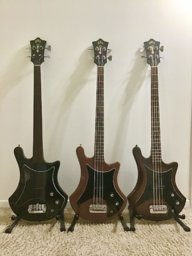
Basically what drives me is my love of the instruments. I love the basses themselves very much, especially beautiful expensive ones (money wise that's vaguely ok for me, when I don't buy basses I buy other expensive things I don't really need). Maybe I should have just been a luthier instead, but I don't have much manual dexterity and it doesn't really fit in with the rest of my life plans...

I don't have any natural musical talent (no ear for pitches, no accurate sense of rhythm), so in order to become an acceptable musician I think I need to work very hard. However, I become discouraged fairly easily with my lack of progress and I stop putting in the effort after a little while. A few years later I put together the courage to try again, but quickly become disgusted with how bad I am.

I don't have this problem in other areas of life: usually I learn things very quickly and without much effort. I'm not sure why my brain can't learn music the way it learns languages or sciences. Or even sports: when I do physical activity I feel like I'm making progress and it's not hard to keep motivated.

How do I break through the barrier of being very bad at something and not seeing much progress when I try becoming better?

Thats hard,How do you teach somebody how to Love something they're in different about?
What got you interested in playing, at first? you need to find that passion to push through that platteau,
I got stuck in a rut/platteau that lasted over ten years. Like you I lost any enthusiasm for playing I thought putting it away for awhile would help me for get some bad habits I had, in reality it just caused a gap in my development, and opportunities to get better. I got back by my own will to become "more than a HACK" , set small/short goals, learned new songs, just dove in trying to absorb everything, really worked on my shortcomings, strengthen my weakness! I wanted to be known as agood, well rounded player, a first call guy.
When I first started playing I was lazy & depended on others to show me things. I was the worst guy in the band. I did what needed to get through the set. probably the emergency or last resort guy, Not horrible, just unmotivated, I f you asked me to learn a part or song I could do that, but not much else.
I got tired of being know as the "Hack". What snapped me out of laziness was A really good friend wanted to start a band with some other friends, most good players, so if I wanted to be "in" the Band I needed to buckle down & into the "shed"! I worked on technique, Theory, Timing & rhythm,I bought books, went on the web, any where I could to catch up, to the guys that never took a break. I practiced for months,4-6 hours a day.It finally paid off when My buddy complimented me after a rehearsal, You really sounded good tonight! even the key board player (a music snob), Hey you dont suck anymore! I guess I finally turned the corner!
Its also nice to have someone in your corner. while I was cramming & a little down on my self cause couldnt get a part down, I was ready to throw in the towel. My friend( same guy,making band) consoled me,"hey dont beat yourself up, not everyone can do everything,we all have weaknesses & strengths! everyone has something they do better than every one else! Your groove is really strong! build on that! Dont focus on what you cant do." that little speech pwas just the pick me up i needed! it motivated me to push through. set small goals not huge diffcult ones.GL
 
Maybe your brain is just tapped from getting a medical doctorate? The thing has limits.

Maybe your approach needs to be less textbook and more conversational. Just have a seat and focus on something else while you noodle around. Perhaps you don't have time to just noodle around though. I think the reason guitar and bass clicked with me whereas violin and piano did not was that guitar is so portable (outside, a friend's house, in front of the TV, next to my bed).

Whenever I have shown people how to play two chords, I always tell them "now do that 200 times."

Playing an hour a day is respectable, but if you are really want to progress, you almost have to count the hours a a day you are not playing.
 
Perhaps the problem is with your expectations. For must people, learning to play an instrument is a long and slow process, and it is not always fun. You seem to want to simply emerge as a fully formed player without going through the necessary stages to learn to play.

It may be that the problem is because your motivation is on a macro level instead of a micro level. Leaning to play an instrument involves hundreds if note thousands of little tasks that you have to first learn separately. Eventually with enough practice you learn to put them together and automate them so you can do multiple task without thinking. For example: First you may learn the name of the open strings, next you learn to pluck the open strings. Later you learn the notes associated with a few frets on one string, and you then learn to simultaneously pluck the string as you press string to the fret with one of the fingers on your other hand. Eventually you know where all of the notes are on all of the strings and you can play them automatically with very little conscious effort. But to get to this level, it requires years of practice.

As a developed player you may deconstruct what you are doing, in other words you look at an individual playing task that is part of a larger playing task. The idea here is to fine tune individual elements of your technique so the macro task works as well as it cane. For example you may look at the shape of your fretting hand, how the fingers move, or how much pressure you use to push the strings to the frets.

For anyone to develop as a musician, they have to have some degree of natural motivation or fascination to work on the micro tasks that make up playing. There are no short cuts unless you are a musical genius who just intuitively knows how to do it. It is easier for some than others, but most people have to work at it.

Different people have different ways of thinking. Some players are very analytical and approach the instrument more like technicians than musicians. Music is an art form. To be a musician you learn to interpret and read between the lines. Even if you play classical music note for note, there is still a lot of improvisation in how you play the notes and phrase the lines. This type of improvisation is informed from years of study of musical history, listening to recordings and performances, and mastering the instrument through study with sage musician. Again lots of hard work.

In 2008 I bought a guitar and started teaching myself to play. I actually learned quite a few chords and could lay down a chord progression and riff with a looper for hours. I enjoyed this for awhile, but really did not have the fascination to really learn to play guitar or learn real songs. Actually I retired from being a professional bassist shortly after that and became an audio tech for a few years before moving into management.

I still have the guitar, pedals, and several amps but I rarely pick them up. I do still try to keep up my skill on bass, but I don't have any plans to perform with other musicians. After a few decades as a pro, the idea of performing music no longer motivates me, but it's difficult to give up the instrument and music entirely...it's sort of part of me.

I suggest some self-reflection. Not everyone is cut out to be a musician, and there is no shame in it. If you want to play, then try to understand what it will really take to learn to play. Accept that it takes most people a long time to develop. If it demotivates you to think about the big picture, then you have to have the discipline to only think about the small tasks need to learn to play. For motivation you must learn to use little victories with these small tasks for positive reinforcement instead of getting frustrated because you're not a master musician. Understand that if you don't have a natural drive to play an instrument it's sort of a lost cause. The drive is an intrinsic motivation.

Be honest with yourself and accept the truth. Do you want to be a musician or are you deceiving yourself. If the answer is you want to be a musician, get to work and stop quitting every time you face a little setback. Give it an extended time of continous hard work with a good instructor who can guide you. If you don't develop after that, then perhaps you lack the necessary aptitude. Again there is no shame in this. Do whatever gives you joy.


Good Luck.
 
I'm having a hard time with theory and pattern memorization. For me this is weird in the extreme: I've picked up a master's degree in physics and a phd in computer science, which are very theory intensive, without much effort, and now I'm doing a medical doctorate, which is very memorization oriented, also without much effort... Why my brain can't apply the same principles to music is quite baffling.

I am also having a hard time doing the required multitasking. As soon as I try to play something slightly different I lose the rhythm. I can't seem to count in my head while playing to keep track of where I should be in a chord progression.

I can never figure anything out by ear, I don't know why. I can listen to a large variety of music and enjoy it, and somehow I can tell something is wrong when mistakes are made, but when I try to use my ears to figure out which notes are being played, all of a sudden it's as if it's all just noise...


I tried at some point, did not enjoy it much. Usually I prefer teaching myself things.
I understand the preference for teaching yourself, I was self taught up to the point where I gained a music degree.
Although I live in completely different timezone, if you would like a diagnostic assessment on your playing via Skype or similar? PM me.
 
I recommend a learning app called Yousician. You learn at your own pace. You can learn to read music notation and tablature, while learning theory. You can play traditional & popular songs at 4 different skill levels. It records what you play and grades you. I believe it will keep you motivated. You can try it for free 10 minutes a day until see if you want to to subscribe.
 
The patterns in music are recognized the same way you recognize patterns in physics,t.
But in my opinion it's the "outside the lines" stuff that should make music special.
Here Marc Chagall is painting what he feels, what he is thinking about, what he is worried about, what he is hopeful for, but not what he is seeing. My outside guess is that you are trying to observe and analyze. My very bad advice, given your academic strengths, is to turn to music as an outlet instead of focusing on it as an achievement or a destination to be reached.
Schirn_Presse_Chagall_Engelsturz_Basel.jpg

puzzle-chagall-violoniste-bleu.jpg
 
Yeah, what I've seen of music theory is simple enough (with equal temperament tuning a lot boils down to mod 12 arithmetic...), I just have a hard time relating it to what I'm hearing.
Music theory is more than just mod 12 arithmetics. It includes the study of tonality, scales, chords, harmony, etc. All this should be grounded in ear training. A keyboard is essential for this. A good teacher should guide you.
 
  • Like
Reactions: Wasnex
Learn to sing. I don't mean with a vocal coach, just learn to sing along with tunes you like. This internalizes the music at an intuitive level. You're obviously plenty smart, but it's overshadowing the creative side. Everyone has some level of musical intuition and appreciation, obviously some more than others. Once you can touch that side, then the other side of your mind will glom onto all the mathematics that's present in music, and you'll have your way in.
 
I gave up on keeping my motivation up. No gigs, band members using any excuse not to practice, bored practicing by myself. Sold one trumpet( I play that, too) and have the other for sale at reduced price. Took several pics of my best 3 basses and they’re up for sale beginning tomorrow.

I’ve partly retired from my “ real job”, but thank God for it: it keeps me busy a few hours a week, pays well and keeps me around intelligent, working people. Music no longer does that.

After 53 years playing music, I’m about to say “ I’m done, you take it.”
 
Alright, I'm sorry if this is a dumb post, but I'm a crappy musician and I need help finding a way forward.

Basically what drives me is my love of the instruments. I love the basses themselves very much, especially beautiful expensive ones (money wise that's vaguely ok for me, when I don't buy basses I buy other expensive things I don't really need). Maybe I should have just been a luthier instead, but I don't have much manual dexterity and it doesn't really fit in with the rest of my life plans...

I don't have any natural musical talent (no ear for pitches, no accurate sense of rhythm), so in order to become an acceptable musician I think I need to work very hard. However, I become discouraged fairly easily with my lack of progress and I stop putting in the effort after a little while. A few years later I put together the courage to try again, but quickly become disgusted with how bad I am.

I don't have this problem in other areas of life: usually I learn things very quickly and without much effort. I'm not sure why my brain can't learn music the way it learns languages or sciences. Or even sports: when I do physical activity I feel like I'm making progress and it's not hard to keep motivated.

How do I break through the barrier of being very bad at something and not seeing much progress when I try becoming better?
Sometimes I hum some crazy lick
Alright, I'm sorry if this is a dumb post, but I'm a crappy musician and I need help finding a way forward.

Basically what drives me is my love of the instruments. I love the basses themselves very much, especially beautiful expensive ones (money wise that's vaguely ok for me, when I don't buy basses I buy other expensive things I don't really need). Maybe I should have just been a luthier instead, but I don't have much manual dexterity and it doesn't really fit in with the rest of my life plans...

I don't have any natural musical talent (no ear for pitches, no accurate sense of rhythm), so in order to become an acceptable musician I think I need to work very hard. However, I become discouraged fairly easily with my lack of progress and I stop putting in the effort after a little while. A few years later I put together the courage to try again, but quickly become disgusted with how bad I am.

I don't have this problem in other areas of life: usually I learn things very quickly and without much effort. I'm not sure why my brain can't learn music the way it learns languages or sciences. Or even sports: when I do physical activity I feel like I'm making progress and it's not hard to keep motivated.

How do I break through the barrier of being very bad at something and not seeing much progress when I try becoming better?
I like to just jam along with the radio sometimes. Or imagine and hum some crazy tune or lick with challenging intervals and make myself play it.
 
You seem like a decent guy, so don’t take this the wrong way, if you don’t have a good
sense of rhythm, you can’t play bass, period. You can try and hide in a rhythmically
simplistic style, but if you’re ‘off’, you can’t play that either. Personally, I don’t see how
a person can play any instrument without a good sense of rhythm. If you want to do
something creative, try some other mediums, (drawing/painting, writing, acting).
Now, some people will say I’m wrong, but think about this: I felt that way too, but instead
of telling anyone, I wrote a song. A musician would have put his feelings down on his instrument, and used that as his voice. That’s what instruments are for.
 
I think the great thing about starting when you're young is that you can't really tell how much you suck. You have to get the building blocks in place no matter what, but it helps if you're not constantly beating yourself up while you're doing it. I think there's something great about learning to "sing it first", even if you don't sing it well; you train your brain, the mechanical part can be separate. As far as "mod 12" you need to understand that almost all of the way we talk about music is based on seven-degree scales, and the note names and convoluted system of flats and sharps are about preserving their relationships with one another. I don't think there's anything essential about "being a musician" that you can't learn through brute force if you put in the time, you just have to have a reason to care enough to do it.
 
I didn’t start with theory until I was over 5 years into playing. It would have slowed me down at the start for sure. I had no interest other than playing a great bass part. So I took the musical approach while you’re taking a hard math approach.
This is art. Try that approach and see if this mindset helps.
 
Perhaps practicing a slow, walking, boogie-woogie bass line. The first 5 notes of the A-Major scale forwards and backwards. Slow, evenly spaced notes. Use a metronome at any speed and match it's beats.

You recognize your lack of an accurate sense of rhythm. I believe this is the root of your problem.

I have known people who had no sense of rhythm, they could not tap their feet nor clap their hands in sync with a song's beat. They also had absolutely no interest in musical instruments of any kind. Oddly, some liked music and some didn't. Like those you see in the audience swaying and clapping out of sync with the music. They're diggin' the music even though they can't really connect rhythmically.

I've always had a sense of rhythm, so I can't imagine the lack of it. I used to believe everyone had it.
 
It sounds like you started learning music at an older age? If this is true then you are in an uphill battle. Some may argue but learning an instrument as an adult is extremely challenging.

One hour of practice per day should help you improve but its more important what and how you practice.

Work on stuff you have difficulty with. Practice to a metronome. Break up your hour into four 15 minute sections or six 10 minute sections. Each se tion should be dedicated to one technique only.

step 1: play and sing intervals/scales
step 2: play a scale shape, ascending/descending quarters and eights only to a metronome
step 3: right hand, alternate fingers, use 3 fingers, use a pick all to a metronome
step 4: work on appreggios and their inversions
step 5: last 20 minutes try to learn simple songs by ear
These are only suggestions, good luck on your journey.
step 5
 
Haha, all this is fairly overwhelming, thanks to everyone for the suggestions and offered help!

I think I've got a few ideas to run with for the next few months. Also my friend's brother teaches music and we've just talked about him giving me a few lessons for pointers, I think it'll help that the teacher is someone I know!

I'll report back with progress at some point, just getting support from you all has already improved my motivation :)
 
Alright, I'm sorry if this is a dumb post, but I'm a crappy musician and I need help finding a way forward.

Basically what drives me is my love of the instruments. I love the basses themselves very much, especially beautiful expensive ones (money wise that's vaguely ok for me, when I don't buy basses I buy other expensive things I don't really need). Maybe I should have just been a luthier instead, but I don't have much manual dexterity and it doesn't really fit in with the rest of my life plans...

I don't have any natural musical talent (no ear for pitches, no accurate sense of rhythm), so in order to become an acceptable musician I think I need to work very hard. However, I become discouraged fairly easily with my lack of progress and I stop putting in the effort after a little while. A few years later I put together the courage to try again, but quickly become disgusted with how bad I am.

I don't have this problem in other areas of life: usually I learn things very quickly and without much effort. I'm not sure why my brain can't learn music the way it learns languages or sciences. Or even sports: when I do physical activity I feel like I'm making progress and it's not hard to keep motivated.

How do I break through the barrier of being very bad at something and not seeing much progress when I try becoming better?
Passion... If you don't have it, you'll always be mediocre. Nothing wrong with that... just sayin'.