• TalkBass has been independent since 1998. Add your voice.
    Create a free account to reply to discussions, view embedded media, and browse with fewer display ads.
    Join freeLog in
    Want zero display ads or expanded classifieds tools? Compare plans.

How to replace pot with individual circuit board

years ago when I was banging around various day jobs as a young man (while gigging at night), I ended up with a job at the Littlefuse Company in suburban Chicago. I had a materials inventory control job where we had to keep track of various metals associated with the onsite manufacturing work (from simple to specialized industrial stuff) ... this included lead, tin, antimony, silver, gold, platinum. Being around all these materials was actually kind of interesting, at least for a while. The really crazy spot in this factory was the plating room. The guys that worked in there had full hazmat suits and hoods and breathing gear, and the room was double sealed (and probably was a negative pressure environment too). Crazy hazardous/dangerous manufacturing environment for sure.
 
If you lived closer (I live in south central MO) I'd have you bring it over to my place and I'd show you how to do it. It's not at all hard but that's easy for me to say because I've soldered stuff for 50 years. Even went to milspec soldering school...that and a $1.50 will buy me a cup of coffee.

There are plenty of YouTube videos showing how to unsolder/solder but I learn better sometimes by having a teacher sitting right next to me and then I do it while they watch me and give suggestions. It's the old "give a man a fish...adage".
Agree 100%, nothing like having an instructor by your side. I'm IPC trained to NASA-STD-8739.3 Mod 6 and I get to work with all the new techs at work before they go to their IPC class.

The pros in the repair department at work would pop it off really quick with a heat gun. Then, they would clean off old solder with copper braid. They have really nice tools, and would have a nozzle just the right size. I would not attempt it at home with a cheap heat gun.
Hot air rework stations are very handy, but it's beyond what's needed in a situation like this. Cool stuff to look up for anyone interested.
 
This is pretty ordinary through-hole circuit board construction, just bread-and-butter stuff for an electronics tech. This is a job for a decent quality soldering iron (like a 30-watt Weller), a dab of rosin flux or "no-clean flux paste" (always for electronics, not plumbing!) and some 63/37 lead-tin solder, and most of all, some Chem-Wick desoldering braid. What you do is swab the solder joints down with a little alcohol (to clean off any goo, WD-40, or control sprays put on over the years), put a little dab of flux on the joint, hold the braid on it and heat through the braid with the iron. The solder will melt, the rosin will cause it to soak up in the heated copper braid. Just work gently and keep moving to fresh braid to soak up the solder.

You don't want a hot-air soldering tool, and definitely never a heat gun for this job.

The more difficult job will be finding the correct ohms and taper pot, and the right mechanical fit pot to replace it in the guitar, and match the circuit board footprint.

If you can find one that fits the instrument and knobs correctly and has the right ohms and taper, there are ways to make the board fit.

This is really a good job for a pro, or a good electronics tech, or a electronics hobbyist. It's a bit harder than a typical guitar re-wire.

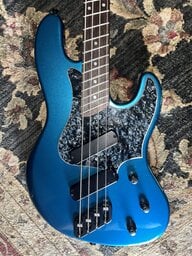
I darth-vadered a clear picture from the internet of this model bass to show what it looks like clearly.

They did it this way so the active version of the amp would fit in the same routed cavity as the passive version of this bass.

IMG_1183.jpg
 
Also - if you can't find a perfect replacement potentiometer, you may be able to repair the old one.

I have repaired any number of potentiometers in vintage amps by disassembling them and fixing what's wrong.

Frequently had success using parts from other pots made by the same manufacturer. Even if the shaft and the bushing lengths are all wrong, you can often steal the resistor wafer, wiper contacts and such from a similar port and fix the original. Many tweed Fender amps I've worked on needed such fixes.

Usually the pots are fairly easy to take apart, if you're very careful. The can is usually held down by four little tabs that crimp over the bushing side of the body. The tabs can be bent back, a little. They're often brittle, but slow, gentle bending, as little as possible to release them often works out.
 
Also - if you can't find a perfect replacement potentiometer, you may be able to repair the old one.

I have repaired any number of potentiometers in vintage amps by disassembling them and fixing what's wrong.

Frequently had success using parts from other pots made by the same manufacturer. Even if the shaft and the bushing lengths are all wrong, you can often steal the resistor wafer, wiper contacts and such from a similar port and fix the original. Many tweed Fender amps I've worked on needed such fixes.

Usually the pots are fairly easy to take apart, if you're very careful. The can is usually held down by four little tabs that crimp over the bushing side of the body. The tabs can be bent back, a little. They're often brittle, but slow, gentle bending, as little as possible to release them often works out.
I've done this on many vintage amps where the pots are no longer in production and haven't been for many decades. It's amazing how creative one can get when desperate enough.

I never throw away vintage parts like this. One never knows when you made need a part from that stash.
 
Yeah I’ve scraped up Centralab and Stackpole pots from the 50’s, 60’s and 70’s with all kinds of random shafts and bushing lengths. Find them at amateur radio swap meets and even on eBay. Cheap too. But the active parts and stuff can repair wildly valuable vintage parts.

I fixed an early 1960 ES-335 last year that way. The luthier pulled the wiring out and I took care of the two volume pots. Left them with original date codes and authentic carbon wafers that were NOS from the same era but off a pot with a completely wrong shaft. I think he had to rewind one of the PAF pickups so the fresh solder joints wasn’t a problem.

I will say, it is harder to source NOS pots and switches from early 80’s MIJ Fender stuff. I have a 84 Esprit Elite with the early TBX tone controls and those are unobtainium.

There are ways to make this work though, but might take some digging and hunting to put it right.
 

Latest posts